







"Anything good is kind of costly" says Marc Newson


Forty years ago, Marc Newson designed what would become the most expensive work ever sold at auction by a living designer. In this interview, he reflects on affordability, collectible design and current projects, including Ferrari's first electric car.
Newson, who is considered one of the most influential designers of our time, has famously lent his biomorphic style to almost every kind of object imaginable. "Is there anything Marc Newson hasn't designed?" the New York Times asked in 2012.
Since then, the Australian's catalogue has only broadened. It now encompasses, among other things, a Hermès pen, a Beretta shotgun, AI binoculars, the Qantas Skybed, several lines of Louis Vuitton luggage, a samurai sword and, of course, the Apple Watch, which he designed with longtime collaborator Jony Ive in 2015.
Even so, Newson's most famous work remains one of the first things he ever created. The Lockheed Lounge, which turns 40 this year, is notorious for setting a new world record any time it shows up at auction.
The last time one of the metal chaise longues went under the hammer in 2015, it brought in £2.5 million – a price that no living designer has managed to surpass since.

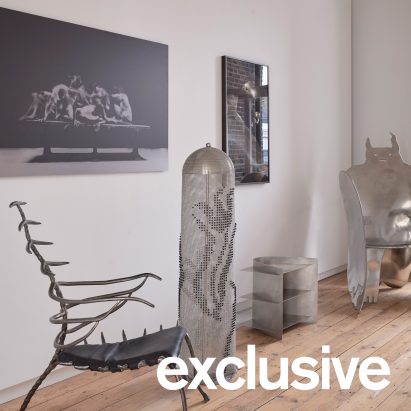
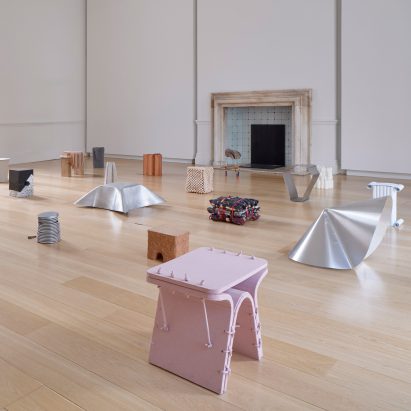
Now, the Lockheed is making a rare appearance as part of a retrospective at art vineyard Château La Coste in the south of France, looking back at Newson's pioneering work in collectible design over the course of his 40-year career.
"They're impossible to find, but I managed to get one," Newson told Dezeen, admitting he had to borrow his chaise from a private collector for the sake of the exhibition. "We sort of nabbed it for a little while."
Interestingly, even Newson himself can't quite put his finger on what it is about the Lockheed that has made it so unprecedentedly expensive.
"I could say lots of things that wouldn't be very polite," he joked. "But I think it's a weird combination of things."
"It wasn't like anything anyone else was doing. And actually, at that time, it was the beginning of a new genre of work, which is this kind of stuff," Newson added, gesturing at the greatest hits in his exhibition, including seminal pieces like the Event Horizon table and Cloisonné seating.
"I didn't want these things to be expensive"
The Lockheed Lounge – known then as LC1 – was one of six experimental seating designs made by Newson for his debut solo show in 1986, fresh off the heels of finishing his degree in jewellery design and sculpture at the Sydney College of the Arts.
Due to popular demand, Newson ended up refining and reissuing the chaise as an edition of 12, mainly because that was all he could afford to make at the time.
"They were a means to an end," he said. "I could only afford to make things by myself if I didn't want to be answerable to anybody else. Which I didn't, ever. I just wanted to be able to do what I wanted, so they were necessarily limited."
When the designer sold the last of these editions in the late 1990s, he was too cash-strapped to hold onto one himself, even though he confesses that he wanted to.
"I needed the money, and they were amongst the more lucrative things that I could sell," Newson remembered.

Newson had anticipated the market for sculptural, limited-edition furniture a full two decades before it was formalised with the launch of the Design Miami fair in 2005.
As a result, he is considered one of the founding fathers of the design art movement – now known more commonly as collectible design – and remains the only designer represented by art gallery Gagosian, which counts Damien Hirst and Jeff Koons among its artists.
In recent years, this formerly niche discipline has risen to become a major force in design, with a slew of dedicated events across the globe, from Tokyo to Dubai. The furniture industry's biggest and most important fair, Milan's Salone del Mobile, even launched a whole section devoted to collectible design for 2026. So does Newson feel vindicated to have done it before it was cool?
"Yeah, I guess I do actually," he said. "But I was really doing it for completely the opposite reasons. I didn't want these things to be expensive. In fact, I didn't really care."
"But they did end up being expensive for, ultimately, the very same reasons that anything – if we mention the horrible word 'luxury' – but anything good is kind of costly."
Ironically, several decades and record-breaking auctions later, his collectible design work isn't the thing that pays the bills.
"I don't survive on this stuff," Newson admitted.
"I wouldn't call it a hobby," he added. "But it's a bit like working in the way that an artist would work – without having to have exhibitions every year or two years to sustain your livelihood."
Sustaining his livelihood instead is the commercial work he does for big-name brands and private clients.
"It's the stuff that I'm doing with Ferrari, it's the stuff that I'm doing with Vuitton, with the luxury companies, but also lots of other stuff," Newson said.
"I always loved the idea of doing something once and doing it properly"
A common theme among many of these projects is their high price point. In fact, the Lockheed isn't his only piece to set records for its costliness.
There's also the $610 million private yacht he designed for Russian billionaire Roman Abramovich, which is billed as the most expensive custom superyacht in the world.
"If I look at the clients that I have now, like Ferrari or Louis Vuitton... these are things that obviously are costly," Newson said. "That is the way it is. But they're not disposable. They're things that, in theory, can last for a very long time – they can be repaired. They're human, and they live through generations."
"I always loved the idea of doing something once and doing it properly, creating something that you could have forever, like a piece of sculpture," he added.

Newson's argument is that, in the long run, investing once in a more expensive, well-made product is actually more cost-efficient than having to replace a cheaper product – except, perhaps, in the case of the superyacht and the Lockheed.
"It's not that I don't want to design things that are accessible for people," he said. "But ultimately, if I'm designing a piece of luggage for Louis Vuitton, everyone's like 'oh my God, that's really expensive', but I guarantee they will have spent more on luggage in their lifetime."
"I understand that's a hard logic to sell people, but I think it's the truth. I'm not suggesting that people go and buy Louis Vuitton luggage. But it is really well made, and it is repairable."
"I'm terrible with technology"
Most recently, Newson has been tinkering away at two hotly debated projects – Ferrari's first electric car and OpenAI's mysterious AI device – working together with Ive as part of their collective studio LoveFrom, which the duo founded after leaving Apple in 2019.
Envisioning the future of electronics presents an interesting challenge for Newson, even after 40 years of practice, given that he considers himself something of a Luddite.
"I'm terrible with technology," he laughed. "Famously really bad."
"I can understand materials and processes and techniques, that's my thing."
Nowhere is this clearer than in his collectible design work at Château La Coste, much of which is honed from a single material in a process carefully designed to either bring out or defy its inherent qualities.
Take the Cast Glass Chair, which makes molten glass structural by firing it in a kiln for up to six months, or his unibody Cloisonné seats, for which he spent months retraining a 40-strong team in China in the near-extinct tradition of cloisonné enamelling.

Ultimately, Newson argues, this kind of granular focus on tactility and materiality is exactly what technology is missing at the moment.
"People have this automatic and sort of instantaneous association that modern means digital and modern means touchscreens," he said.
"I think the opposite should be true," he added. "There's a huge opportunity, I believe, to interject simplicity via tactility, things like that, in ways that people just don't associate or don't expect. So that's why it's interesting for me."
"Creating objects that are understandable, either on an emotional level or a tactile level, that you connect with, that you can form relationships with or bonds with – I guess you could say they're kind of... old-fashioned emotions – but they're extremely valuable."
"Electric cars have done a great job of making people's lives really complicated"
In the Ferrari Luce, various buttons, switches and toggles are designed to regain some of the satisfying physical feedback that's lost when a combustion engine is swapped out for a battery.
"It's all done with the same ambition, which is to simplify," he said. "And I think a lot of the time, technology doesn't simplify."
"Certainly, when it comes to an electric car, they've done a great job of making people's lives really complicated, just in terms of trying to figure out how they work."
The Ferrari Luce is a particular passion project for Newson, partly because he's a longtime fan and proud owner of a 1955 Ferrari 857S.
But also because, unusually for automotive design, LoveFrom's work encompasses the whole vehicle.

"Typically in the industry, it's not the case where singular design entities do everything," said Newson. "There'll be someone that does the exterior, someone that does that part of the interior, and it's all sort of pieced together."
"That's the way the industry works, and that's evident. You can see that in cars, right? You can see the incoherence."
This approach clearly appeals to Newson's omnivorous appetite to design absolutely everything.
"Designing cars, the way that we wanted to do it, is like designing dozens and dozens of products simultaneously that all have to fit together like a sort of jigsaw," he said.
"Variety is exciting, not because I like designing different things, but because I like learning. Actually, that's what it's about the end of the day."
The exhibition photography is by Stéphane Aboudaram.
Dezeen In Depth
If you enjoy reading Dezeen's interviews, opinions and features, subscribe to Dezeen In Depth. Sent on the last Friday of each month, this newsletter provides a single place to read about the design and architecture stories behind the headlines.
The post "Anything good is kind of costly" says Marc Newson appeared first on Dezeen.