









Unseen videos reveal Zaha Hadid's first digital designs


Architect Daniel Oakley has released videos of the first 3D computer models created at Zaha Hadid Architects, exclusively revealed here as part of our Parametricism series.
The videos give a rare insight into the studio's early forays into digital design before it became globally renowned for its fluid, parametric architecture.
They were created by Oakley, who was the first person to introduce a design computer – a Macintosh IIci, into Zaha Hadid's office.
Daniel Oakley has released videos of the first digital designs created at Zaha Hadid Architects
Oakley had gained experience in 3D modelling and animation as an architecture student at the Rhode Island School of Design (RISD) and as a hired artist in the Brown University Computer Graduate Graphics Group.
He first worked with Hadid in 1986, when her studio was designing by hand, on the Tomigaya Building. Oakley was later hired at Zaha Hadid Architects in 1989 as a computer applications specialist in architectural design.
They include digital models of Zaha Hadid's design for the Tomigaya Building
The videos show digital walk-throughs of some of the competition designs he worked on while at the studio, including the Zollhof Media Park.
Over the four years he spent at Zaha Hadid Architects, in an office he refers to as Studio 9, he worked closely with Hadid to test the possibilities of designing in 3D computer models.
Stored on floppy disks, Oakley revisited the decades-old designs and recently created videos that can be viewed on modern computers for the first time.
"After Zaha Hadid encouraged me to leave another architectural office with the promise that Studio 9 would invest in digital technology, I committed fully to developing early computational architectural work within the practice at a time when very few offices were seriously exploring digital design, modelling, or animation," Oakley told Dezeen.
Zaha Hadid Architects was creating their designs by hand when Oakley the team
Oakley said that the studio first had reservations about the digital modelling technology, which was done on rented computers.
This changed after he won a competition organised by Apple UK and Paracomp Software and was awarded a Macintosh IIci computer, a tool that helped advance Zaha Hadid Architects into digital design.
"Despite the innovative results achieved on projects such as Tomigaya and Zollhof Media Park, Zaha, Patrik Schumacher, and much of Studio 9 initially remained sceptical about the long-term role of digital technology in architecture, continuing to rely primarily on painting, drawing, and physical representation," he said.
"I won the competition with the Exploded World image and 3D model study," he continued. "The prize, a Macintosh IIci with 5MB RAM and a 40MB hard drive, became the first major design computer within Studio 9 and helped initiate the studio's transition into digital production."

Oakley spent four years at Zaha Hadid Architects' Studio 9 London office, but continued to work for the studio when he moved to San Francisco.
"Later, in 1998, while based in San Francisco, I arranged a sponsorship through Autodesk and Intergraph Computer Systems that brought the first five high-performance graphics workstations into Studio 9, then among the most advanced visualisation systems available," said Oakley.
"These systems accelerated the studio's move into increasingly sophisticated computational design work, helping lay foundations for the digital architectural language that would later become central to Zaha Hadid's practice and to architecture more broadly during the 1990s and beyond."
As part of our Parametricism series, we took a look at Hadid's fluid Nordpark Railway Stations, which completed in 2005, and the sculptural Heydar Aliyev Centre, which was described by the architect as the "closest thing" to translating her theoretical visions into a built reality.
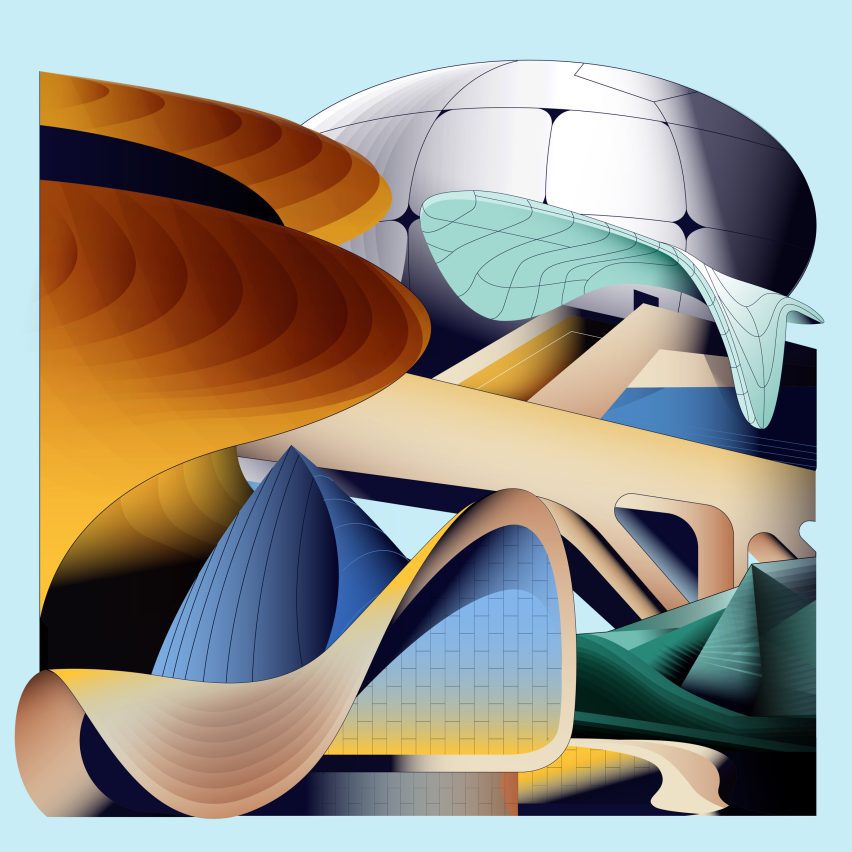
Parametricism
This article is part of our series on parametricism, the theory of architecture developed by Zaha Hadid Architects principal Patrik Schumacher that lays claim to becoming the 21st century's defining style.
The post Unseen videos reveal Zaha Hadid's first digital designs appeared first on Dezeen.