






Barde vanVoltt designs Mexico City penthouse as "brutalist sanctuary"


Dutch design studio Barde vanVoltt has used textured stucco walls, stainless steel panels and sculptural stone elements to outfit a two-level penthouse in Mexico City.
Barde vanVoltt collaborated with local architect and contractor José Muniz to complete the 300-square-metre penthouse, which is owned by a creative couple.

"When fashion designer Tony and writer Rafael met, they envisioned a brutalist sanctuary for themselves and their dogs," said the studio.
"This penthouse became a deeply personal project shaped by their impeccable eye for design and creative worlds."

The home is laid out in an H shape around two light wells wrapped in floor-to-ceiling glass.
An elevator and staircase are positioned in the central bar, with space on either side for internal circulation, and an additional single-flight staircase leads up to the roof.

The lower floor is divided into the living, dining and kitchen area across one wing, and the bedroom, bathroom and dressing room along the other.
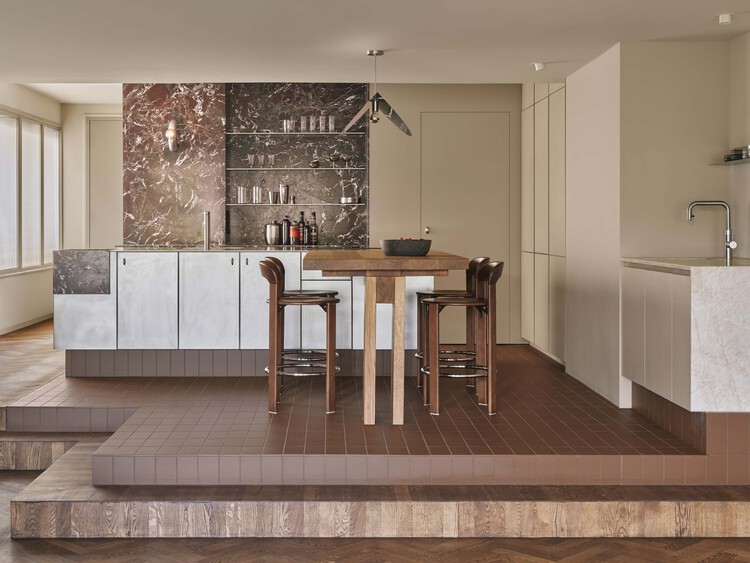
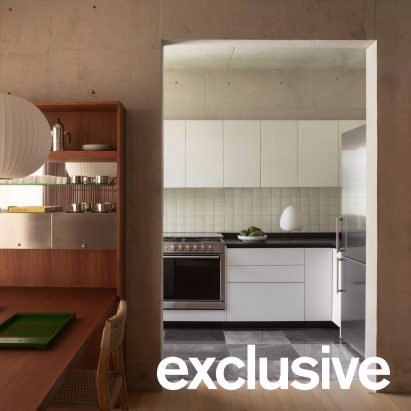
Throughout these spaces, concrete flooring and textured stucco surfaces create a base onto which stone slabs, walnut millwork and reflective elements are overlaid.

"The home translates the concept of Warm Brutalism into an introspective, sculptural living environment defined by materiality, light, and atmosphere," said Barde vanVoltt.
Stainless steel panels wrap the elevator shaft and main stairwell, and form full-height kitchen cabinet doors alongside walnut uppers and lowers.

The bed is housed within an exaggerated wooden frame and backed by a huge wooden headboard that swoops up onto the ceiling.
Dark-tinted glass curves around the bathroom, which features a monolithic stone tub, while louvred walnut shutters slide across the bedroom windows for added privacy.
"Bold, monolithic architectural lines are softened by rounded corners, textured stucco walls, warm walnut carpentry, and sculptural stone elements," Barde vanVoltt said.
"Wooden shutters and curved volumes introduce a sense of stillness within the urban setting."

Black-stained wooden bar stools and dining furniture add visual weight to the neutral interiors, as do the stone countertops and the solid metal-sheet balustrades that flank the roof staircase.
Upstairs, a writer's studio, a gym and a small lounge open to a terrace, where a grill area, a fire pit and a plunge pool create
"a place where brutalist geometry meets the vast Mexico City horizon".

Although based in Amsterdam, where the studio has completed a coffee showroom and a family home in a garage, this is not Barde vanVoltt's first project in Mexico City.
The studio has also renovated a house in La Condesa neighbourhood that is oriented around a mezcal bar.
The photography is by Alejandro Ramirez Orozco.
The post Barde vanVoltt designs Mexico City penthouse as "brutalist sanctuary" appeared first on Dezeen.