












Time management pebble among industrial design projects from the University of Illinois Chicago


Dezeen School Shows: a series of pebbled interactive objects designed to help neurodivergent people with time management is among the projects from the University of Illinois Chicago.
Also featured is a VR controller in the form of a glove, and a furniture collection embodying the principles of feng shui.
University of Illinois Chicago
Institution: University of Illinois Chicago
School: School of Design
Course: Thesis and Documentation
Tutors: Brian Anderson and TJ O'Keefe
School statement:
"Our Master of Design (MDes) in Industrial Design programme aims to broaden students' worldviews and deepen their understanding of their roles as designers through studio classes, workshops, seminars, lectures, visits, and select opportunities for regional and international travel.
"MDes student design projects are not solely formal and aesthetic propositions, but also profound explorations that scrutinise the complex interplay between the natural and artificial elements in society and global culture.
"Concluding the programme, each MDes student explores a topic of inquiry in which they contextualise and formulate a position and develop tangible design responses.
"This process entails a broad range of engagement and adopts a holistic approach, encouraging and empowering students to blend theory with practice."

Cho by Taha Hasan
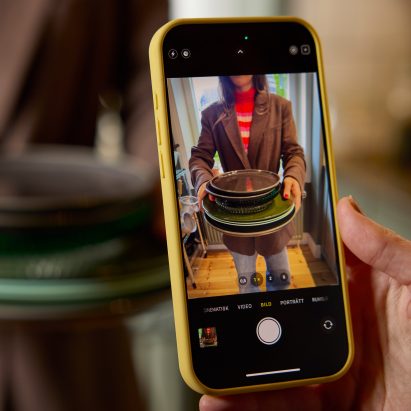
"Cho is an extended reality glove controller that turns VR into a flexible virtual sandbox. Paired with a headset, it allows users to feel and manipulate digital forms in virtual space, extending sensory engagement beyond sight.
"Over the past several decades, design has shifted from direct physical making toward digital creation through abstract interfaces.
"Mice, keyboards, screens and controllers have expanded what designers can produce, but they also distance the body from the act of making.
"As design moves deeper into XR, there is an opportunity to re-centre the hand as the primary site of interaction. Through haptics, vibration, resistance and force feedback, it gives digital form sensory significance and material meaning.
"The hand can once again become central to making and digital objects can feel more relatable, physically legible and emotionally satisfying."
Student: Taha Hasan
Course: Thesis and Documentation
Tutors: Brian Anderson and TJ O'Keefe
Email: shasa40[at]uic.edu

WǔWù by Thirata Noparat
"WǔWù is a set of five objects, each embodying one of the five elements of Feng Shui – wood, fire, earth, metal and water.
"The objects – a desk, a lamp, a sofa, a shelf and a room divider – function as corrective instruments for everyday imbalance, not as mere decorative expressions of their representative element.
"Feng Shui has informed relationships between human behaviour and spatial experience for thousands of years at the scale of cities and architecture.
"Yet in the West, Feng Shui has been reduced to a superficial language of interior styling.
"While it continues to function as a complete spatial philosophy in many Eastern contexts, Feng Shui's core insight, that space and objects can be intentionally shaped to cultivate or correct emotional balance, has yet to fully inform global design practice.
"This project adapts an ancient understanding of balance and shows how it might be activated and lived with at the scale of everyday objects."
Student: Thirata Noparat
Course: Thesis and Documentation
Tutors: Brian Anderson and TJ O'Keefe
Email: tnopa[at]uic.edu

Pebs by Bahar Aryana
"Pebs is an interactive system of small, glowing objects designed to support awareness of time, tasks and transitions through subtle environmental cues.
"Many neurodivergent individuals experience difficulties with time perception, task initiation and sustained focus.
"Most existing organisational tools – apps, alarms and notifications – rely heavily on screens and constant alerts. These can contribute to cognitive overload, distraction and stress.
"Pebs offers a quieter, more intuitive alternative. Rather than interrupting the user, it communicates through soft light, gentle movement and spatial presence.
"Each unit acts as a responsive cue, encouraging the user to begin, pause, or shift attention at their own pace.
"By turning the surrounding space into a subtle guide, Pebs reframes everyday tasks as smaller, more approachable moments: less like obligations and more like a series of manageable steps."
Student: Bahar Aryana
Course: Thesis and Documentation
Tutors: Brian Anderson and TJ O'Keefe
Email: barya[at]uic.edu
Partnership content
This school show is a partnership between Dezeen and the University of Illinois Chicago. Find out more about Dezeen partnership content here.
The post Time management pebble among industrial design projects from the University of Illinois Chicago appeared first on Dezeen.