







Studio Hagen Hall explores Japanese and modernist design ideas at renovated Heion House


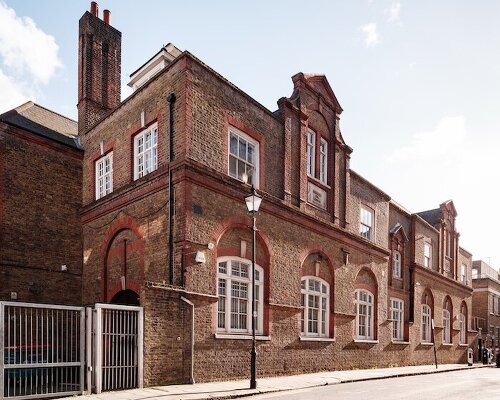
Studio Hagen Hall has modernised a Georgian terraced house in north London, using a pared-back material palette including smoked-oak joinery to create atmospheric spaces informed by Japanese architecture.
Heion House is located within a conservation area in Islington and was designed as a forever home for a couple with a growing collection of Japanese and self-made ceramics, furniture and art.

Architect Louis Hagen Hall's practice was tasked with bringing the three-storey property up to modern standards and reorganising the interior to create more connected and cohesive spaces.
"Working within the constraints of a Grade-II listed Georgian structure was a challenge," Hagen Hall told Dezeen.
"Rather than impose a singular gesture, we focused on a series of small interventions to create a contemporary spatial language, unified by a consistent material palette and recurring motifs such as apertures to visually connect all the spaces."

The clients, who previously spent time living in Japan, wanted the interiors to reflect their passion for Japanese living, as well as their preference for pared-back, modernist design.
"The material choices and construction methods in both modernist and Japanese design are very intentional," said Hagen Hall, adding that the interior prioritises simplicity in order to create a calm environment.

"Modernism brings a kind of spatial and functional rigour, while Japanese principles introduce warmth and sensitivity to nature," the architect added. "Together they create a balanced approach."
Hagen Hall opted not to extend the home's footprint in order to retain the existing garden space, with the project instead focusing on redefining the interior through the use of integrated joinery and subtle layout alterations.

The interior was rearranged to reflect the owners' lifestyle. With no children or regular guests to host, the existing three-bedroom layout was adapted to leave one main bedroom and a variety of versatile living spaces.
The bedroom was relocated from the first floor to the upper-ground floor, allowing the main living space to replace it and make the most of the light and views towards a nearby square.

A new entrance hall was designed to incorporate a genkan – a traditional Japanese entryway step for removing shoes – which provides access to the primary bedroom suite.
The suite comprises a bedroom and an adjoining dressing room that occupy the former lounge. The two spaces are divided by a full-height sliding panel that was built into the bespoke cabinetry by fabricators TG + Co.

A single step connects the hallway with a bathroom featuring a palette of white mosaic tiles, micro cement floors and oak joinery. A small floor-level window visible from the hall creates a visual connection through the house to the garden.
The restored heritage-listed staircase leads down to a lower-ground floor containing the kitchen, dining room and a snug that looks onto a courtyard at the front of the house.

The snug is lined with cabinetry, including a concealed TV and a niche called a tokonoma, which is used for displaying floral arrangements. Built-in leather sofas can transform into a guest bed, with storage for bedding incorporated in the sofa's base.
"The tokonoma niches are framed and often lit to highlight everyday objects like ceramics," said Hagen Hall.
"Conceptually, they reinforce that the home is not just for living, but for engaging with objects, crafts and ritual in a meaningful way."

Textured glass panels framed by a grid of shelves create a display for ceramics that allows light to filter into the space from the kitchen in a way that evokes Japanese shoji screens.
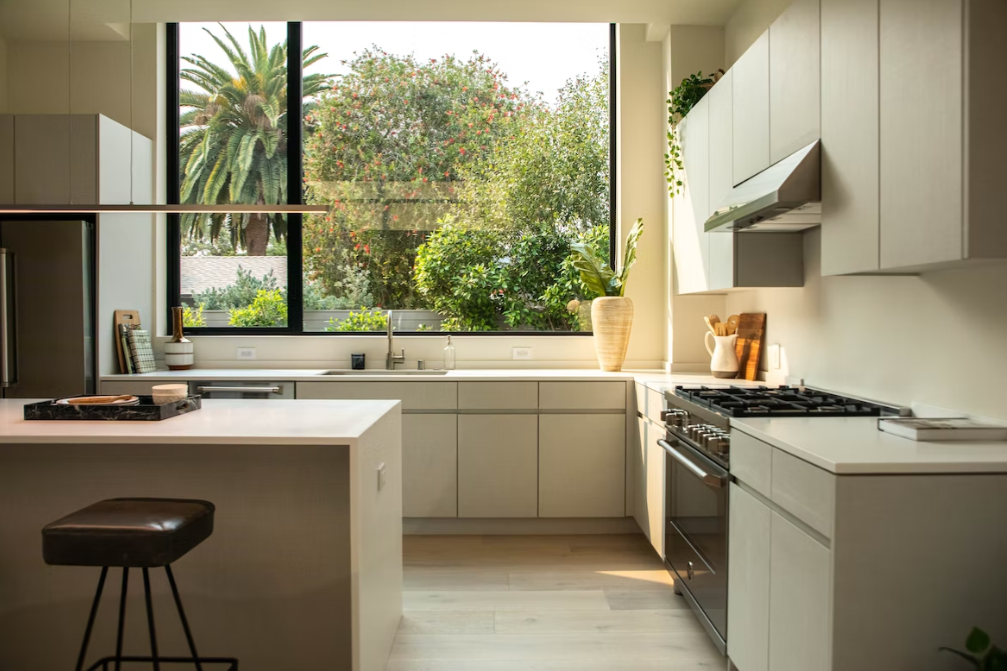
Studio Hagen Hall designed the bespoke kitchen to maximise the utility of the compact space, with different areas designated for either storage or illuminated display areas.

The kitchen connects with a garden courtyard that was lowered to create level access from both the kitchen and the new dining area.
The dining space features a rounded table designed by the architects, which is surrounded by integrated bench seating and enlarged openings that create the feeling of dining among the foliage.

The table is the first piece in a collection developed by the studio in response to the need for bespoke pieces that resolve specific spatial and functional needs.
"Our intention was to create pieces that feel like an extension of the architecture," Hagen Hall explained. "Designing furniture allows us to have greater control over the total environment, ensuring that every element of the build aligns with our broader design philosophy."
The house's upper floor contains a lounge with views over the tree line and the surrounding neighbourhood. An internal window that can be opened using a sliding panel in the next-door room provides a visual connection between the spaces.
The room to the rear of the building contains a freestanding oak bath overlooking the garden. The versatile space also functions as an art studio and home office, with futons stored in the joinery, allowing it to transform into a guest room.

Throughout Heion House, the architects used bespoke joinery along with timber and glass partitions to create spaces that can be connected or closed off as required.
A pared-back palette of materials that will develop patina over time contributes to a harmonious and atmospheric mood that reflects the clients' unique tastes and way of living.

Louis Hagen-Hall founded his multidisciplinary practice in 2020, which focuses on creating functional, beautiful places for modern living.
The studio's previous projects include the transformation of a north-London townhouse into a home inspired by 1970s Californian modernism, and the refurbishment of a 1960s property that references its original mid-century design.
The photography is by Felix Speller.
The post Studio Hagen Hall explores Japanese and modernist design ideas at renovated Heion House appeared first on Dezeen.