








Spatially complex bamboo table among projects from The University of Hong Kong


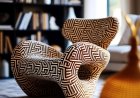
Dezeen School Shows: a table made from bamboo and wood, which uses AI in its design process, is among the projects from The University of Hong Kong.
Also featured is a reconstruction of a log building with local materials, and a construction project exploring soil-based techniques.
The University of Hong Kong
Institution: The University of Hong Kong
Course: The Building Society
Tutors: John Lin, Zhen Liu, Raimund Krenmueller, Kuo Jze Yi, Beven Chang, Yuwei Zeng, Chang Liu, Taketo Nagaoka, Jenny Hsiao, Kaiho Yu, Rainer Hehl, Xin Hua, Deane Simpson, Peng Jiamin, Lidia Ratoi, Luowei Mei, Olivier Ottevaere, Garvin Goepel and Mads Hovgaard Laursen
School statement:
"The Building Society is a one-year postgraduate programme at the University of Hong Kong that offers a Master of Science in Advanced Architectural Design.
"Students and faculty research, design and prototype on-site collectively in a full-time, one-year, three-trimester programme to implement experimental building practices with local communities.
"The programme is committed to teaching through real-world practice, emphasising the architect's social contract as key to addressing complex challenges.
"By integrating historical knowledge with contemporary technological innovation, it explores new paradigms of sustainable architectural practice, fostering interdisciplinary collaboration and integrating design research with practice."

The Human House Community Centre by MScAAD Studio Cohort students
"Located in Duonage Village of the Lisu community in Weixi, Yunnan, the Human House is a living space constructed from reclaimed timber.
"Throughout the process of design and construction, the team from the building society worked closely with village builders, taking the act of building itself as a medium for dialogue and creation.
"Drawing from the relationships among the settlement, the mountain terrain and the surrounding forest, the design explores the potential of structure and space.
"Within a framework that is both light and resilient, the architecture responds to its environment, reinterpreting local materials and craftsmanship towards a contemporary expression of sustainable building."
Students: Xu He, Xin Hua, Yingzhe Wang, Aijia Yu, Xue Feng, Xuanshu Tao, Siyi Ke, Li Zhou, Chengyi Yin, Luowei Mei, Yezi Yin, Junzhe Fan, Shinan Ru, Jiun-Yu Chang, Jiaxin Bao, Yuwei Zeng and Renjie Jiang
Course: MScAAD Studio Cohort 1
Tutors: John Lin, Jze Yi Kuo, Zhen Liu and Raimund Krenmueller

From log walls to lightweight structures by MScAAD Studio Cohort students
"The Human House project started with the dismantling of an old log building and the reconfiguring of its materials, reimagining the structural logic and spatial order of local timber construction.
"Whereas the traditional log construction evokes volume and mass, the students' transformation of the material creates an airy, lightweight structure that generously holds space.
"From the reclaimed materials to the final construction, a series of scale models and 1:1 prototypes were built, exploring aspects of tectonics, assembly logic and detailing."
Students: Xu He, Xin Hua, Yingzhe Wang, Aijia Yu, Xue Feng, Xuanshu Tao, Siyi Ke, Li Zhou, Chengyi Yin, Luowei Mei, Yezi Yin, Junzhe Fan, Shinan Ru, Jiun-Yu Chang, Jiaxin Bao, Yuwei Zeng and Renjie Jiang
Course: MScAAD Studio Cohort 1
Tutors: John Lin, Jze Yi Kuo, Zhen Liu and Raimund Krenmueller

Between Tulous by MScAAD Studio Cohort students
"The Fujian Tulou are a unique typology of fortified communal buildings made primarily by the Hakka people from rammed earth and wood, dating back as far as the 12th century.
"The revitalisation project by The Building Society is located in Longyan Shizhong and confronts a unique constellation of two neighbouring tulou representing two opposing characters that became central to the design: one with largely intact living quarters, the other one invaded by a dense bamboo forest.
"The tension between those poles inspired a study of negotiating differences, redefining boundaries, connecting opposites and integrating with the existing qualities of the historical context on multiple levels – from the geometry of the space to existing local construction techniques and materials.
"The proposed intervention, currently under construction, offers a critical commentary towards the conventional attitude of preservation, exemplified by the nearby UNESCO world heritage reconstruction of a tulou cluster.
"In contrast, it is emerging from a playful confrontation of historical and contemporary design and building techniques."
Students: Siqi Chen, Chuyue Zhang, Jinxiu Liu, Hao Wang, Guanqian Zhang, Menglong Yang, Haowei Lin, Sibo Zhao, Qixuan Hu, Peiying Ma, Ling Sun, Jiaqi Cai, Chenglong Wang, Hanyang Long, Yiheng Qiao and Tianya Zhang
Course: MScAAD Studio Cohort 4
Tutors: Kuo Jze Yi, Raimund Krenmueller, Beven Chang and Yuwei Zeng

Multi-material glulam structures by Guanqian Zhang, Sibo Zhao, Siqi Chen and Ling Sun
"As part of a the Fujian Tulou revitalisation project, a 1:2 scale model and a 1:1 section of a bridge were built that showcases structure, material and fabrication-related innovations.
"The main spanning glue-laminated elements have been composed with the help of topology-optimisation algorithms, to determine the distribution of various grades of timber materials.
"This allows the use of lower quality and reclaimed timber where forces within the cross section allow it.
"The resulting functionally differentiated material pattern has a unique aesthetic expression and makes sense not only technically but also as it connects the project back to the material history of the original site.
"Slanted cuts and precise connection details have been created by robot CNC machining as well as traditional carpentry techniques, exploring synergies between digital and manual craft."
Students: Guanqian Zhang, Sibo Zhao, Siqi Chen and Ling Sun
Course: MScAAD Studio Cohort 4
Tutors: Jze Yi Kuo, Raimund Krenmueller, Beven Chang and Yuwei Zeng

The Hutong Toolbox by MScAAD Studio Cohort students
"Traditional dwellings have always evolved through continuous trial and error, iteration and progression driven by the intelligences of residents and technological development.
"The hutong courtyard house is no exception, and it does not belong to any specific fixed era. However, the evolution of the courtyard house after it transformed into a Zayuan (multi- household compound) seems to have neither been noticed nor recognised by the academic community and the official sector.
"The self-construction in contemporary Zayuan consists of a series of construction experiments full of humour, creativity and imagination.
"We regard this spontaneous state of self-construction as a rich source of inspiration for making good use of Zayuan and redefining modern Hutong life.
"The Hutong Toolbox is more than just a set of designed architectural elements within hutongs – it is a methodology of micro-infrastructure interventions and a platform that empowers community-led regeneration.
"In a complex and fragile environment like Beijing's Hutongs, large-scale redevelopment or rigid preservation often proves ineffective.
"The Hutong Toolbox offers another possibility: a platform-based mechanism that guides residents to adaptively and autonomously improve their living spaces."
Students: Ao Xinran, Chen Qixin, Chen Yiwen, Feng Jiaying, Fu Yifang, Hu Ruoyang, Huang Yanzhou, Jiao Hongxin, Lei Jingzhen, Lin Lihan, Liu Changxiang, Liu Xin, Qin Yushang, Sun Wanting, Wang Ningxin, Wang Yating, Xing Zhuoxuan, Zhang Ziyu, Zhuo Zishun and Zong Qihan. Text by Feng Jiaying
Course: MScAAD Studio Cohort 3
Tutors: Chang Liu, Taketo Nagaoka and Jenny Hsiao

ReGeneLog: a regenerative genealogy of timer components by Yanzhou Huang, Xinran Ao, Qixuan Hu and Yiheng Qiao
"ReGeneLog employs AI to activate components as behavioural agents within a generative simulation.
"Here, they interact through constraint-based matching, negotiating structural compatibility and spatial logic to form emergent assemblies.
"New materials are introduced when needed to supplement missing or degraded pieces, allowing historical fragments to integrate with contemporary construction.
"In this paradigm, the designer becomes an orchestrator of material ecologies – guiding collective regeneration rather than imposing fixed forms.
"Outcomes are tested through simulations evaluating structure, ventilation, comfort and circulation.
"ReGeneLog thus offers a new, adaptive and data-driven design method through which historical materials evolve into new architectural forms, deeply rooted in place."
Students: Yanzhou Huang, Xinran Ao, Qixuan Hu and Yiheng Qiao
Course: AI in Rural Contexts
Tutors: Kaiho Yu and Zhen Liu

Group project: New Materials
"With local masters and workers from Henan Province, two walls were built using traditional soil-based techniques: rammed earth, digging, rendering and handshaping.
"The finished walls act as a technical catalogue for future construction decisions, aiming to inform and advance sustainable development in the village of Zhoushan through the ecological use of local raw earth materials.
"A practical exploration of rammed earth construction, the project is led by The Building Society, driving the revival of earth-based building craft."
Students: Jiaxin Bao, Mengyang Cao, Zifan Feng, Cheng Jin, Siyi Ke, Jiamin Peng, Xuanshu Tao, Rongyao Xu, Zhihui Xu, Yuwei Zeng, Jingbo Zhang, Li Zhou and Yean Zhu
Course: New Materials
Tutor: Kuo Jze Yi

Making of: Ritualistic objects and meaning by Research-Based Design students
"Design practice is based on manufacturing knowledge from craft to industry – what world views and philosophies support these technologies?
"How can we gain a deeper understanding in design? What is the meaning of an architectural object?
"How is meaning generated through the production as well as the performance of a designed artefact? What are the implicit cultural realities of design practice?
"Tackling those questions, the seminar was structured in four phases: an introductory week with lectures on knowledge production, an excursion to Japan to explore experience-based knowledge, and a phase for applying this knowledge in designing and making a 1:1 prototype of a ritualistic artefact.
"The seminar expands the idea of a designed object beyond its functions by exploring how cultural artefacts perform, from turning materials into forms to creating deeper meanings."
Students: Xu He, Xin Hua, Yingzhe Wang, Aijia Yu, Xue Feng, Xuanshu Tao, Siyi Ke, Li Zhou, Chengyi Yin, Luowei Mei, Yezi Yin, Junzhe Fan, Shinan Ru, Jiun-Yu Chang, Jiaxin Bao, Yuwei Zeng, Renjie Jiang, Mengyang Cao, Ka Chun Chan, Wan Tung Chan, Fangxin Deng, Zifan Feng, Cheng Jin, Lei Li, Juntao Li, Kaiyi Liu, Shihui Li, Jiamin Peng, Jianwen Shi, Yingbei Wang, Rongyao Xu, Zhihui Xu, Jiaoyan Zhao, Jingbo Zhang, Junping Zhang, Yean Zhu, Ao Xinran, Chen Qixin, Chen Yiwen, Feng Jiaying, Fu Yifang, Hu Ruoyang, Huang Yanzhou, Jiao Hongxin, Lei Jingzhen, Lin Lihan, Liu Changxiang, Liu Xin, Qin Yushang, Sun Wanting, Wang Ningxin, Wang Yating, Xing Zhuoxuan, Zhang Ziyu, Zhuo Zishun and Zong Qihan
Course: Research-Based Design
Tutors: Rainer Hehl and Raimund Krenmueller

The Bamboo Forest by MScAAD Studio Cohort students
"The site for this design research project is an abandoned Tulou in Fujian, China. Due to a fire that took place decades ago, the inner wood-and-earth structure of the original building collapsed, leaving it abandoned for many years, with only the outer earthen walls remaining mostly intact.
"Over time, an unintentional topography formed within the isolation provided by the outer walls – turning rotten wood and rain-soaked earth into fertile soil.
"As locals discovered this unique condition, they casually started planting, leading to the emergence of a lush bamboo forest that became a habitat for a plethora of plant and animal species.
"Engaging with these highly specific conditions, the teaching team guided students to propose a reinterpretation of this ingeniously flowing landscape, generating architectural interventions that are nestled within the bamboo forest, responding to its unique character."
Students: Ziwei Li, Shuyuan Zhan, Chengyun Wu, Hongxue Wang, Jiawen Li, Qi Wang, Xinrui Tan, Bolin Peng, Zhuoran Zhao, Jingyi Wang, Can Zhang, Mincong Chen, Yuan Gao, Haohui Zhang, Hanyu Shi, Sizhuo Li, Xin Meng, Qianhe Liu, Jingtao Li, Xiaoqian Wu, Haoyue Xu and Yidiu Zhan
Course: MScAAD Studio Cohort 5
Tutors: John Lin, Zhen Liu and Xin Hua

Topics in Urbanisation by Chang Yupu, Hongchi Chen, Ningqi Geng, Haizhou Huang, Yuanfan Lan, Yutong Li, Haoyu Liang, Jingxi Liu, Xuanzhuo Liu, Wenwen Wang, Xinhan Yu, Kei Yin Yuen and Ruoyu Zhao
"Urbanocene frames urbanisation as core to the Anthropocene, redefining cities not as discrete objects but as part of planetary entangled networks shaping global landscapes via trade, extraction and pollution.
"This shifts architectural and urban analysis to examine near/far, visible/invisible, human/more-than-human and multi-scale dynamics, moving beyond conventional morphological mappings to expanded representation.
"This course explores these themes through collaborative experimental A0 site drawings, blending analytical exploration and intuition to document diverse site entanglements as storytelling tools.
"Supported by theoretical talks and drawing-focused discussions, the open-ended drawing process is a playful exploration, aiming to extend Michael Sorkin's principles for architects."
Students: Chang Yupu, Hongchi Chen, Ningqi Geng, Haizhou Huang, Yuanfan Lan, Yutong Li, Haoyu Liang, Jingxi Liu, Xuanzhuo Liu, Wenwen Wang, Xinhan Yu, Kei Yin Yuen and Ruoyu Zhao
Course: Topics in Urbanism
Tutors: Deane Simpson and Peng Jiamin

Human and non-human cohabitation by MScAAD Studio Cohort students
"Poche, as a negotiable architectural space between solid and void, has long been a site of creative potential.
"This studio's Cheung Chau project reinterprets poche as the ground for human-nonhuman cohabitation, where mass becomes an interface for interspecies negotiation.
"Beginning with an analysis of Italian precedents, students will translate canonical details into machine protocols.
"A core technical focus is the robotic fabrication of non-standard wooden joints, which reimagine historical masonry logic in contemporary timber construction.
"Through iterative digital and physical prototyping, the initial massing is hollowed, thickened and perforated to form an inhabitable structure.
"This process explores how robotic making can unlock the latent ecological and spatial capacities of architectural matter, embedding traces of cross-species activity within the very fabric of the dwelling and bridging historical craftsmanship with computational design and automated fabrication in Hong Kong's context."
Students: Chang Yupu, Chen Hongchi, Chen Shangjie, Geng Ningqi, Huang Haizhou, Jiang Yuqian, Lan Yuanfan, Li Yutong, Liang Haoyu, Liu Jingxi, Liu Xuanzhuo, Liu Yuan, Lu Shuduo, Wang Runing, Wang Wenwen, Wu Wenjie, Xiao Jingwen, Yu Xinhan, Yu Zhehan, Yuen Kei Yin, Zhao Ruoyu, Zhao Tianle and Zhou Xingrun
Course: MScAAD Studio Cohort
Tutors: Lidia Ratoi, Kaiho Yu, Luowei Mei and Jiamin Peng

Under Pressure by MScAAD Studio Cohort students
"This innovative construction system combines lightweight inflatable formwork with concrete casting.
"By precisely controlling the negative space created by the inflatable balloons, the method allows to generate concrete surfaces with a fluid, Baroque-inspired geometry.
"Developed in collaboration with industrial partners in the Greater Bay Area, this research demonstrates an economical and sustainable construction method using pressurised air vessels to counteract the hydrostatic pressure of liquid concrete, offering a replicable paradigm for material innovation and technical application in architecture."
Students:Mengyang Cao, Ka Chun Chan, Wan Tung Chan, Fangxin Deng, Zifan Feng, Cheng Jin, Lei Li, Juntao Li, Kaiyi Liu, Shihui Li, Jiamin Peng, Jianwen Shi, Yingbei Wang, Rongyao Xu, Zhihui Xu, Jiaoyan Zhao, Jingbo Zhang, Junping Zhang and Yean Zhu
Course: MScAAD Studio Cohort 2
Tutors: Olivier Ottevaere and Kaiho Yu

The Mushroom by MScAAD Studio Cohort students
"The mushroom is the first of a series of 1:1 prototypes created with the innovative construction method described above.
"It demonstrates the unique architectural vocabulary arising from the combination of inflatable and rigid formwork elements.
"The project successfully integrates the heavy texture of concrete with structural lightness, creating a unique dialogue between traditional craftsmanship and innovative technology through a balance of active tension and compression."
Students: Mengyang Cao, Ka Chun Chan, Wan Tung Chan, Fangxin Deng, Zifan Feng, Cheng Jin, Lei Li, Juntao Li, Kaiyi Liu, Shihui Li, Jiamin Peng, Jianwen Shi, Yingbei Wang, Rongyao Xu, Zhihui Xu, Jiaoyan Zhao, Jingbo Zhang, Junping Zhang and Yean Zhu
Course: MScAAD Studio Cohort 2
Tutors: Olivier Ottevaere and Kaiho Yu

Augmented Structures by He Xu, Mei Luowei, Yin Chengyi, Fan Junzhe, Li Shihui, Wang Yingbei and Deng Fangxin
"Augmented Structures explores how augmented reality can become a direct interface between digital design and physical construction.
"Centred on the design and making of table-leg prototypes to support a tabletop, students worked with wood sticks and bamboo splits to develop structurally informed forms that are both materially specific and spatially complex.
"Through AI-assisted form-finding and structural computation, students generate and refine design proposals, then use AR holographic guidance to translate them into 1:1 fabrication and assembly.
"Rather than treating AR as a visualisation tool alone, the course positions it as an active medium for communicating design intent, coordinating assembly and enabling the construction of intricate structural systems through a hands-on workflow that links generative design, material behaviour and technology-infused craftsmanship."
Students: He Xu, Mei Luowei, Yin Chengyi, Fan Junzhe, Li Shihui, Wang Yingbei and Deng Fangxin
Course: New Technologies in Design (AR/VR/AI)
Tutors: Garvin Goepel and Mads Hovgaard Laursen
Partnership content
This school show is a partnership between Dezeen and The University of Hong Kong. Find out more about Dezeen partnership content here.
The post Spatially complex bamboo table among projects from The University of Hong Kong appeared first on Dezeen.