









Sosokki Anac designs angular Abogoga cafe in Gimpo to resemble ancient ruins


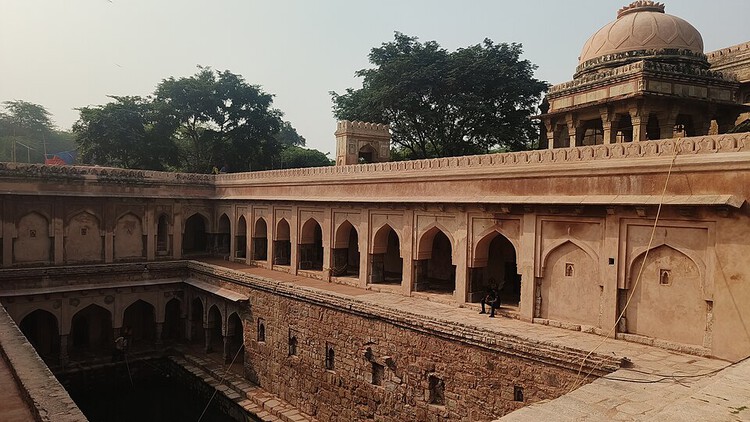
Monolithic brick volumes intended to evoke "the ruins of an undiscovered ancient civilisation" conceal this cafe in South Korea, designed by local architecture studio Sosokki Anac.
Named Abogoga, the cafe and bakery sits alongside the Han River on the outskirts of Gimpo, Gyeonggi Province.

Sosokki Anac divided the cafe across three red-brick forms, designed to appear separate from the exterior but united by a high, angular exposed-concrete interior.
"I was interested in creating a dreamlike, almost fictional atmosphere that merges universal familiarity with something unfamiliar," said design lead Gi-Tae Chung.

"The project was conceived as the ruins of an undiscovered ancient civilisation, buried beneath the glaciers of Alaska – as if the traces of a forgotten world had resurfaced after the reset of human history," Chung told Dezeen.
"Red brick was chosen for its closeness to a primordial architectural material – something ancient, tactile, and deeply rooted in human construction," he added.

To create what Chung described as a "sense of exploration", Abogoga is accessed via a short bridge across a rocky patio, leading into the elbow of an L-shaped plan designed to prevent the whole interior from being revealed at once.
This narrow entrance opens into a double-height hall, with a large counter for baked goods at its centre and a coffee bar lining its southern edge, both finished in stainless steel to contrast the raw concrete ceilings overhead.
Within a more narrow wing to the east, low-level windows face out towards the river next to a rectilinear brick structure, with arched openings at its base framing additional seating and plants on its roof.
Concrete and steel walkways connect to a series of seating mezzanines and terraces, along with bathrooms positioned above a ground-floor kitchen framed by a brick arch.

"Although the project is located along the lower reaches of the Han River, we felt that the view here was not inherently dramatic," explained Chung.
"Instead of relying on it, we chose to construct a closed, introverted mass that deliberately conceals the river on approach. Only once inside does the view suddenly open up, creating a moment of release - a spatial climax," he added.
"Rather than revealing the interior all at once, the spatial sequence unfolds gradually through maze-like circulation and layered volumes, encouraging a sense of exploration."

Based in Seoul, Sosokki Anac is an architectural and interior design studio founded in 2004 that operates under the culture and arts conglomerate Sosokki Group.
Elsewhere in South Korea, architecture studio Sukchulmok recently also used sculptural red-brick forms to create the Parconido Bakery Cafe, while Centre Pompidou Hanwha by Wilmotte & Associés is preparing to open in Seoul.
The photography is by Jung-gyu Kim.
The post Sosokki Anac designs angular Abogoga cafe in Gimpo to resemble ancient ruins appeared first on Dezeen.