







Mimosa Architects shapes Czech cabin from "rock, river and fire"


Burnt wood and black metal define this rural cabin in the Czech Republic, created by local studio Mimosa Architects to replace its scorched predecessor.
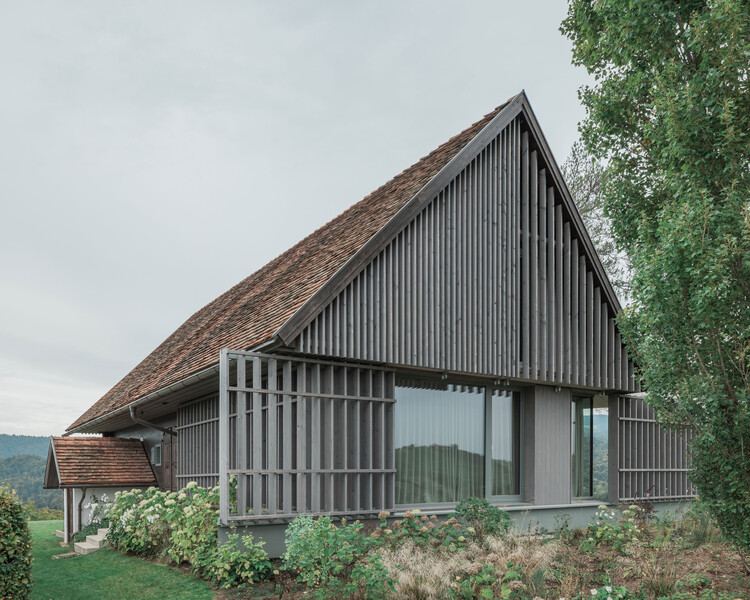
Wrapped in blackened larch boards, the 78-square-metre cottage is located near Prosečnice on the banks of the Sázava river, and sits on the site of another cabin that burned down.

Mimosa Architects drew from the surrounding nature and the site's position between the river and rocky terrain, designing the cabin to blend in with its forested environment.
"We believe that such a relationship is one of the prerequisites for the long-term protection of the landscape," Mimosa Architects principal Petr Moráček told Dezeen.

"The river literally flows within fishing rod reach," he continued.
"With this in mind, we wanted to draw a link between each natural aspect of land and the site's original structure – rock, river and fire."

After the fire, the only remaining feature of the structure was the stone plinth it rested on. This was retained as the base for the new cabin, keeping it elevated from flooding and also giving it views over the river.
The structure is entirely timber-based, primarily using natural and recycled materials.
"Reusing the original stone foundation made it possible to avoid new foundations and minimise interventions in the terrain," said Moráček.
"Charring the larch wood gives the timber a durable quality, and as a plus, its dark facade ensures that the natural scenery is not disturbed."

While the exterior of the cabin is meant to "perhaps somewhat cynically" reference its predecessor, the interior has been made lighter with the use of spruce bio-board, accented with black steel.
Throughout the cottage the material and colour palettes were pared-back and minimal, keeping the space uncluttered and "cave-like". Its sparse decor encourages the feeling of free-flowing movement between the indoors and outdoors.

The downstairs level contains the kitchen, dining area and living room in one open-plan space, with bedrooms on the first floor.
"The generosity of the main space is enabled by the small upstairs rooms," Moráček explained. "After all, the purpose of going out of the city is to be together."

The cabin's light spruce wood walls, ceilings and furniture are punctuated by hints of black metal from the wood-burning stove, the staircase and in the smaller hardware details.
Grounding the space, the floors are a long-lasting natural linoleum that reference the grey of the stone plinth and rocky terrain outside.
The shared space spans the full height of the cabin and connects the front and back of the site, overlooking the river and the cliffs.
"The interior space is essentially just a simple connection between the areas in front of and behind the cabin," said Moráček.

The entire length of the cabin facing the river has been glazed, and a raised terrace running alongside it has views of the Sázava.
A large folding shutter shelters the cottage from strong sunlight, and also gives the house the option to transform into "a closed, impregnable box".

Outside and towards the back of the timber-framed structure, water-resistant sheet metal has been installed to facilitate drainage and surface run-off on the roof.
Apart from requiring electricity, the cottage is substantially self-sufficient. An on-site well supplies water, the stove, basalt wool insulation and electric heaters are used for warmth, while a wastewater tank sits within the plinth beneath.

Other rural homes in the Czech Republic include a 19th century cottage renovated by Studio Plyš, a hilltop residence with a larch annex extension by Päivä Architekti, and a 1970s stone hut transformed by Atelier Hajný.
The photography is by Petr Polák.
The post Mimosa Architects shapes Czech cabin from "rock, river and fire" appeared first on Dezeen.