






Zaha Hadid's Nordpark stations topped with parametric "ice formations"


As part of our ongoing Parametricism series, we look at the Nordpark Railway Stations, a collection of four funicular railway stations in Innsbruck, Austria, designed by Zaha Hadid.
Built along a 1.8-kilometre-long funicular railway track, which stretches from the city centre up to a mountain overlooking the city, the stations were each topped with a curved form in Hadid's signature parametric style.

The double-curved glass shells sheltering the stations were designed to mimic the "natural ice formations" of the Alpine region in, what was described by the studio as, a "shell and shadow".
"We studied natural phenomena such as glacial moraines and ice movements to develop a fluid language of natural ice formations, like a frozen stream on the mountainside," the studio said. "Two contrasting elements 'shell and shadow' generate each station's spatial quality."

Commissioned in 2005, Zaha Hadid Architects designed the four stations – named Loewenhaus, Hungerburg, Congress and Alpenzoo, along with a 242-metre-long cable-stayed bridge.
Hadid sought to create a "coherent overall architectural language" for the four stations, which along with matching canopies are finished with black detailing and perched on concrete plinths.
The curvature of the shells – made possible through parametric design tools – allows them to double as both the stations' roofs and envelopes, while the open-air interiors are stripped-back with soft-edged forms.

According to the studio, the intention was for the sculptural shells to appear as if hovering above their concrete platforms, with a concept of "lightness" giving way for large cantilevers and "small touch down areas".
"Lightweight organic roof structures float on concrete plinths, their soft shapes and contours creating an artificial landscape that describes the movement and circulation within," it said.
The shapes of the canopies, which were collectively made from 850 thermoformed glass panels, were designed using parametric tools to create unique forms that relate to the stations' altitude and topography.

"Adaptation to the specific site conditions in various altitudes while articulating a coherent overall architectural language is critical to this design approach," the studio said.
"Each station has its context, its topography, its altitude, its movements. The track's inclination and ratios are dominant technical parameters," it continued.
"A high degree of flexibility enables the shell structures to adjust to these various parameters while still being part of the same formal family."

For their construction, Hadid used state-of-the-art design and manufacturing technologies from the automotive industry. This is evident in the "streamlined" forms akin to industrial products of that era.
"New production methods like CNC milling and thermoforming guarantee a very precise and automatic translation of the computer-generated design into the built structure," the studio said.
"The results are reminiscent of streamlined industrial design pieces from car bodies to yachts and airplane wings."
Two years of construction saw the stations in operation from December 2007.
Situated at city level, the Congress station is the first of the four railway stops. It is linked to the subsequent Lowenhaus station via the New Hungerburg Railway Bridge, which carries passengers across the Inn river.
The cable-stayed structure, also designed by Hadid, is complete with a pair of slanted concrete pylons. At the Lowenhaus station, a passenger platform is sheltered by a sloping portion of the shell that flows down to ground level in a single movement.

Above this, the Alpenzoo Station sits at the highest gradient of the four structures, where passengers can access the Alpenzoo Innsbruck – a nearby tourist attraction.
The station's structure is composed of a raised concrete platform topped with a leaf-shaped shell that opens up to the surrounding landscape.
The final, and arguably most wing-like, of the four stations is the Hungerburg, which features an expansive, arching structure perched 288 metres above the city.

Described by architecture critic Jonathon Glancey as being designed "as much for aesthetic as practical effect", the prominent glass-shelled stations remain in use as both public transport and a tourist attraction.
"Hadid's railway is in a different league," Glancey wrote for the Guardian following the project's opening. "Ambitious, sophisticated and designed as much for aesthetic as practical effect, it's a first-class work of art and engineering."

Primarily used for tourism, the line transports approximately 800,000 passengers a year from the Innsbruck city centre to the high Alpine terrain in a short 20-minute ride.
The Nordpark Railway Stations followed Hadid's completion of the nearby Bergisel Ski Jump, which we listed as the most significant building of 2002 for our 21st-Century Architecture: 25 Years 25 Buildings series.
In 2008, the project was shortlisted for the Stirling Prize by the Royal Institute of British Architects.
The photography is by Werner Huthmacher unless otherwise stated.
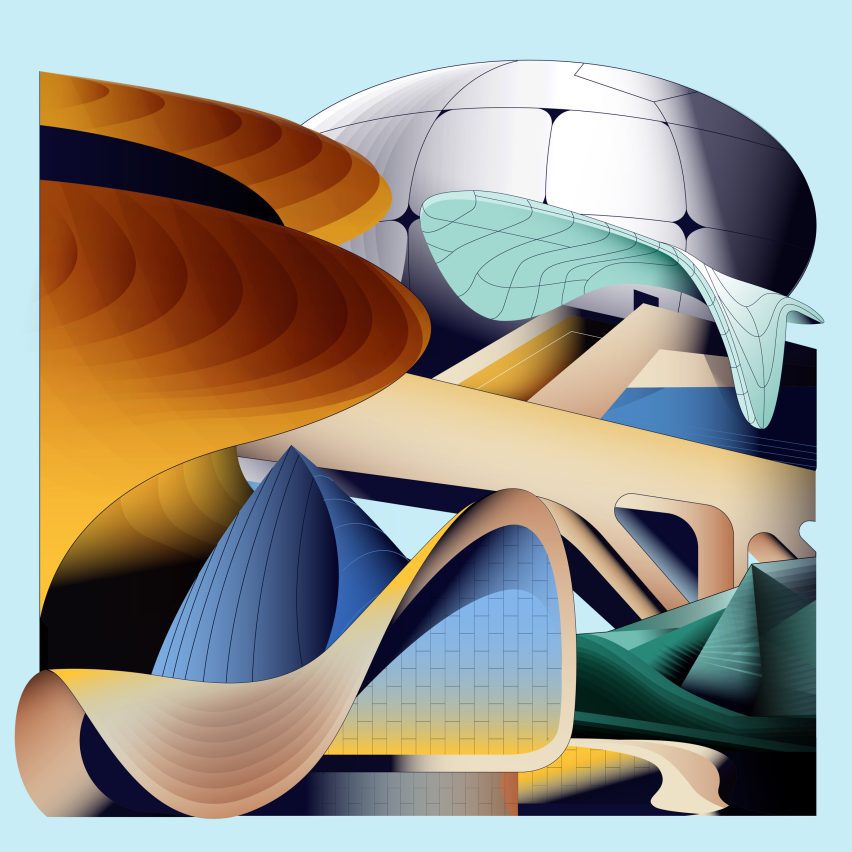
Parametricism
This article is part of our series on parametricism, the theory of architecture developed by Zaha Hadid Architects principal Patrik Schumacher that lays claim to becoming the 21st century's defining style.
The post Zaha Hadid's Nordpark stations topped with parametric "ice formations" appeared first on Dezeen.