









Khanna Schultz infuses House in Amagansett with "atmosphere of quiet contemplation"


New York studio Khanna Schultz has taken cues from Japanese architecture to create a "net-positive-energy" house in the Hamptons, New York, which features dark wood cladding and a large rooftop solar array.
The House in Amagansett was designed for a philanthropist who had spent several decades living in Japan and wanted a weekend home that "reflected her life abroad while serving as a peaceful retreat for herself and her family".
The project takes its name from its location in Amagansett, an exclusive hamlet in East Hampton, on Long Island in New York state.

It was built on a landlocked quarter-acre property that formerly held an ageing house in bad condition.
The old building was removed, but the team kept an existing pool and many original plantings, including two mature crape myrtle trees. The trees became a "focal point" of the new design.
"The house was designed around two existing, majestic crepe myrtle trees whose twisted trunks offer an organic counterpoint to the abstraction and simplicity of the building's clean lines," said Brooklyn-based studio Khanna Schultz.

The architects conceived a rectilinear, L-shaped house with two levels and a basement. The entrance is on the south, and the preserved crape myrtle trees are found on the east side of the home, where they overlook the pool.
The Japanese philosophy of "gradual revelation" was embraced while conceiving the house, from the facade treatments to the interior layout.
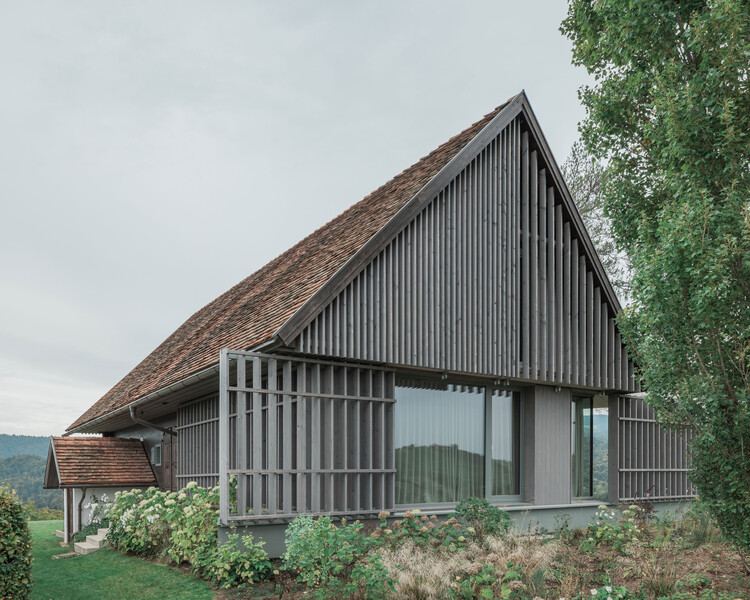
The dwelling is clad in dark wood – specifically, black-stained, thermally modified spruce – that was informed by rustic Japanese buildings.

The front elevation is mostly opaque, while the home opens up in the areas where it faces the backyard.
The approach to the building features a "metaphorical moat and bridge".
The "moat" is actually a pair of light wells cut into the ground, which bring downlight down to the basement level.
"This moat not only enhances the experience of entering the home, but also allows natural light to filter into the basement spaces, creating a connection between the underground rooms and the outdoor environment," the team said.
Inside the home, the design was informed by Japanese domestic life and a commitment to efficiency.
"The design process was one of great precision," the team said. "Every inch of the house was carefully considered, much like the design of a car – compact yet efficient, with no space wasted."

The ground floor holds the communal spaces, along with the primary bedroom suite, garage and screened porch. The upper level holds bedrooms, and the basement contains a family room.
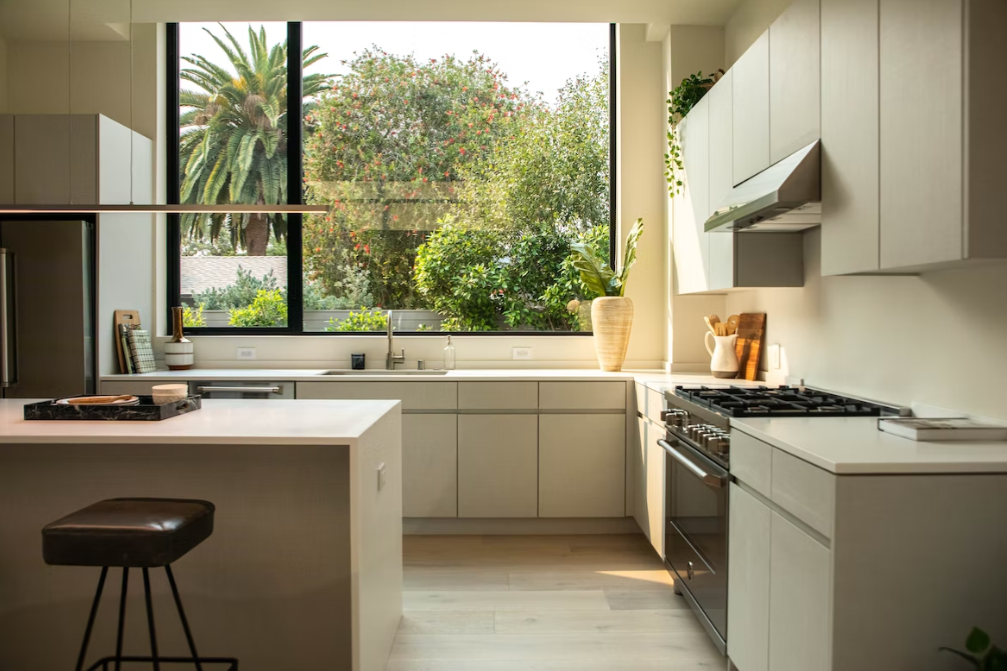
Elements like light-filtering screens and bleached-oak flooring provide a sense of calm.
Furnishings include a dining set by George Nakashima Studio, a lounge chair by Finn Juhl, and bespoke pieces by Brooklyn craftsman Mark Jupiter.

"Each piece is carefully chosen to complement the home's serene palette, adding to its atmosphere of quiet contemplation," the team said.
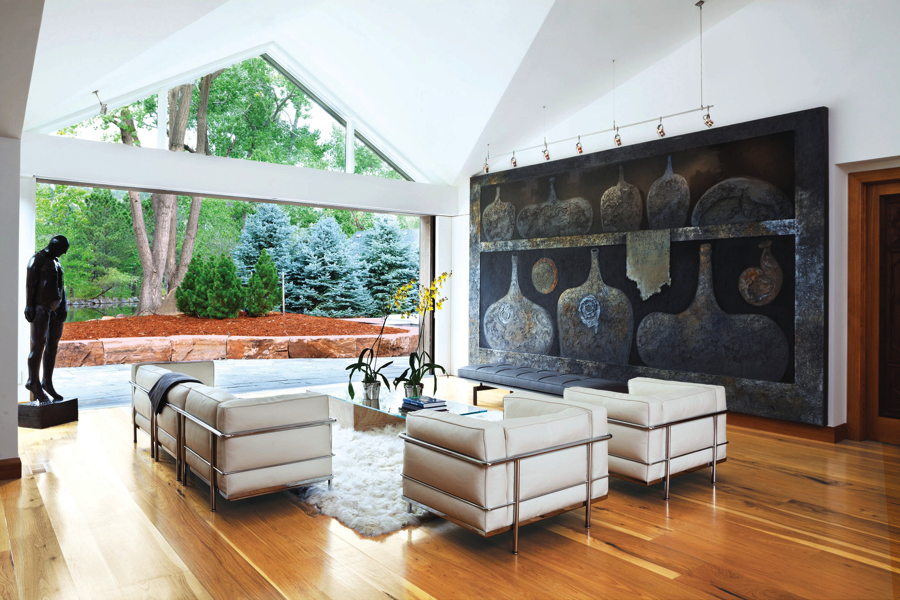
The home also features the client's art and ceramics collection, many of which are works she acquired during her time in Japan.
The client's concern for sustainability informed many of the design decisions. The house is designed to be "positive energy", according to the studio, meaning it produces more energy than it consumes.

Power is generated via a 23.25-kWh rooftop solar array, which generates more power than is actually needed for the house. The excess energy is sent back to the grid.
A geothermal heating and cooling system and an energy recovery ventilation system help minimise energy consumption.
The project also entailed the addition of native plants to attract birds and pollinators.
"At the heart of this project lies a respect for nature and simplicity," the team said.
Other projects in Amagansett include a glass-and-wood holiday home on a secluded site by architect Jerome Engelking, and a cedar-clad dwelling that was originally designed by Charles Gwathmey and received a sensitive update by Worrell Yeung.
The photography is by Eric Petschek.
Project credits:
Architect: Khanna Schultz Architectural and Interiors
Project team: Robert Schultz, Veronica Patrick, Navajeet Khatri, Vrinda Khanna
Structural design: DiLandro Andrews
Landscape design: Beitel Landscape Associates
General contracting: Flanzer Construction
Photo styling: Katja Greeff
The post Khanna Schultz infuses House in Amagansett with "atmosphere of quiet contemplation" appeared first on Dezeen.