










Parametric design at Seoul Robot & AI Museum is "both shelter and pedagogy"


Continuing our parametricism series we look at the Seoul Robot & AI Museum by Turkish studio Melike Altınışık Architects, which was designed to showcase the technologies used in its construction.
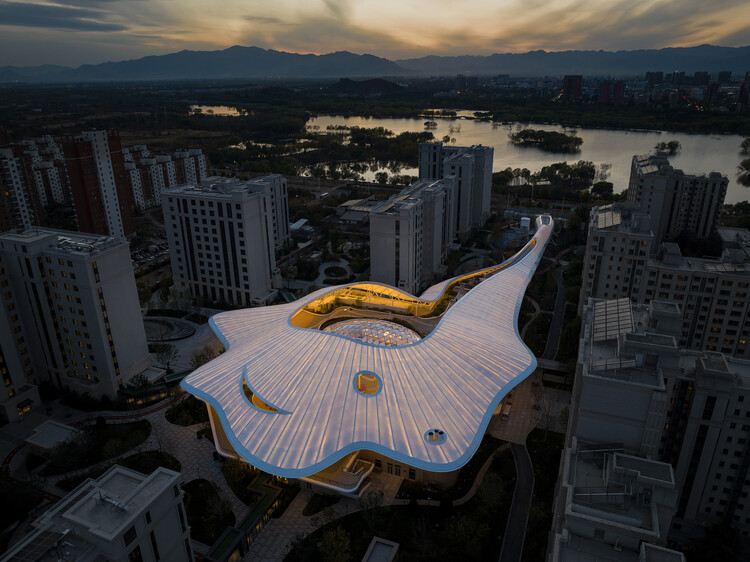
Opened in 2024 in the South Korean capital, the Seoul Robot & AI Museum (RAIM) has a spaceship-like design that aims to provoke wonder and curiosity in passersby.
Its function, being dedicated to robots and AI, was a key influence on how RAIM was designed and built.

Parametric design was used to test thousands of design options for the museum, aiming to optimise structural efficiency, material use and the integration of robotic fabrication strategies.
However, studio founder Melike Altınışık said that adhering to a parametric architectural style was not the main goal for RAIM, and human intervention in the design was key.
Made with laser-CNC machining and robot welding, the gridded patterns in the metal facade panels and joints derive from the structural steel grid concealed behind, designed to form a unified building rather than a separate structure and decorative skin.

"A museum dedicated to robotics and AI demanded that we think parametrically about not just geometry, but about how the building system could demonstrate the precision and optimisation embedded in its engineering," Altınışık told Dezeen.
"The structural steel frame, the coordinated facade panels, the integrated building systems – these emerged from relationships between performance criteria, not from a stylistic agenda," she continued.
"Computation did not replace intuition. Throughout the process, we moved between digital simulation and physical models, between algorithmic testing and spatial intuition. The parametric model became a tool for sharpening our thinking, not determining it."

Most of the four-storey building is enclosed, save for a strip of windows on the ground floor that wrap the entrance space, cafe, shop and library.
A tunnelled escalator leads from the entrance to the main exhibition spaces on the upper floors, bypassing office and administration spaces located on the first floor.
Design for Manufacturing and Assembly (DFMA) methods were used throughout the building. The structure and facade panels were designed parametrically, prefabricated off-site with robotic systems and then assembled on-site with smart coordination systems and robotic assistance.
Smart building systems were integrated throughout the building, including adaptive climate control, data-driven building management, and smart wayfinding, aiming to enhance the operational efficiency of the building and improve flexibility for exhibitions.
Altınışık wanted to celebrate all the technologies that went into conceiving and building RAIM, and showcased them in the building's design for visitors to discover as they move through the space.
"The building does not simply display robotics and AI; it demonstrates them through how it was conceived, engineered and fabricated," said Altınışık.
"Visitors encounter the building's own parametric design strategy, its robotic fabrication processes, and its integrated smart systems as part of the curatorial experience – the architecture becomes both shelter and pedagogy," she continued.
"The structural steel system is not hidden; it is articulated and celebrated. This honest expression of construction logic reflects the building's core message: that precision engineering, smart systems, and technological integration can be beautiful, not merely functional."

RAIM represents a shift in the possibilities of parametric design, using digital processes not only in the design process but also in manufacturing and construction.
This seamless use of technologies in all phases of building will have a profound effect on the architecture industry, said Altınışık.
"For the past two decades, there has been a gap between what we could conceive digitally and what we could practically build," she said. "DFMA methodologies and smart robotic fabrication are closing that gap."
"We are moving into a phase where computational thinking extends across the entire design-to-fabrication pipeline," Altınışık continued. "The division between design and construction is becoming obsolete. The parametric model becomes not just a design tool but a construction platform."

According to Altınışık, designing simultaneously for manufacturing and assembly optimises the final form of the building and its production, as it can be controlled to a greater level of precision with robotic fabrication.
"This is genuinely transformative," she said. "It enables mass customisation, the ability to produce highly differentiated, optimised forms while maintaining economic viability; it allows for greater precision and, paradoxically, greater sustainability, because optimised structures use fewer materials."

However, she warned that any use of computational design should be guided by an architect's design intention, as "the risk is that we become seduced by complexity for its own sake".
"Smart construction and DFMA methodologies represent the technical evolution of parametricism, but architectural evolution lies in using these tools to create buildings that are culturally specific, materially honest, structurally optimised, and deeply human," said Altınışık.
"The question is not whether we can build complex forms, but whether those forms serve something meaningful, and whether the process of building them is as intelligent as the form itself."
The photography is by Namsun Lee.

Parametricism
This article is part of our series on parametricism, the theory of architecture developed by Zaha Hadid Architects principal Patrik Schumacher that lays claim to becoming the 21st century's defining style.
The post Parametric design at Seoul Robot & AI Museum is "both shelter and pedagogy" appeared first on Dezeen.