







Kengo Kuma captures "sensory memory of architecture" in Jaipur Rugs collection


Japanese architect Kengo Kuma has collaborated with Indian brand Jaipur Rugs to develop Faces, a collection of wool rugs modelled on his buildings, exhibited at Milan design week.
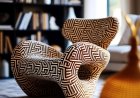
Faces comprises 16 rugs that draw on the facades of landmark buildings designed by Kuma with his studio Kengo Kuma & Associates, including the Albert Kahn Museum in France and the Suntory Museum of Art in Japan.
According to the architect, the rugs aim to embody the atmosphere and feeling of the buildings, rather than being a literal representation of them.

"Rather than translating the facades directly, we were more interested in capturing the sensory memory of architecture," explained Kuma.
"What remains in our memory is not the exact form or geometry, but the atmosphere it creates, the way light touches a surface, the depth of layers and the subtle textures that we perceive almost unconsciously. In this sense, the rugs are not representations of buildings, but traces of these experiences," he continued.
"Through material, texture and soft transitions, we attempted to reinterpret those memories in a tactile form. It is less about visual reproduction and more about evoking a feeling that can be sensed through the body."

The rugs are named Kasane, Kigumi, Chirashi, Bokashi, Sukima and modelled on the facades of four projects – the Suntory Museum of Art in Tokyo, the Kanayama Community Centre in Gunma, the GC Prostho Museum Research Centre in Aichi and the Albert Kahn Museum in Boulogne-Billancourt, France.
Kengo said the names of the rugs refer to traditional Japanese construction techniques used by the practice and seen in the buildings used as references.

The rugs were crafted from wool with viscose for rigidity and are available in several colours.
However, colour is used sparingly, with natural and earthy shades of brown and grey prioritised across the range, and pops of bold black-and-white graphics.

"As rugs are objects that come into direct contact with the human body, we sought to use colours that are as close to nature as possible," said Kuma.
"At the same time, within each rug, we carefully adjusted the tones so that contrasts would not feel too pronounced. Rather than creating strong visual differences, we aimed for a more subtle harmony, allowing the colours to gently coexist within a quiet and unified atmosphere."
Both the Sukima and Bokashi rugs draw on the Suntory Museum of Art.
Sukima has a gridded design, evoking the way light filters through the slatted facade of the museum, while Bokashi is intended to emulate "subtle graduations and blurred transitions", nodding to the use of sliding screens in the building.

Drawing on the Kanayama Community Centre, Chirashi is defined by "a scattering of elements", nodding to its patterned stone facade, and the Kiguma rugs nod to the traditional wooden construction utilised at the GC Prostho Museum Research Centre.
Finally, the Kasane rugs have a layered design, with a mix of colours and patterns, referencing the Albert Kahn Museum's irregular, overlapping elements on its facade. It is the only rug available with green tones, a departure from the neutral beige and grey palette.
"Kengo Kuma's Facaces collection for Jaipur Rugs is architecture as textile," concluded Jaipur Rugs artistic director Greg Foster.
"The collection is one of the deepest collaborations we have worked on with any designer, with precise conversations with Kengo's team on the exact craftsmanship and colour palette that would accurately recall his buildings."

Jaipur Rugs is India's largest artisan of handmade carpets. It is exhibiting the collection during Milan deist week at the Jaipur Rugs' showroom on Via Marco Minghetti and also at the celebrated Crespi Bonsai Museum.
Elsewhere at Milan design week, Aesop has launched its first collection of lamps, called Aposē and Marcin Rusak is exhibiting flower-infused furniture.
We rounded up eight must-see Milan design week installations, which include a pink maze and a two-storey Eames house.
The photography is courtesy of Jaipur Rugs.
Milan design week 2026 takes place from 20 to 26 April 2026 at various locations across Milan, Italy. See Dezeen Events Guide for more architecture and design events around the world.
The post Kengo Kuma captures "sensory memory of architecture" in Jaipur Rugs collection appeared first on Dezeen.