







Zero-waste textiles project among work featured at New Designers 2026


Dezeen School Shows: a textiles project created using deadstock and second-hand yarn is among the projects from this year's New Designers showcase.
Also featured is a collection of ceramic cups informed by woodlands and an accessible design for an toaster.
New Designers
Institution: New Designers Class of 2026
School statement:
"The UK's most established graduate design showcase returns in 2026, spotlighting the next generation of design talent.
"Taking place from 1 to 4 July, New Designers reflects the increasingly interdisciplinary nature of design today, bringing together emerging talent in a more dynamic, connected and immersive experience for both exhibitors and visitors.
"For over 40 years, New Designers has championed emerging creative talent, providing a vital platform for more than 2,500 graduates annually to present their visionary ideas to industry professionals and the public.
"The 2026 edition marks an exciting new chapter, uniting graduates from across the UK in a single, cohesive showcase taking place over one week."

From Foliage To Food by Aurora Stevens
"My project bloomed from a respect for nature, enjoyment of food and a response to the climate crisis. Through my work, I explore the unseen connection between the foods we consume and the planet they come from.
"All seeds, vegetables and fruits are grown by plants, but when they are consumed, the product isn’t necessarily associated with their parent plant.
"Through my collection, I investigate humans' partnership with cultivation and the development of plants into crops for consumption.
"When grown at home, each stage of the plant's life is witnessed; each new leaf or blossom is a miracle of nature that we get to be a part of. These pieces focus on the lifecycle of a tomato plant and mimic the leftover tomato pedicel, sepal and stems.
"Through this, I have developed an appreciation for the leftover organic materials, which serve as evidence for the consumption of their fruits.
"This project questions where we miss seeing the value of plants and their produce, and reconnects the foods we eat to the natural elements that provide them."
Student: Aurora Stevens
Course: BDes (Hons) Jewellery and Metal Design
School: University of Dundee

Min Musling by Freja Malle Høyer
"Enter Min Musling, a Danish term of endearment meaning 'My Mussel', and feel protected from the noise, unrest and chaos of the outside world. Inside, you are immersed in the sea and protected like the pearl that you are.
"This embroidered interactive art installation is an exploration of the Danish coastline, structured around wellbeing through the inclusion of five elements.
"Sight: visual immersion in the ocean and natural surroundings; touch: tactile and three-dimensional elements; rest: the viewer can enter the mussel and rest; cuddle: a weighted blanket; play: the mussel moves and changes appearance when someone is inside.
"The installation is composed of natural fibres, alternative deadstock and second-hand materials."
Student: Freja Malle Høyer
Course: BA (Hons) Hand Embroidery
School: Royal School of Needlework

RePaper Line by Eli Tinapp
"RePaper Line is a hands-on recycling system that transforms wastepaper into a new, usable material in three steps: shredding, pulping and pressing.
"This product is made for schools and other educational settings. It teaches sustainability, material value and responsible design in a tangible way, making it easy to remember by mechanical interaction."
Student: Eli Tinapp
Course: BA (Hons) Product Design
School: University of Sussex

Enduring Impressions by Isabella Malmström-Bevan
"Enduring Impressions is a collection that explores the intersection of sustainability, material innovation and contemporary surface design, responding to the growing need for environmentally responsible practices within the fashion industry.
"Rooted in a process-driven approach, my work investigates how natural resources and experimental techniques can redefine the aesthetic and functional qualities of athleisure textiles."
Student: Isabella Malmström-Bevan
Course: BA (Hons) Textile Design
School: Nottingham Trent University

The Garden of England by Molly White
"The Garden of England A/W55 is a future focused conceptual project.
"Taking inspiration from the county of Kent, it hones in on how fruit and veg waste can be repurposed into biomaterials suitable for use within the couture fashion industry and how this can be combined with surface pattern design through innovation."
Student: Molly White
Course: BA (Hons) Textile Design
School: Falmouth University

Interpreting Natural Form by Matthew Morris
"Matthew Morris' project focused on woodturning locally and sustainably sourced timber into hollowed forms, allowing the natural properties of the wood to inform the final product."
Student: Matthew Morris
Course: BA (Hons) Contemporary Design Crafts
School: Hereford College of Arts

Community by Ellie Gummery
"This collection of cups explore the woodland as a symbiotic community, drawing parallels between ecological systems and human communities.
"The individuals of the woodland are depicted through slip and stencil decoration, coated with ash glaze to directly connect people to the natural world through use.
"Cups are objects of social connection, facilitating community engagement inspired by nature's example."
Student: Ellie Gummery
Course: BA (Hons) Contemporary Design Crafts
School: Hereford College of Arts

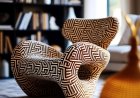
The Jarapa Chair by Iris Reed
"The Jarapa Chair represents the continuation of innovation and adaptation in heritage craft practices, merging the materials and processes of two classic pieces from the region of the Alpujarra in southern Spain; the 'bulrush chair' and the 'jarapa rug'.
"Many heritage skills are naturally sustainable and jarapas are a great example of circular economy in design, traditionally made with old rags or waste from the textile industry and repurposing old looms from the Moorish period.
"This piece takes the principles of jarapas by using pre-owned t-shirts and by using the technique of the bulrush chairs creates a strong and colourful seat whilst fighting the waste produced by the over-polluting fashion industry."
Student: Iris Reed
Course: BA Product and Furniture Design
School: London Metropolitan University

Your Last First – Toaster by Bhavnesh Modgill
"This project explores how everyday products might be re-imagined when informed by both universal and circular design principles.
"Using the domestic toaster as a case study, this project aims to investigate how appliances might be designed to be more accessible, intuitive and inclusive, whilst also addressing issues of repairability and product lifespan.
"Exploring how we might transition away from designing multiple products for segmented user groups, the project considers whether a more universally accessible approach could reduce the need for multiple appliances, thereby lowering material use and overall production.
"In doing so, it also explores the potential to de-segregate users through design, creating a single product that supports a wider range of needs without differentiation.
"By rethinking the toaster's internal architecture and user interface, the project proposes a more considered approach to everyday objects; one that extends product life while broadening accessibility."
Student: Bhavnesh Modgill
Course: BSc (Hons) Product Design
School: University of Brighton

Interwoven: Reclaiming the Domestic Fibre by Ellie Blow
"The interior textiles utilise found, deadstock and second-hand unwanted colour and materials.
"By working with found yarns, the collection reduces waste, extending the lifecycle of unwanted and discarded fibres.
"The collection employs a uniquely developed zero-waste construction process with each knitted panel laser cut and reassembled into interlocking compositions of florals through to geometrics.
"There are no off-cuts or excess materials generated in the process. Every stitch and fibre counts."
Student: Ellie Blow
Course: BA(Hons) Textiles
School: Edinburgh College of Art
Partnership content
This school show is a partnership between Dezeen and New Designers. Find out more about Dezeen partnership content here.
The post Zero-waste textiles project among work featured at New Designers 2026 appeared first on Dezeen.