











Faux Flora helps pollution-blinded bees to find real flowers


British designer Justina Alexandroff has created a fake flower that stands out to insects, potentially helping them navigate polluted city air and fighting declines in pollination.
Alexandroff's Faux Flora was designed to assist bees and other pollinators that are struggling because of air pollution, which has been shown to degrade the scent of flowers, hiding them from the insects' perception.
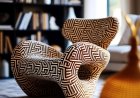
Shimmering, fragrant and intricately structured, the Faux Flora effectively imitates the natural qualities of flowers, but with the volume turned up.

Placed among blooms, they should "act as visual and olfactory beacons", Alexandroff says, guiding the pollinators to the real flowers nearby.
Alexandroff built on recent scientific discoveries on insect recognition with the project, using a combination of material science, scent chemistry and digital design to create an object that would appeal uniquely to pollinators.
The 3D-printed objects have a parametric design inspired by fractals, a reflective surface created through structural colour, and embedded scent molecules chosen for their robustness in the face of pollution.

Alexandroff, who began Faux Flora as part of her masters in Material Futures at UK university Central Saint Martins (CSM), hopes that once the invention is fully developed, it could become part of serious efforts to fight biodiversity loss.
"Insect biodiversity is unimaginably important and we are seeing a decline in populations globally," said Alexandroff. "It's being referred to as the 'insect apocalypse'."
"They do so many different types of ecosystem functions – forming the foundation of food webs, pollinating 85 per cent of flowering plants and recycling nutrients – yet there's no 'coherent strategy' to slow and reverse the damage humans are causing."

Alexandroff developed her design based on PhD research by biologist Aditi Mishra published recently in the peer-reviewed journal The Science of Nature.
In it, Mishra outlines three traits that insects use in concert to identify flowers, recreating the elements with inorganic materials to test her theory.
Alexandroff wanted to take it further, creating an "enhanced flower" that vividly expressed these three traits – radial symmetry, a sweet scent and reflective surface – in order to solve the problem of sensory pollution, where human-made stimuli interfere with the senses of other species.

For the radially symmetric shape, she used parametric design to create forms similar to the fractal geometries seen throughout nature, including, microscopically, in grains of pollen.
For the sweet scent, she collaborated with NICE Labs, Bangalore, which had developed an algorithm predicting the most attractive scent formulation, and added jasmine as its robust molecule remains potent even through air pollution.
To bring a reflective quality, Alexandroff worked with structural colour, where colour is created through micro-ridges in the surface scattering light, as opposed to actual pigments.
This is famously found in nature in iridescent phenomena such as the blue morpho butterfly, but has been increasingly recreated by materials scientists and designers exploring biomimicry.
While Alexandroff worked with resin – embedding the scent within it before 3D printing, and adding nanocellulose for the structural colour – her dream is to eventually 3D print in ceramic.
"Clay is already used in scent diffusion due to its porosity, and these devices could therefore be watered with the scent formula, much like you water a plant," she said.

"I see these devices as becoming more like pollinator scent diffusers – using a 'pollinator perfume' – and I'm interested in collaborating with ceramists and exploring UV glazes and emerging optical properties in this field," Alexandroff continued.
The designer has been continuing the development of Faux Flora since her graduation from CSM over the course of a three-month residency at the Hong Kong prototyping labs of The Mills Fabrica.
She has not yet reached the testing stage for her prototypes, but is excited by a proposal to engage school children in monitoring their success.

"I think it is such a wonderful idea because, if by watching the devices and documenting the time and species of insect, young people can learn the act of ecological observation and citizen science, the devices become multi-purpose," she told Dezeen.
In attempting to serve the needs of insects and understand their perspective, Faux Flora can be considered an example of interspecies design, which Alexandroff prefers to term "multi-species design".
It follows in the footsteps of works such as Alexandra Daisy Ginsberg's Pollinator Pathmaker, where garden design was used to appeal to insects, and Tomas Saraceno's Web(s) of Life exhibition, which attempted to make all species welcome.
The post Faux Flora helps pollution-blinded bees to find real flowers appeared first on Dezeen.