












Is Coastal Decor Out of Style in 2026?
Every few years, the internet declares a design style dead. Chevron went first, then farmhouse, then gray everything. Coastal decor has been sitting on that list since the “coastal grandmother” moment peaked and the trend cycle moved on. So it’s a fair question to ask before you commit to a new sofa or repaint a bedroom: is coastal finished, or did it just get quieter?
The honest answer is that coastal decor is not out of style in 2026. What went out of style was a specific, literal version of it — the one built on seashell wall decals, rope-wrapped candle holders, and driftwood signs with the word BEACH painted across them. That look aged badly and fast. The underlying style, though, has done what durable styles always do: it shed the novelty and kept the fundamentals.
What Actually Fell Out of Favor
The version of coastal that’s genuinely dated is the themed version. Designers use a specific distinction here — theme versus atmosphere. Themed rooms announce a location. Atmospheric rooms evoke a feeling.
Anything in the first category is what’s aging poorly right now:
- Anchors, starfish, and nautical rope as repeated motifs
- Navy-and-white stripes used on every surface in a room
- Faux driftwood finishes and distressed “weathered” furniture
- Beach-word signage and framed sailboat prints
- Turquoise-heavy palettes borrowed from resort hotels
None of that reads as relaxed anymore. It reads as a set. The giveaway is repetition: one woven basket is texture, but eight marine objects on a shelf is a theme, and themes date faster than materials do.
The Style That Replaced It
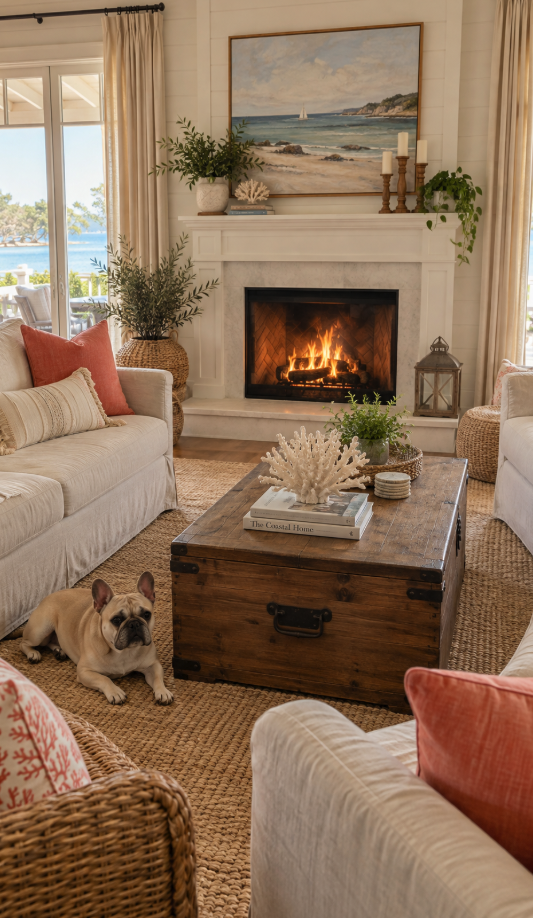
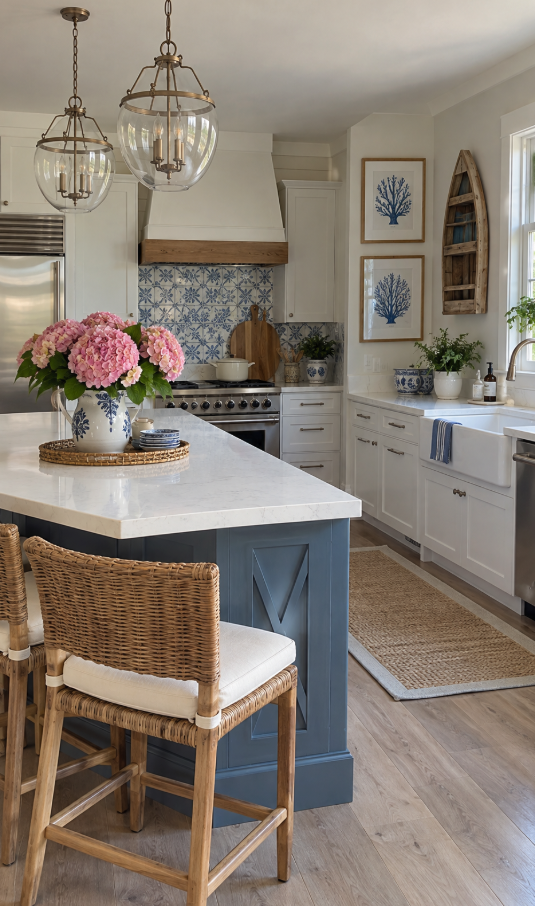
What’s growing instead goes by a few names — quiet coastal, coastal minimalism, or modern coastal. It keeps the light, air, and calm of the original and drops the iconography entirely.
The defining shifts are straightforward:
Palette. Warm neutrals lead now. Sand, oat, bone, and putty carry the room, with muted sage or a soft washed blue used as an accent rather than a base. Cool grays and bright aqua have receded.
Texture over pattern. The coastal feeling in 2026 comes from material, not motif — linen, raw cotton, jute, rattan, unlacquered wood, plaster walls, and slubby weaves that catch light
unevenly.
Restraint in the accessories. One large piece of ceramic beats a shelf of small marine objects. Negative space is doing the work that decorative clutter used to do.
Blurred boundaries. Coastal now overlaps heavily with Japandi, organic modern, and Mediterranean interiors. That crossover is exactly why it’s survived — it stopped being a category and became a texture palette that mixes with other styles.
Why Coastal Has Real Staying Power
There’s a structural reason this style keeps returning while others disappear. Coastal is built on light, natural materials, and low visual noise — three things that don’t depend on a trend cycle. It responds to how people actually want to feel at home, which hasn’t changed in twenty years.
It also has geographic anchoring that trend-driven styles lack. In coastal markets from Florida to the Carolinas to Southern California and the Pacific Northwest, this isn’t a trend at all. It’s regional vernacular, and it holds resale value in those markets specifically because buyers expect it. A beach house furnished in heavy dark traditional pieces feels wrong to buyers in a way that has nothing to do with fashion.
How to Make Coastal Feel Current
If you already have a coastal room and it’s reading dated, you usually don’t need to start over. Three adjustments handle most of it.
Start by warming the palette. Swapping cool gray-blues for warm sand and greige tones does more than any furniture change, and paint is the cheapest lever you have. If a full repaint isn’t realistic, changing the largest textile in the room gets you most of the way there.
Next, remove the literal objects. Pull the anchors, shells, and signage. Replace them with a single sculptural item — a large ceramic vessel, a piece of unframed abstract art in muted tones, or a bowl of something textural. Aim for fewer, larger, quieter pieces.
Finally, upgrade the textiles, because that’s where the softness lives. A washed-linen coastal bedding collection in oat or fog does more for a bedroom than any decorative object, and it works with the mattress and frame you already own.
Is It Worth Investing In Right Now?
For most homeowners, yes — with a caveat about where you spend. Put money into the neutral, textural pieces: the sofa, the bed, the rugs, the window treatments. Those carry across styles and won’t strand you if your taste shifts in four years.
Keep the trend-sensitive elements cheap and swappable. Throw pillows, small art, and accent pieces should be things you can replace without regret. That rule applies to any style, but it matters more with coastal, since the failure mode is almost always over-committing to decorative motifs rather than to the base palette.
Coastal decor isn’t going anywhere in 2026. It just stopped shouting about the beach and started suggesting it instead — and that version is far more likely to still look right in a decade.