







Underground House of the Future reinvents Chinese cave home with 3D printing


University of Hong Kong professors John Lin, Olivier Ottevaere and Lidia Ratoi have worked with students to overhaul an underground house in northern China, suggesting a new future for these traditional dwellings.
Underground House of the Future is a complete rebuild of a house in Zhangbian Township, a village in the Loess Plateau in Henan Province, where people traditionally dig their homes out of the earth.

Their revamped version features complex brick vaults, 3D-printed terraces and a tensile netted canopy, designed to make the building safer, more versatile and more resilient to climate change.
The project was developed in partnership with the local municipality and funded through Project Mingde, a foundation that sits under the University of Hong Kong's civil engineering department.

Similar to Lin and Ratoi's previous project, the Traditional House of the Future, the project began with an open-ended brief to examine how these historic houses are used today and how they might evolve to address current challenges.
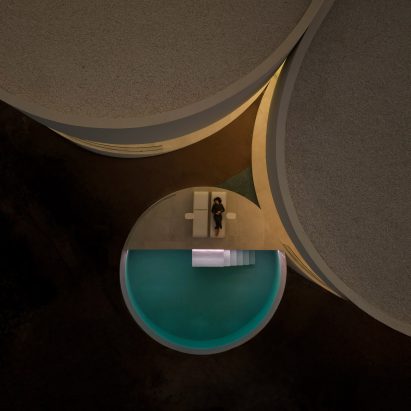
The typical underground house centres around a rectangular courtyard, approximately eight by ten metres, excavated to a depth of six metres.

Arched doorways lead through to rooms tunnelled out from the courtyard on all sides.
The thermal mass of the surrounding earth helps to maintain a stable interior temperature, protecting residents from summer heat and winter frost.
"The underground cave dwellings, or 'dikengyuan', represent an ingenious response to inhabitation in a region historically devoid of timber and other conventional building materials," Lin, Ottevaere and Ratoi said.
"This simple yet spatially sophisticated form maintains the Chinese affinity for courtyard living while leaving the maximum possible amount of land above ground for agriculture – an elegant symmetry between living below and working above," they continued.

In their initial research, the professors found that 80 per cent of the houses in the region were still in use. But more were later abandoned after damage from a major rainstorm in 2021, revealing the threat posed by climate change.
The trio also noted how tourists typically visited the faux cave houses of the nearby Dikengyuan Folk-Custom Cultural Park, described by Ratoi as "like a Disneyland of underground houses".

Their idea was to create "a focal point for generating economic value in the village", which led them to work with local social-media star Miss Zhu.
By introducing climate-adaptive measures to Miss Zhu's home, they transformed it into a space that can host various public and community events, from weddings and funerals to parties or exhibitions.

A team led by robotic fabrication specialist Ratoi addressed the courtyard, using 3D-printing robots to create tiered concrete terraces.
These terraces integrate seating, an earthen kiln for cooking and planters for growing food. Most importantly, they can absorb large volumes of rainwater, reducing the risk of flooding.

A perimeter drainage channel was also added, diverting any excess water to underground storage so that it can later be reused.
"Traditionally, underground houses managed rainwater by tamping soil to direct runoff into a single drainage pit, an approach effective under stable climatic conditions but increasingly overwhelmed by extreme rainfall," explained the team.

The team, led by architect and Rural Urban Framework co-founder Lin, oversaw the reconstruction of the house's interior.
The single-vaulted rooms were replaced with more complex multidirectional vaults, allowing for larger spaces. New vertical voids and skylights were also added, bringing in more daylight from above.
"Construction relied on adaptations of traditional techniques, in which local craftspeople can build complex brick vaults using only a simple curved bamboo branch and string," said the team. "The public rooms extend local construction traditions rather than replacing them."

The third addition taps into designer Ottevaere's expertise in complex geometries, as demonstrated by previous collaborations with Lin, such as The Warp and The Pinch.
A huge net is stretched across steel frames to create a tensile canopy, offering sun shading while preventing anyone from falling over the edge.
The design was carefully planned to allow space for the growth of a new tree, which was installed in the courtyard as part of the project.

"The translucent fabric creates a pattern of shifting light and shadow, transforming the courtyard into a luminous space for communal events," said the team.
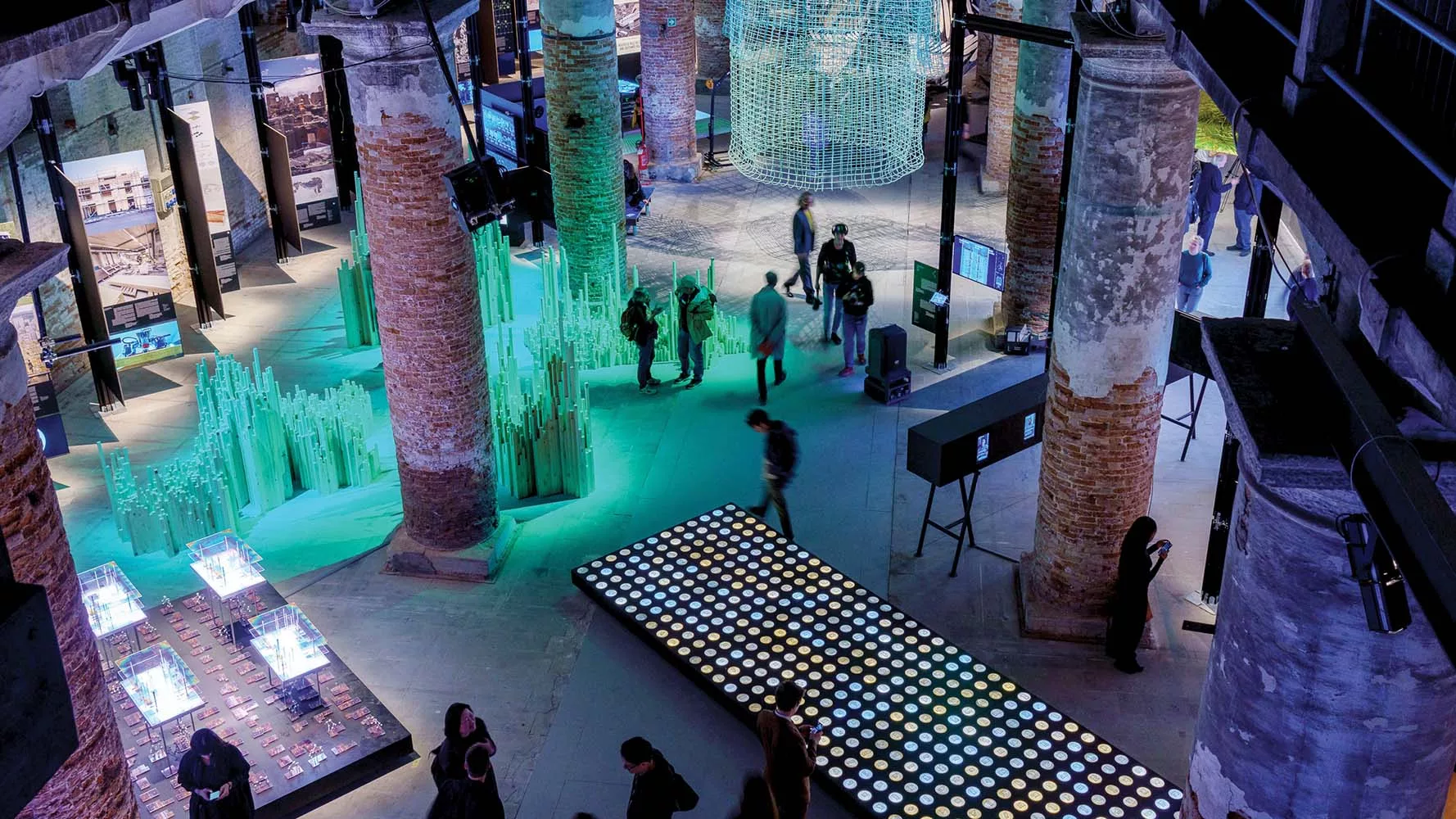
A model of the Underground House of the Future was exhibited as part of Carosello, an exhibition that formed part of the Venice Architecture Biennale 2025 curated by Carlo Ratti.
Project credits:
Design: John Lin, Olivier Ottevaere, Lidia Ratoi
Donor and funding body: Project Mingde Foundation
Project lead: Jenny Hsiao
Project team: Anila Ma, Wilson Wu, Hayden Ng, Jiun-Yu Chang, Yiran Liu and student volunteers from the HKU Department of Architecture, Department of Civil Engineering, and Master of Science in Advanced Architectural Design
Construction: Anhai Liu with local masons and carpenters
Robotic printing: Weiguo Xu, Tsinghua University
Additional funding: Zhu Lin and family,
Lee Hysan Foundation, Special Projects Fund at HKU Department of Architecture
The post Underground House of the Future reinvents Chinese cave home with 3D printing appeared first on Dezeen.