






Ten young designers and studios to watch from Salone Satellite 2026


Textiles composed like music and vessels made with the help of a sensitive robot feature in our round-up of the most exciting emerging designers and studios from Salone Satellite – Milan's annual showcase for under-35s.
When the heaving halls of furniture fair Salone del Mobile get overwhelming, Salone Satellite provides a retreat, bursting with innovative ideas and aesthetics – some of which are a few years away from featuring on the main floor, others refreshingly non-commercial.
Here, Dezeeen's contributing editor Rima Sabina Aouf chooses ten of the many talents who made an impression this year, with objects ranging from delicately glowing lamps to monster stools.

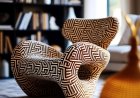
Aya Kawabata's textiles are extraordinary. Each tapestry she showed at Salone was produced with just five thread colours but contains multitudes, built up through complex arrangements of pattern and structure and developed through extensive experimentation.
The designs read like an endlessly inventive fusion of psychedelia, constructivism, folk art and cyberpunk. A classically trained musician, Kawabata says she composes them like she composes music, responding to rhythm, structure and temporality.

Horse hair and 3D printing rarely meet, but they are juxtaposed in the work of Aiko Design founder Nicolás Romero. 3D-printed in high definition from translucent PLA, his totemic Númina floor lamp has a beautiful, complex texture – one inspired by the indigenous Chilean crafts of horesehair weaving and wicker production.
A runner-up in the SaloneSatellite Award, Romero was one of several inspiring young designers at the fair giving new warmth to 3D-printed objects and using his skills to centre ancestral traditions.

Chinese designer Dong Liu's objects look humble but deconstruct industrial processes in interesting ways. At first glance, nothing more than a conical paper shade atop a pile of sticks, his TG-01 lamp is all about the internal connector system, which allows anyone to DIY their own version using collected branches of almost any size.
His Un-Controlled candle, meanwhile, is constructed drip by drip using a specially designed machine that rotates to catch droplets of wax from above, creating a unique form every time. The objects are thoughtful and sometimes even amusing – a Milan rarity.

Third place-getter in the SaloneSatellite Award, German studio Jüngerkühn is another example showing young designers trying to bring the beauty of unpredictability to digital fabrication. Their Soft Touch research project involved the building of a custom machine that carves digitally produced patterns into porcelain, scraping and cutting away to produce a unique vessel.
The machine's two-axis robot arm is designed to "feel" the object's surface and react to it similarly to how a craftsperson would, producing line work that is detailed but irregular. The aesthetic is not quite human, not quite robot, and fully mesmerising.

Invalid Syntax/Federico Zorrozua Gonzalez
Argentinian architect Federico Zorrozua González describes his independent practice Invalid Syntax as an experimentation platform built on "error, the improbable and the grotesque".
That translates to projects such as the Invalid Wall, a lightweight, low-cost and mobile room divider system built for the age of housing crisis, where people have to move often and adapt one-room spaces for multiple functions. His display at Salone Satellite included Invalid OS, a computer programme he had developed to explain his work on his behalf.

If the pieces at Salone's new collectible furniture mini fair Raritas struck you as a little same old same old, try Korean artist and designer Popcorny Unicorny, aka Hanee Shin. Pop art meets Korean folklore in her fantastical works, which combine sculpted wood, technicolour paintwork and unexpected materials such as socks and discarded work gloves.
The Dokkaebi Butts stool represents the ogre-like Korean mythological creature the dokkaebi, while the Ho Table series features enormous tiger feet forged from charred wood salvaged from wildfire-damaged forests.

Danish studio Russo Betak took first prize in the SaloneSatellite Award with one of the pieces in its Ark lighting collection – another focused on bringing softness and warmth to 3D printing.
Unusually, the designers don't use 3D printing to produce fully formed objects; instead, they print their biomaterial – made from seashells discarded from restaurants – into flat sheets and sculpt these by hand in the short period before they cool and harden.
The technique may seem counterintuitive, but the results are elegant and masterful, harking back to bent and moulded plywood.

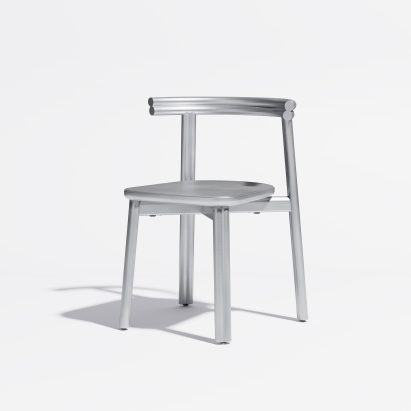
The Line chair and TriCo side table and stool by Japanese designer Masaya Kawamoto are peak minimalism. Made of thin sheet metal, they are strong but so visually light you almost dare not sit on them, and so harmonious in their balance of straight lines and gentle curves and tapers that you instinctively feel at peace.
Both items are made from just a few elements that interlock without fixings and can be disassembled, making them efficient to mass-produce and transport.

It's easy to imagine furniture and homeware brands falling over themselves to work with London- and Düsseldorf-based Nikola & Florian. They have an ease and versatility with their Scandi cool aesthetic, and their pieces involve flatpack and sustainable construction methods without adhesives or permanent fixings.
A favourite piece is their Rila vase, made in bright pops of borosilicate glass and presenting a novel way to style flowers.

Salone del Mobile got its own Marina Abramović moment with Japanese designer Takuma Yamazaki, who sat perfectly still for hours to complete his Bio-Vide chair. This furniture-performance fusion is just one facet of Yamazaki's 10-year-long research project, which has focused on trying to understand animacy – or the moment when objects acquire a sense of life.
Yamazaki's material experiments have seen him work with cow bone, hide and rhythmically inflated balloons to see what humans consider to be living. At a time when more designers are exploring our species' connection to other living beings, this is an interesting flip side of the coin.
SaloneSatellite was on from 21 to 26 April at Salone del Mobile, Fiera Milano, Rho. See Dezeen Events Guide for more architecture and design events around the world.
The post Ten young designers and studios to watch from Salone Satellite 2026 appeared first on Dezeen.