






Soviet-era architecture informs Kazakhstan cafe by AT Interiors


Bespoke furniture and details, including a colourful swan mosaic, help to evoke the atmosphere of a 1960s pavilion that previously occupied the site of this cafe in Almaty, Kazakhstan, designed by local firm AT Interiors.
The project to revive the Aqqu Central Cafe in Manshuk Mametova Park was initiated following a presidential directive aimed at restoring Almaty's historical identity by recreating some of its 1960s modernist buildings.

The original cafe was a popular meeting place for locals, who associated it with a pair of swans that lived in the adjacent ponds and gave the site its name, since aqqu means white swan in Kazakh.
AT Interiors aimed to translate the spirit of the original open-air kiosk, which was destroyed by fire in 1995, into a year-round restaurant that retains the atmosphere of its predecessor.

"Given the project's deep social significance, we felt a profound responsibility to honour the collective memory of Almaty," architects Alyona Krasatulina and Vladislav Churikov told Dezeen.
"To achieve this, we conducted extensive archival research, seeking to strike a delicate balance between nostalgic continuity and the standards of modern global design."

To replicate the 1960s pavilion's lightness and connection to the surrounding park, AT Interiors created a lightweight steel-and-glass structure with fully glazed facades that wrap around the perimeter.
The building follows a similar triangular footprint to its predecessor. But instead of the original constructivist geometry and sharp lines, the architects opted for a softer, more contoured shape.

The 650-square-metre ground floor is designed to be as open as possible to maintain views in all directions. The kitchen is accommodated within a large basement to minimise the need for internal walls or partitions in the dining space.
The project's conceptual starting point is a vibrant swan mosaic by local artist Anastasia Zharko, which features a palette of blue, yellow, red and burgundy that is carried through the interior.

The architects used the city's vintage photographs to inform the decor, which includes elements sourced from local flea markets and brands known for their replicas of classic modernist designs.
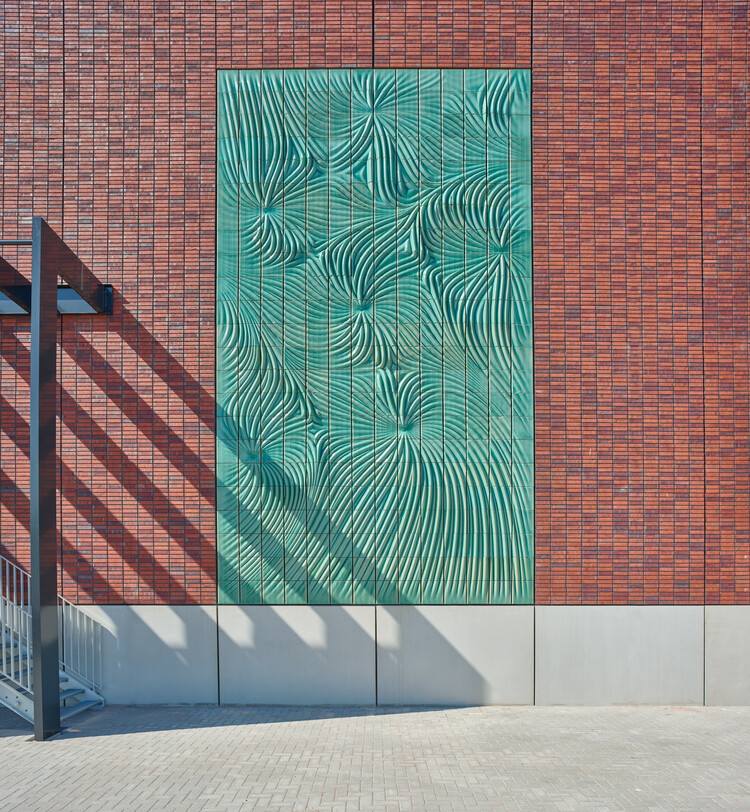
The material palette predominantly comprises natural oak veneer and handcrafted ceramic panels by local studio Faski. The geometric panels used for the reception desk and bar were informed by the concrete balconies of Almaty's Soviet-era housing blocks.
AT Interiors opted for iconic lighting design such as Verner Panton's Flowerpot pendant lamps and the P376 pendants by Kastholm & Fabricius to lend the space an authentic 1960s feel.
Churikov designed key components, including armchairs, coffee tables, metal blinds and shelving, which are complemented by furniture from local brands such as Jana Cara and Qaragash Furniture.

"Aqqu Central Cafe confirms the success of architecture rooted in respect for history," the studio said.
"The project demonstrates how lost heritage can be recovered through a painstaking search of archival data by uniting global design trends with the unique cultural code of old Almaty."
Other projects recently completed in Almaty include Asif Khan's transformation of a Soviet-era cinema into a cultural centre, as well as a cafe and wine bar featuring bespoke stained-glass windows.
The photography is courtesy of AT Interiors.
The post Soviet-era architecture informs Kazakhstan cafe by AT Interiors appeared first on Dezeen.