

















Sanjay Puri Architects references stepped wells for Indian university


"An open auditorium" formed of stepped terraces crowns this sprawling brick-clad university building in Indore, revealed here exclusively by Indian studio Sanjay Puri Architects.
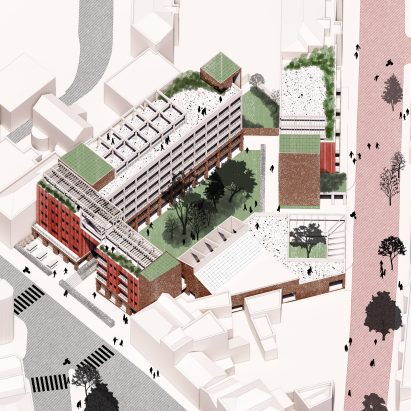
Located on the growing 13-hectare campus of Prestige University in the state of Madhya Pradesh, the five-story building contains offices, seminar halls, an auditorium, a library and a cafe.

Its defining feature is its 9,000-square-metre walkable roof, which comprises 463 stepped platforms that can be used as individual social spaces or as a singular auditorium for up to 9,000 people. Four terraces are accessible by wheelchair hoist.
According to Sanjay Puri Architects, its design was modelled on ancient stepped wells in India, which it said "were spaces not just built to store water but large social interaction spaces bringing the community together".

"Since this entire campus will provide education for over 3,000 students when completely built, we envisaged the entire stepped rooftop to be used as an open auditorium housing all the students together," studio founder Sanjay Puri told Dezeen.
"In addition, these terraces act as spaces for social interaction, studying and relaxing. The college has already held multiple functions on these terraces, including flag hoisting on Independence Day, open lectures and games."

The 30,800-square-metre building steps up diagonally from its northern point, reaching a height of 28 metres. At its base is a shallow pool, designed to help passively cool the building.
While providing events and meeting spaces, the stepped design of the building was intended to reduce the visual impact of its expansive volume, which is deliberately low-lying to minimise the amount of mechanical vertical circulation required.

The roofscape is punctured by courtyards, which draw light and ventilation deep into the plan, with the help of a diagonal "indoor street" that runs the length of the ground floor.
According to the studio, this derives "from traditional Indian architecture", which often has minimal dependence on artificial lighting and air conditioning.
The main structure of the building is formed of concrete and fly ash bricks, enveloped with clay brick cladding. The elevations also feature decorative perforated screens, formed from glass fibre-reinforced concrete screens and used to provide additional ventilation.
Inside, floors are lined with Indian sandstone while the concrete structure was left exposed.

Shared spaces, including the 700-seat cafe and indoor auditorium, are located on the ground floor alongside the university's administrative offices and the courtyards, which are open for recreational activities.
The large library sits on the first floor, featuring a bridge that spans the "street" below, while the 45 classrooms occupy the second and third floors. The top floor contains all the faculty-related administrative facilities.

Puri co-founded his studio with Nina Puri in Mumbai in 1992. Its other recent projects include a 12-storey residential building in Maharashtra wrapped in curved screens and the spiral-shaped Nokha Village Community Centre in Rajasthan.
Other landmark buildings recently completed in India include the Minerva Tower, the country's tallest completed building, designed by Mumbai firm Architect Hafeez Contractor.
The photography is by Vinay Panjwani.
Project credits:
Architect: Sanjay Puri Architects
Lead architects: Sanjay Puri, Ruchika Gupta, Madhavi Belsare
Design team: Manveer Chopra, Devendra Dugad, Arjun Gupta, Bijal Bhayani
Structural consultant: Pyramid Consultants
MEP consultant: SEED Engineering Consultants
Landscape consultant: Envision Landscape Consultants
Facade GFRC work: Everest Composite
Client: Prestige Education Society
The post Sanjay Puri Architects references stepped wells for Indian university appeared first on Dezeen.