





























Imago audio player lights a path for ethical AI use in music


Central Saint Martins graduates Domenico di Paolo and Kieran Feechan have created a novel listening device in the form of Imago, which turns a critical eye on the use of AI in music.
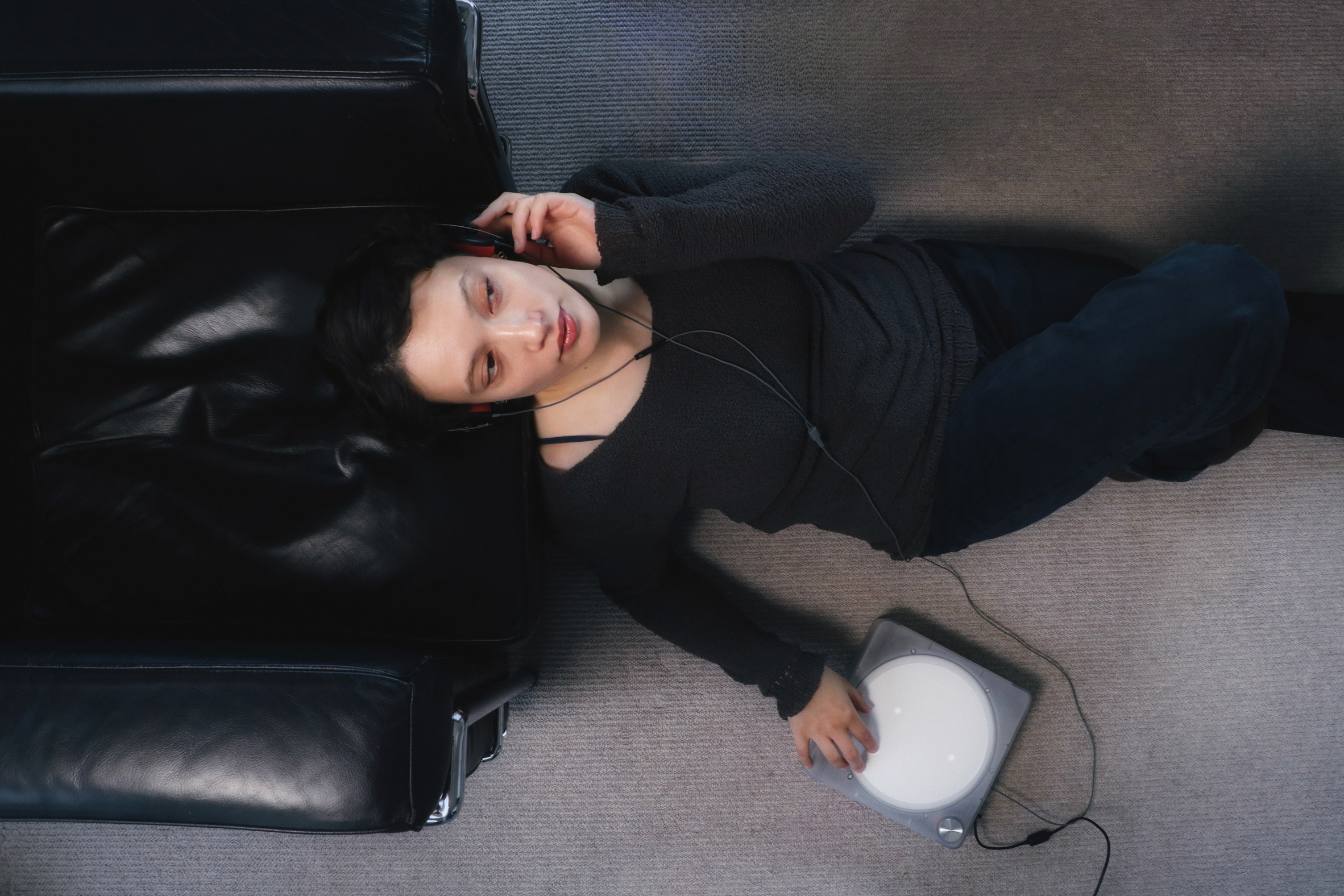
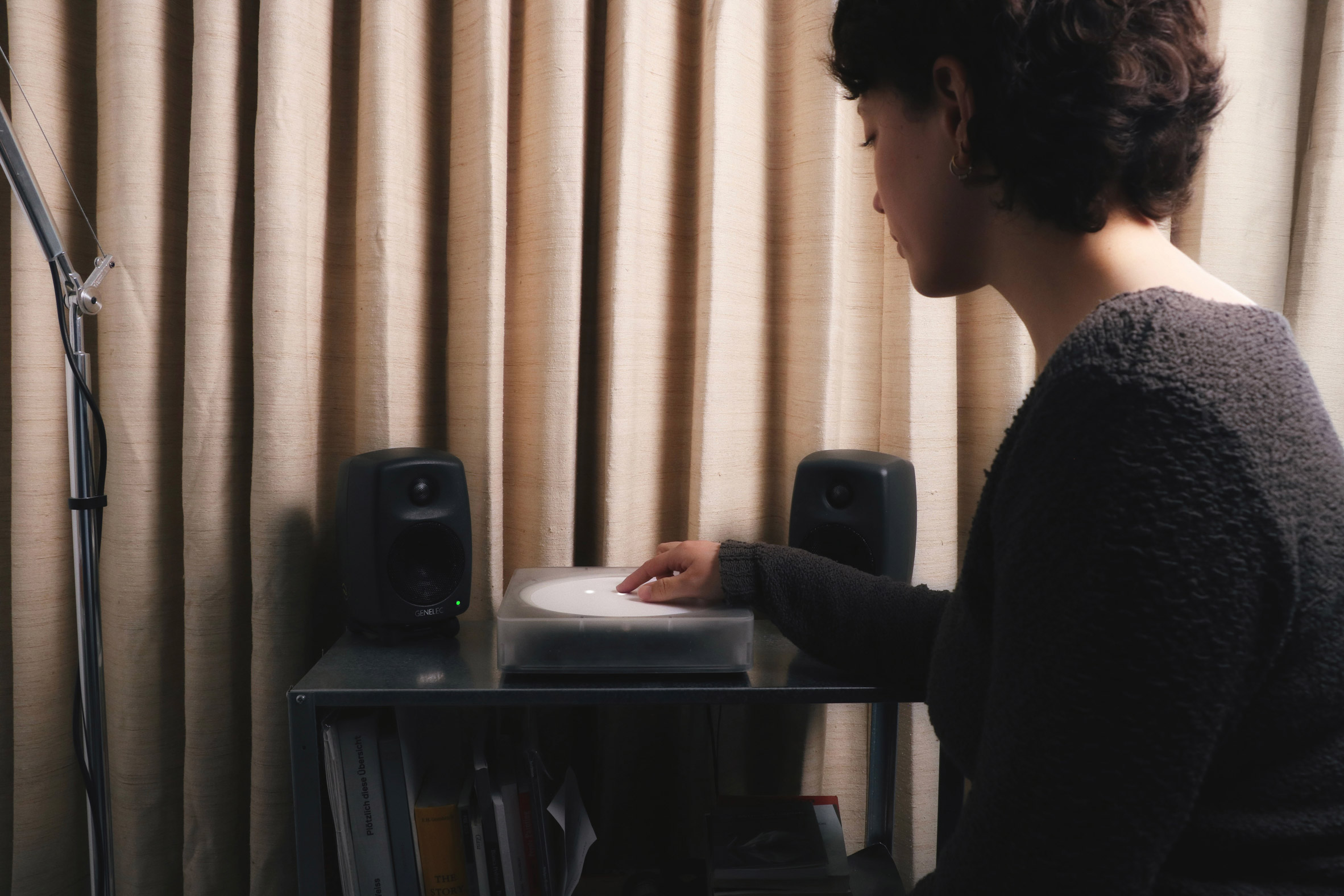
Looking a bit like a crystalline record player, Imago presents listeners with a circular touchscreen lit up with three glowing dots that they can slide around with their fingers to modify a composition.
Feechan and di Paolo think of Imago as a cross between a "deep listening device" and a synthesiser. It lets listeners explore a unique soundscape carefully curated by a particular recording artist and activated through an AI machine learning model.
Imago is a device designed for deep listening
The idea is that the musician and listener ultimately create a real-time composition together, with the listener's simple finger input triggering an evolving piece of music governed by carefully crafted rules, similar to the outcome of Brian Eno's pioneering Bloom project with software developer Peter Chilvers.
For the artists recording music to be played on the device, it represents a whole new way of working that lets them explore artificial intelligence as a co-creation tool while retaining control over their data.
Instead of creating a single static recording, these musicians put together a highly personal audio dataset of recordings such as single instruments, a person singing or electronic sounds. This is fed into Imago's machine learning model, which is also personalised to them.
No scraped data is used, and all of the processing takes place offline, on the device, using minimal energy so artists can avoid sharing their work with technology companies.
Feechan and di Paolo worked closely with the French experimental sound lab IRCAM, attached to the Centre Pompidou, which developed the machine learning model specifically for the project.
They also worked with four artists who created their own datasets. Among them were French electronic producers Canblaster and Molécule, who built their sets from synthesiser recordings, and British composer Robert Laidlow, who worked with a library of 1940s BBC Philharmonic Orchestra recordings that he owns.
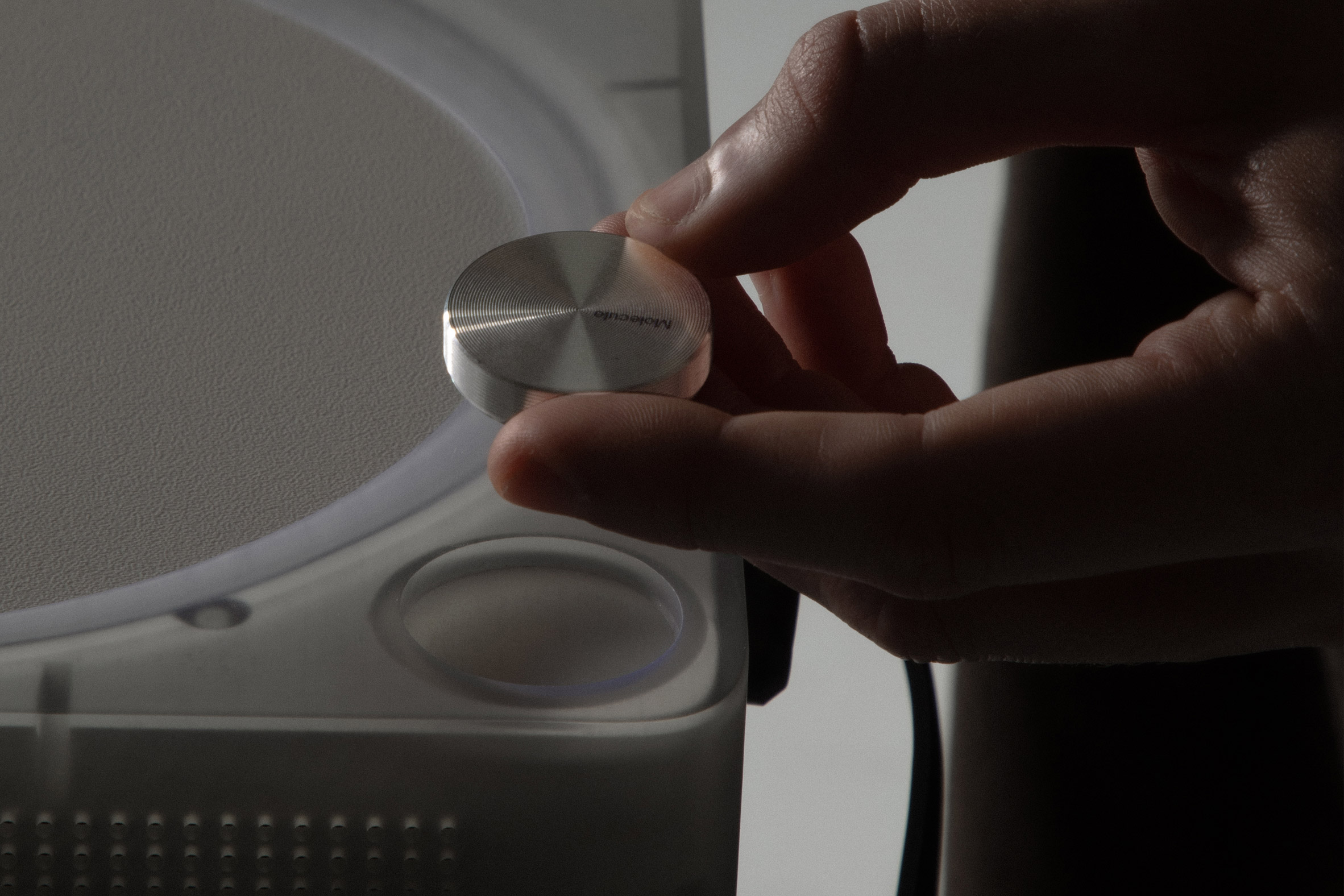
Each of these datasets is housed and encrypted on a physical object – a small, NFC-equipped metal "puck" that the listener places in a slot on the corner of the Imago device to start the music, as if loading a record, tape or CD.
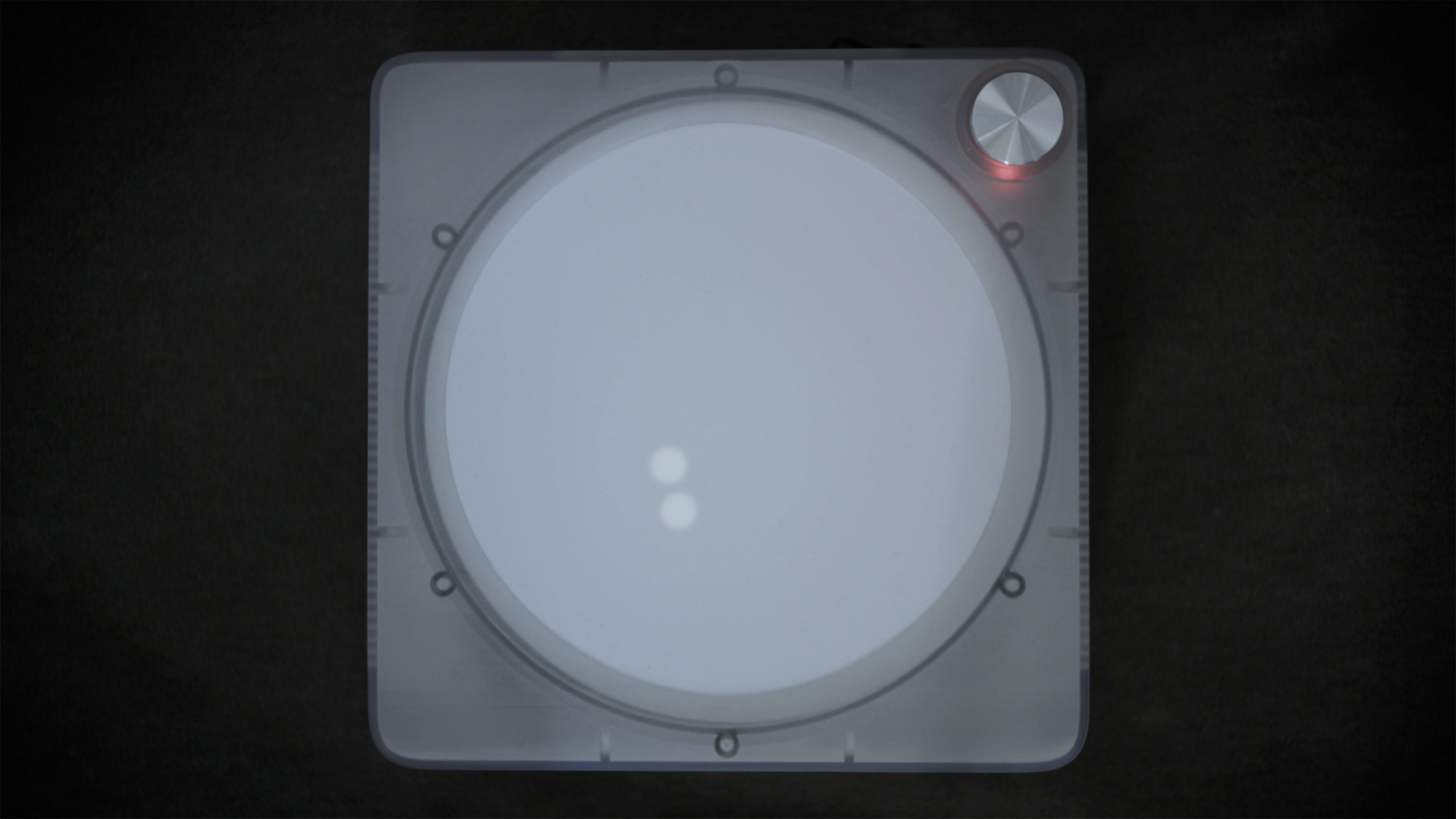
When they drag their finger across the touchscreen and reposition the dots, the listener is effectively exploring a multidimensional map of the artist's sound – what is technically termed the model's "latent space".
"Each dot represents one of three generative voices within the composition," Feechan told Dezeen. "Each one is producing sound independently, but together they form a single piece of music."
Three dots is the default, but listeners can also double tap a dot to go down to two or one.
"When you move a dot around the screen, you're changing the character of that voice - its texture, warmth, and density," he continued. "Move it to one area and it might sound bright and granular. Move it elsewhere and it deepens, becomes more resonant."
"At the same time, the position of each dot is also influencing the compositional rules – how that voice behaves over time, what rhythmic or melodic decisions it makes," Feechan added.
The machine learning model disentangles the timbre of the audio from its structure, introducing a high degree of creative control for both artist and listener.
"The composition you hear at any given moment is the product of where all three [dots] sit in relation to each other," Feechan continued.
Artists can incorporate their own compositional rules around aspects such as melody, rhythm and phrasing during the training stage, further personalising their model.
While the architecture behind the sound is complex, Feechan and di Paolo aimed for the listening experience of Imago to be simple enough for anyone to enjoy.
"The intention is that you navigate by ear, not by eye. You listen, you move, you respond to what you hear," said Feechan. "That's the act of deep listening we're trying to encourage."

Imago's compositions cannot be recorded, stored or repeated – they exist only in the moment the listener hears them.
In positing dataset creation as an artistic act, keeping infrastructure local and transparent, and giving musicians sovereignty over technology, Feechan and di Paolo aim to critique the status quo of generative AI in music today.
"In most commercial AI music systems, as is well documented, the training data is scraped without consent from millions of artists whose work is then used to compete directly against them," said Feechan.
"In ours, every sound the model has ever heard was recorded, curated, and fully owned by a single musician who chose to be involved," he continued. "The artist retains complete control. Nothing is transmitted. Nothing leaves the device. That's not a subtle difference – it's a fundamentally different relationship between artist and technology."
"We believe these technologies carry genuine creative potential for artists, but that potential remains locked until the ethical foundations are corrected."
Feechan and di Paolo created Imago as part of their graduate degree in industrial design at London's Central Saint Martins. Last year, fellow graduate Max Park also created a critical AI-based work called Prompting Nowhere, reimagining the technology through the eyes of Arts and Crafts pioneer William Morris.
The post Imago audio player lights a path for ethical AI use in music appeared first on Dezeen.