








Goldstein Heather doubles London home's footprint with four-storey extension


Architecture studio Goldstein Heather has transformed a Victorian terrace house in London, adding a four-storey extension with arched openings and a sculptural timber staircase.
Named West London House, the home in Stamford Brook was overhauled by Goldstein Heather to expand and reorganise what the studio described as a "disjointed scissor-like layout" and better accommodate the client, a couple with three children.

"Although the original house was already an imposing, end-of-terrace house, because of its comparative narrowness, our clients always felt somewhat constrained," studio co-founder Giles Heather told Dezeen.
"They craved a feeling of openness that allowed for connection between members of the family, but without crowding each other," said Heather.

The four-storey extension occupies the site of a 1930s army centre, which sat adjacent to the original property and was acquired by the client when it came on the market.
This former army building was subsequently demolished to make space for the 244-square-metre lateral extension, doubling the home's footprint to 500 square metres.

Externally, the extension was designed to mirror the original facade in "near symmetry", which is intended to unify the Victorian facades with the contemporary elevations.
The two sides of the house have separate front entrances and internal staircases, allowing them to remain distinct whilst being connected across all four storeys.

The original home's Victorian facade has been restored, with layers of paint removed and brickwork repaired. Inside, suspended ceilings have been removed to unveil original mouldings.
To remain in keeping with the local style, the studio opted for a pale yellow brick facade with a concrete render for the extension, with a zigzagging facade on the top floor to add visual interest.

At the heart of the extension is a light-filled ground-floor living space comprising an open-plan kitchen and double-height dining area.
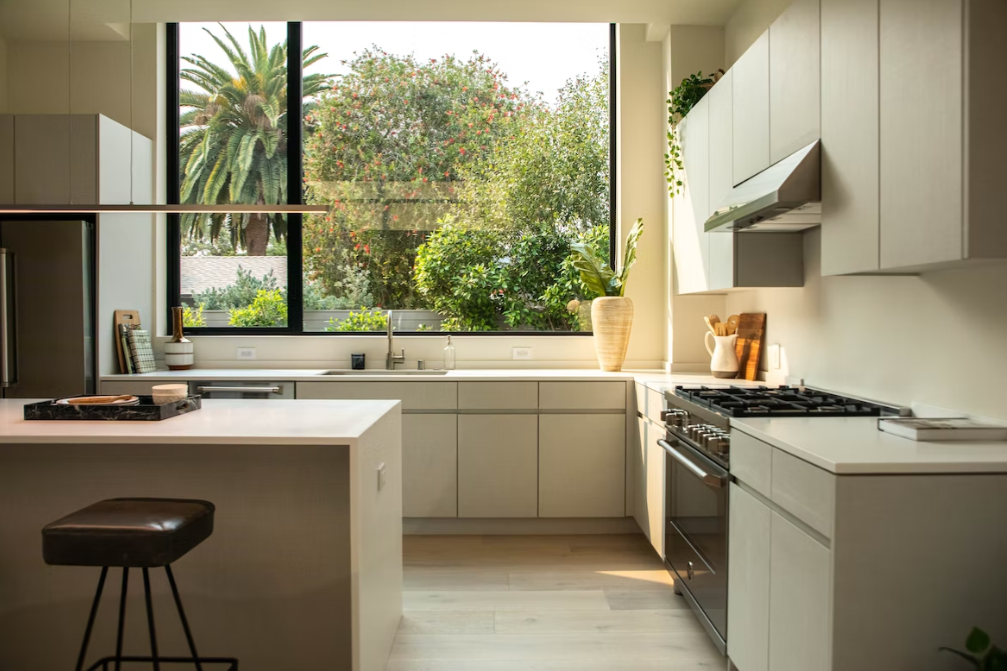
Developed alongside designer Sebastian Cox, the kitchen features bespoke ash joinery and cabinetry, alongside a long marble island with green veining. Pendant lights commissioned by the client hang above.
Taking advantage of the site's east-west orientation and unobstructed position next to a park, a double-height void is used to draw natural light into the space.
The former kitchen-dining space at the front of the original house, which lacked natural light and garden access, has been converted into a study.

Marking the transition from the kitchen to the dining space is a series of wide arched openings that punctuate the pale textured walls.
Geometric half-moon-shaped windows offer glimpses of surrounding trees in the rear garden.

"Columns keep spaces open but distinct – round arches are grand in one sense, but also restful, calm and resolved," described Heather. "They also play wonderfully with light."
"The goal for the interior design was to create a restful, spacious, light-filled and open space," added Heather. "The material palette was tightly controlled tonally, but we often looked to soften definite edges through natural textures."

Overlooking the kitchen-dining space below, a mezzanine seating area is framed by a curving timber balustrade.
A sculptural Douglas fir staircase links the four floors of the extension, with stairs and landings progressively widening towards the upper levels.

Responding to the brief for both privacy and connection within the home, the second floor was designed as an interconnected suite for the three children, spanning both old and new sides of the house.
On the third floor is the main bedroom, complete with a dressing room and a balcony that makes use of a former box room from the original plan.
Goldstein Heather is a London-based architecture and design studio founded by Heather and Simon Goldstein.
Other London home extensions recently featured on Dezeen include a residence with a pavilion-like addition by Emil Eve Architects and a loft revamp in Walthamstow by Office S&M that explores "how far cork can go".
The photography is by James Retief.
Project credits:
Architect: Goldstein Heather
Planning consultant: Maddox Planning
Structural engineer: Float Structures
Quantity surveyor: Metrum Consulting LLP
Main contractor: IC&T
The post Goldstein Heather doubles London home's footprint with four-storey extension appeared first on Dezeen.