







ARO transforms Green-Wood Cemetery greenhouse in New York into welcome centre


New York architecture studio ARO has restored a historic greenhouse at the storied Green-Wood Cemetery in Brooklyn, surrounding the structure with a new welcome centre and entrance courtyard.
ARO transformed the corner site adjacent to the still-active 19th-century Green-Wood Cemetery, which is an early example of American rural cemeteries with arborous, rolling grounds, to support its expanded operations.

The greenhouse was constructed in the late 19th century and once served as a flower shop servicing the cemetery, before falling into disrepair. The cemetery administration purchased it and decided to consolidate its scattered welcome programmes into the site.
Green-Wood Cemetery's senior vice president of development, Lisa Alpert, said the building was meant to be as "much for the living as for the dead".

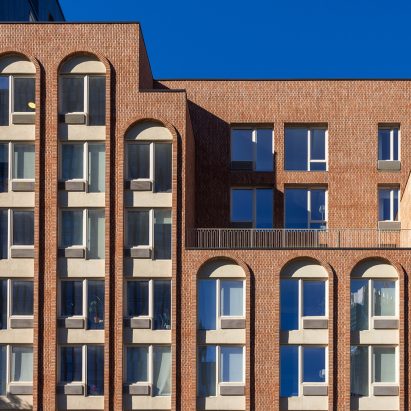
Two primary moves characterise the project – a renovation of the historic greenhouse and the construction of a burgundy-coloured building to accommodate welcome spaces, historical programming, archives and administrative offices.
To do this, ARO created an L-shaped structure that wraps around the greenhouse and orients the building's viewpoints towards the arched gateway at the top of the cemetery's hilled drive.

The greenhouse was painted green, while the new building features burgundy cladding, a colour chosen to reference the brownstone arched gateway.
ARO principal Kim Yao said that the design meant to represent the cemetery "reaching out into the neighbourhood" and called the greenhouse a "jewel" on the corner.

Part of this "reaching out" also included landscaping around the structure, which visually extends the cemetery's greenery, such as in the entry courtyard between the greenhouse and the burgundy building. The landscaping was designed by New York studio Michael Van Valkenburgh Associates.
The entry courtyard brings visitors to a lobby that connects directly to the restored greenhouse.
Here, ARO added acoustic panelling and radiant heating, replacing the brick floor and some of the panes, though the load on the delicate steel structure had to be kept very light.

This renewed space frames more views of the cemetery beyond. On the other side, the lobby connects to an open gallery space with stone floors and large panes of glass, through which the articulated brise-soleil is visible, as is the greenhouse structure.
Upstairs, the office programme was left open-plan, looking out towards the east.
"That view is something we talked about from day one, consistently, as very important," said Yao. "We're always being centered around the greenhouse."
From the office space, visitors can see the landscaped roof of the portion of the new build that sits lower, which was topped with mounds and rocks resembling burial grounds.

ARO, known fully as Architecture Research Office, was founded in 1993 in New York.
Maintaining historic structures amid Brooklyn's 21st-century redevelopment has occupied architects in recent years.
Northwest of the cemetery, Herzog & de Meuron recently converted a historic power station into an arts complex. On the other side of the borough, in Bushwick, Bench Architecture converted a steel mill into a high-end coworking space, members club and spa.
The photography is by Rafael Gamo.
Project credits:
Architect: ARO
Owner's representative: About the Work
Structural engineering: TYLin
Landscape architecture: Michael Van Valkenburgh Associates
MEP/FP engineering: Altieri
Lighting Design: Tillotson Design Associates
Acoustics: Threshold Acoustics
LEED consulting: Encompass Energy & Code Green
Façade consultant: Heintges
Civil engineering: AKRF
Code: JS Consulting Engineers
Expediting: RPO
Cost estimating: Stuart-Lynn (additional estimating and cost consulting performed by Hunter Roberts Construction Group)
Envelope: Simpson Gumpertz & Heger
Greenhouse analysis: Atelier Ten (performed in pre-design)
Construction manager: Hunter Roberts Construction Group
The post ARO transforms Green-Wood Cemetery greenhouse in New York into welcome centre appeared first on Dezeen.