










"The relationship between architecture and capitalism on which parametricism was premised ceased to exist long ago"


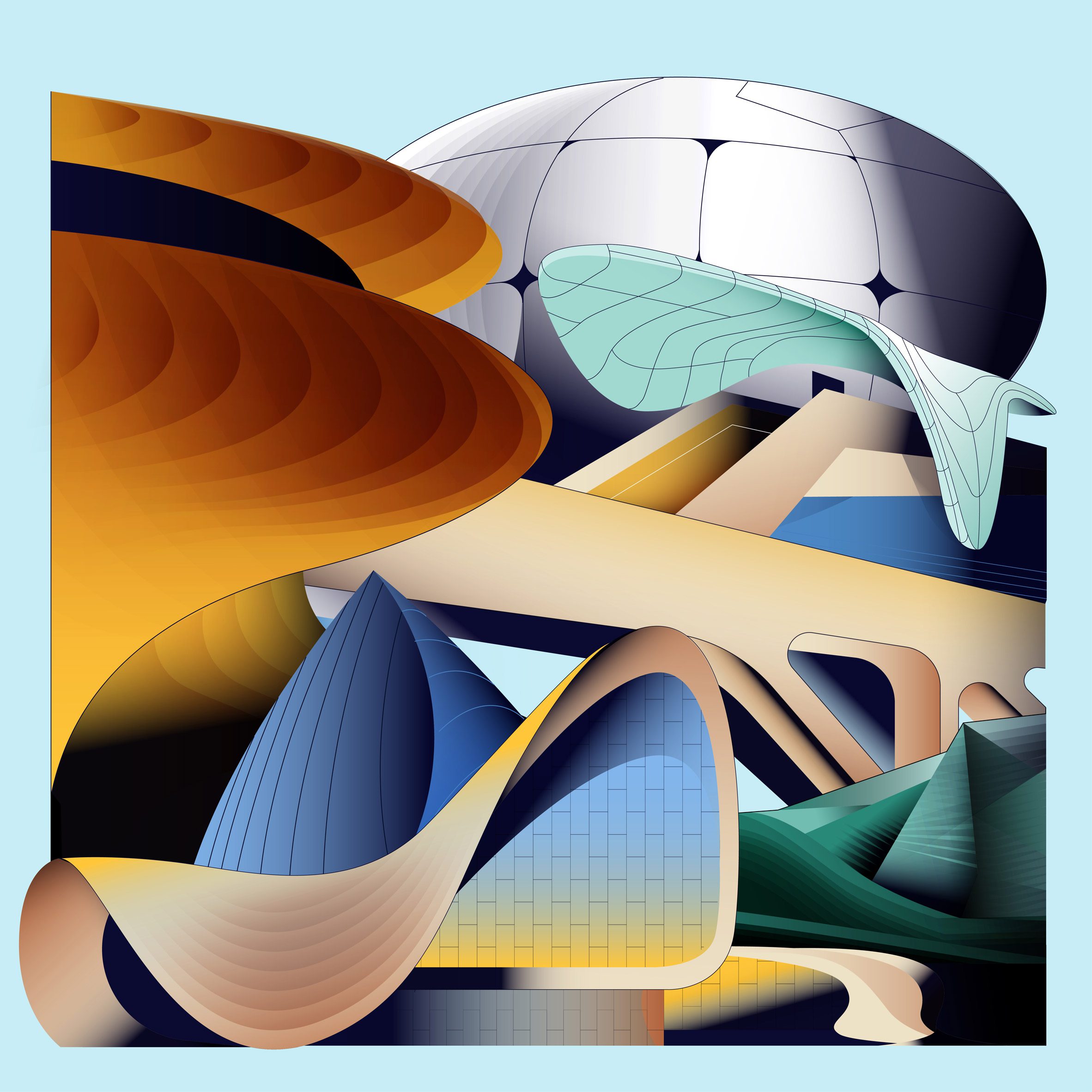
Parametricism can never become a dominant architecture style now that the forces of capitalism are no longer interested in the lives of the masses, writes Douglas Spencer.
Parametricism was to be "the great new style after modernism". Patrik Schumacher had announced it as such in 2008, in his Parametricist Manifesto, presented at that year's Venice Architecture Biennale.
Postmodernism and deconstructivism, he declared, had been mere transitional episodes in the history of the avant-garde. Pitstops on the road to parametricism, whose arrival marked a "new, long wave of research and innovation".
The fault in Schumacher's manifesto is that it doesn't do full justice to the significance of his own argument
From the vantage point of the present, it might be tempting to be equally dismissive of parametricism. Less a long wave, more a brief burst of misplaced enthusiasm. But the fault in Schumacher's manifesto – however improbably – is that it doesn't do full justice to the significance of his own argument.
By positioning parametricism within the avant-garde, Schumacher situates it within a lineage where formal experimentation is understood and valued as an end in itself. But his manifesto actually makes an about-turn from the idea of architectural autonomy, breaking ranks with the practices with which he is seeking affiliation.
The archetypal figures of the avant-garde, like Peter Eisenman, Rem Koolhaas, or even Schumacher's partner in practice, Zaha Hadid, might conjure up novelties by toying with architecture's formal repertoire, or ransacking its history for inspiration, but Schumacher takes his bearings from outside the discipline. He legitimises parametricism in relation to contemporary conditions of capitalist development, arguing the relevance of the style with reference to the social and economic ends to which it can be turned. Schumacher, in this sense at least, is in fact a late modernist.
Despite their apparent interchangeability, the terms "modernism" and "avant-garde" are not exactly equivalent. The distinctions between the two are especially critical in architecture. Where modernist architects sought to align the discipline to modern industry and metropolitan life, "avant-garde" is largely a label of self-legitimation, used to indicate distance from and disdain for the ordinary and the commercial.
Earlier 20th-century movements from very specific contexts – the Italian Futurists or the Soviet Constructivists, for instance – were retrospectively identified under the catch-all of the avant-garde in the later 20th-century. Architects and critics thereby fashioned for themselves an origin story that would lend substance to their own endeavours.
Such were the means by which certain late-20th century architects, typically tied to elite institutions, built their reputations. The New York Museum of Modern Art's 1988 exhibition Deconstructivist Architecture, curated by Philip Johnson and Mark Wigley, and featuring the work of Hadid, Frank Gehry, Wolf Prix, Koolhaas, Eisenman, Daniel Libeskind and Bernard Tschumi, exemplifies this self-promotional tendency.
Schumacher's description of parametricism as a "style" falls short of capturing the distinctly programmatic essence of his own project
Schumacher's description of parametricism as a "style" is unhelpful in this regard, suggesting a misplaced kinship with the self-designated architectural avant-garde. While apt to describe the work of Hadid, it falls short of capturing the distinctly programmatic essence of his own project.
Schumacher argues for parametricism in modernist and not avant-garde terms, advocating for the correlations between architecture's formal and technological advances and those of capitalism in its contemporary manifestations. What modernism was for the preceding era of Fordism, the welfare state, urban planning, and social reform, parametricism was to be for post-Fordism and neoliberalism.
What was for Le Corbusier in the 1920s a choice between "architecture or revolution" is for Schumacher, in the 21st century, a choice between architecture and stagflation. If capitalism, in its efforts to revive falling rates of profit, was to seek out flexible, networked and entrepreneurial means of accumulation, then a parametricist architecture would provide for their spatial articulation.
"Architecture," Schumacher argues in his manifesto, "finds itself at the mid-point of an ongoing cycle of innovative adaptation – retooling the discipline and adapting the architectural and urban environment to the socio-economic era of post-Fordism." On this basis, he takes it upon himself to "develop an architectural and urban repertoire that is geared up to create complex, polycentric urban and architectural fields which are densely layered and continuously differentiated."
In an essay written in 1990 for the Yale School of Architecture's journal Perspecta, the Marxist geographer David Harvey identified the process of urbanisation as an essential element of post-Fordist strategies of "flexible accumulation". He argued that capital, having relocated and globally dispersed industry from its traditional urban locations, had now remade the city as a site of accumulation by other means.
Modernist monumentality and its sense of permanence, argued Harvey, had "been challenged by an 'official' post-modernist style that explores the architecture of festival and spectacle, with its sense of the ephemeral, of display, and of transitory but participatory pleasure." Image-focused and self-referential, post-modern architecture was found by Harvey to be an ideal architectural accompaniment to the intensified fetishisation of the commodity and the city alike.
The work of ZHA, then and since, largely comprises the regular staples of urban commodification
Schumacher, having read Harvey, took the latter's critique of post-Fordism as a prescription for practice. Unlike postmodernism, however, parametricism would not be a mirror of post-Fordist production, but an instrument of its organisational apparatus.
Formal experimentation in architecture would be laboratory-like and put to work in the service of ends outside of architecture itself. Parametricism would address itself to the organisational complexities of large corporations, the networked conditions of neoliberalism, and the entrepreneurial imperatives reshaping the process of urbanisation. It would "create complex, polycentric urban and architectural fields which are densely layered and continuously differentiated".
This was an ambitious project, Schumacher attempting to triangulate the formal capacities of computational design, new managerial strategies in the workplace, and abstract philsophical conceptions of folding and smoothness from the philosophy of Gilles Deleuze and Félix Guattari. An indication of what this might look like when applied at the scale of the city can be grasped from the images produced by Zaha Hadid Architects (ZHA) for their unrealised project of a masterplan for the Kartal district of Istanbul in 2006. The urban fabric of the city appears as if subjected to some unseen field of forces, pulling its warp and weft out of their rectilinear arrangements.
In practice, parametricism could not achieve this operational scale. The work of ZHA, then and since, largely comprises the regular staples of urban commodification – galleries, museums, pavilions and concert halls – and luxury-end residential projects to which the practice's facility with form lends a readily monetisable sheen of elegance.
Some suggestion of parametricism's larger and organisational ambitions can be found in its work for corporate clients like BMW or the commercial property developer SOHO, where architectural means are employed to structure and articulate organisational interaction within and between different zones of activity. But what might have been, according to Schumacher's manifesto, is perhaps best glimpsed in the ZHA-designed Dongdaemun Design Plaza (DDP) in Seoul (pictured).
A massive and multi-storeyed complex of educational, commercial and public spaces, the DDP is balanced between spectacle, utility and infrastructure. The form of the gargantuan project, with its convoluted array of tunnels, ramps and intersections, and its futuristic aesthetics, evokes curiosity, invites exploration and provides for casual, everyday use.
Capitalism is today concerned with accelerating inequality and maintaining unevenness
At the same time, the terms of its success are also the terms of its failure, and vice versa. To effectively answer to the organisational ambitions of a parametric urbanism, a project like the DDP would need to assume the scale of a district, if not an entire city. In which case it would lose the allure of its novelty, becoming a ubiquitous and inescapable condition, without respite from its optimised structures of circulation.
This prospect cannot be realised, in any case, because the relationship between architecture and capitalism on which parametricism was premised ceased to exist long ago. Capitalism no longer plans to incorporate the urban masses into its operations. It doesn't aspire to the even development of its territories. Capitalism is today concerned with accelerating inequality and maintaining unevenness. It is politically, and not organisationally, motivated.
In these circumstances, projects such as the DDP are confined to an existence as urban relics, piecemeal probes into a future that cannot be.
Douglas Spencer is an educator, theorist and writer on architecture, urbanism and landscape. He has taught at the Architectural Association, the Royal College of Art and the University of Westminster, and is currently teaching at Iowa State University where he holds the Pickard Chilton Professorship in Architecture. His essays have been published in several academic journals and books, and he is the author of The Architecture of Neoliberalism (2016), Critique of Architecture (2021), and the forthcoming Form and Fetish: Architecture, the Commodity, and the Ends of Capitalism (2026).
The photo is by Edmon Leong.
Parametricism
This article is part of our series on parametricism, the theory of architecture developed by Zaha Hadid Architects principal Patrik Schumacher that lays claim to becoming the 21st century's defining style.
The post "The relationship between architecture and capitalism on which parametricism was premised ceased to exist long ago" appeared first on Dezeen.