









"Software designers must abandon their roles as the custodians of libraries, logic and grids"


Designers should use AI's foibles as a chance to move away from the ruthlessly rational approach that has come to dominate software, writes Nick Foster.
There's been plenty of talk about the neutral, pared back and increasingly homogenous design of today's electronic devices. Less frequently discussed, but arguably more significant, is how this trend has affected the software that lies within.
For decades, the creators of software have followed a dogma of experiential seamlessness, productive efficiency and the reduction of cognitive load. This has resulted in an industry where templates are king, conventions define decisions, and every errant bump is smoothed away in service of global standardisation.
Every interaction feels optimised, streamlined and joyless
Good design has now become synonymous with invisible design, but by removing every point of difference, we have removed any notion of character. By removing every seam, we have also made this world slippery, leaving us with very little to intellectually or emotionally grab onto.
As a result, the apps I use to hire plumbers look and feel remarkably similar to those I use to watch skiers do backflips. Every brand feels the same, every function feels the same, every interaction feels optimised, streamlined and joyless. By any measure, these pieces of software are miracles of engineering and triumphs of logic, yet they feel profoundly underwhelming to live with.
There are many reasons for this drift towards sameness, which are actually quite difficult to argue with. Metrics like ARPUs (Average Revenue Per User), DAUs (Daily Active Users) and CTRs (Click-Through Rates) have defined the priorities of our technology industry for decades. In Capitalist Realism, the cultural theorist Mark Fisher defined this as "business ontology" – where every app, every website and every physical object is judged solely on its ability to facilitate a transaction. In this world, a moment of friction isn't just a usability hurdle, it's a lost dollar.
Unfortunately these priorities have also leaked into the design community, leading to a software landscape (and an associated aesthetic) that I refer to as mid-20s mid. This austere, reductive and painfully rational form of design has become de rigueur in the world of software, and is earnestly defended by countless designers in understated smocks during their sharing-plate dinners.
Whether such designers were unwillingly forced into this corner or not, this dedication to metric-chasing uniformity may soon prove to be their undoing. If the design of software has become solely about delivering optimisation, or plugging pre-existing elements into pre-defined grids, then there is very little need for true creativity, expression or – for that matter – designers.
Today's artificial intelligence (AI) tools find this kind of formulaic automation remarkably simple, and the deployment of such tools is already well underway. So, in this new reality, what's the designer's contribution to the future of software?
Large language models are inherently stochastic systems with their own quirks and foibles
Well, I don't think the answer lies in artificially adding a veneer of character or expression. Like many people, I can get rather wistful about Frutiger Aero interfaces, late '90s Winamp skins and weird Sony products, from back when digital technology felt interesting, experimental and exciting. But nostalgia is a trap, and these things already have had their time.
Likewise, I don't think we navigate our way out of this cul-de-sac of sameness by seeking refuge in the worlds of wabi-sabi, kintsugi or any other trite, western reappropriations of rustic authenticity. Craft won't save us here. We'll need some significantly deeper thought.
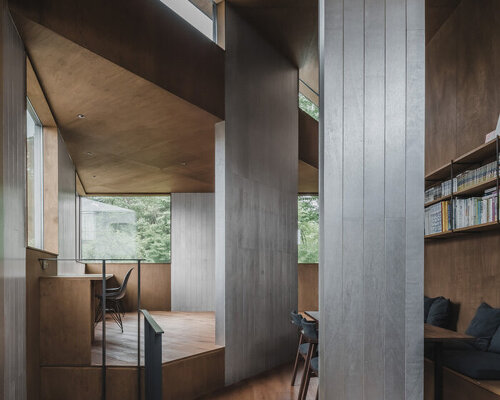
In architecture and interiors there's been a distinct shift in recent years towards "material honesty", where the true nature of a material is allowed to shine through rather than be covered up, painted over or simulated. I think we need to start thinking about AI in this way, as a material. I'm not here to discuss whether AI should or shouldn't become the backbone of consumer technology, but if this does happen, I think we might benefit from thinking more about the inherent characteristics, quirks and tendencies of these capricious models.
Think about music. The portable guitar amplifier was first introduced almost a century ago, a technological step which enabled musicians to reach larger audiences than ever before. But these amplifiers came with side effects, namely distortion. Sound engineers spent decades trying to remove these impurities in order to achieve higher fidelity sound reproduction (hence "hi-fi").
But an altogether different group of people (let's call them "creative" people) heard something more interesting. They decided to accept these unintended artefacts, and include them into their musical toolbox. From this mindset came rock 'n' roll, heavy metal, punk, grunge, hardcore and the expansive, all-conquering landscape of contemporary electronic music.
With that in mind, we must remember that at their core, large language models are inherently stochastic systems with their own quirks and foibles. They behave inconsistently, they rarely give the same answer twice and they frequently make mistakes. This is fundamentally different to all previous mental models of computing, yet we seem intent on squeezing these probabilistic tools into deterministic roles – ironing out all the unintended noise, and using them to streamline, automate and outperform what we already do today.
What if instead we let AI systems be what they want to be?
This approach is consistent with the metric-driven mentality of the past, but there's undoubtedly a whole world of other opportunities out there. Not everything is a task. Not every friction should be considered negative. Not everything needs to be done more quickly, more efficiently or more precisely. To use Robin Evans' terms, not everything is compressive, some things are donative.
In maintaining this monocultural focus, not only do we continue to push towards the same labour-saving traps that have ensnared us for generations, but we might also miss something fundamentally new in the periphery.
What if instead we let AI systems be what they want to be? A small community of creative people is leaning into the friction and the inherent instability, uncertainty and hallucinatory nature of the world's foundation models. This is encouraging, but rather than fundamentally evolving our conceptual approach to technology, I fear this work will eventually come to rest in galleries or as fringe "media experiments".
But this experimental attitude could also define a new role for software designers, many of whom are currently facing an existential threat. Could they help make AI more visible and allow it to breathe? Could they find ways to help us become comfortable with its imperfections and deviations? Could they understand this material's unique properties instead of forcing it into yesterday's templates? I'd argue that they have very little choice but to do so.
Given its inherent unpredictability, as AI becomes more ubiquitous, the software that underpins our lives is likely to include moments of negotiation, discussion and disagreement. So how do we design for that?
When unpredictability, memory and mood become part of our relationship with technology (in both directions), what might that lead to? If every interaction with a brand is somehow different than the previous, if our grocery shopping is preemptive and assumptive, and the very notion of "apps" dissolves into something fluid, intangible and transitory, what does that look like?
I'm certain something fundamentally new is on its horizon
I know these provocations run counter to everything we've come to expect from our software, and would fail even the most basic of today's accessibility and usability standards. I know this could lead to endless annoyances and inconveniences, but isn't there a slight chance that it could also lead to something interesting?
Is there a faint possibility we could create new moments of joy, intrigue and curiosity-inducing confusion? If we're willing to just take a look, is there an entirely new digital world hiding behind the conservative, pragmatic, sterile wall of software we live with today?
My thinking here is not fully formed, but I'm certain something fundamentally new is on its horizon. If software designers are going to survive this wave of automation, they must abandon their roles as the custodians of libraries, logic and grids, and become the architects of an entirely new set of imaginings, using this eccentric, unstable material as their scaffold.
That's when things will get interesting again.
Nick Foster is a British designer based in Oakland, California. He specialises in exploring the future, and has worked with technology companies including Apple, Google, Nokia, Sony and Dyson. He was previously head of design at Google's research lab Google X. In 2021 he was named a Royal Designer for Industry by the Royal Society for Arts. His writing has appeared in The New York Times, Monocle and The Alpine Review, and his first solo book, Could Should Might Don't, was published in 2025.
The photo is by Hal Gatewood.
Dezeen In Depth
If you enjoy reading Dezeen's interviews, opinions and features, subscribe to Dezeen In Depth. Sent on the last Friday of each month, this newsletter provides a single place to read about the design and architecture stories behind the headlines.
The post "Software designers must abandon their roles as the custodians of libraries, logic and grids" appeared first on Dezeen.