








SO-IL uses pink concrete to give Brooklyn apartment block "civic presence"


Architecture studio SO-IL utilised precast, coloured-concrete blocks in various sizes to give the 144 Vanderbilt apartment block in Brooklyn, USA, a distinct identity.
The latest of SO-IL's collaborations with design-forward New York developer Tankhouse, 144 Vanderbilt was constructed using stacked concrete blocks that rise from the north to south its tallest point facing busy Myrtle Avenue.

The facade of the 89,000-square-foot (8,300-square-metre) building, which is six storeys tall at its highest point, consists of precast concrete panels with a fluted texture, and is coloured a rosy pink.
As much of the neighbourhood consists of brownstone buildings and red-brick structures, the studio found that the pink colour created a sense of consistency, while still standing out.

"It's both contextual, but also slightly stands out, because of the becase of size and being in a corner," SO-IL co-founder Jing Lui told Dezeen.
"We knew that it needed to have a civic presence."

The panels follow the structure's irregular stacking pattern, which produces recesses, stacks and cantilevers that provide visual interest and create opportunities for balconies, while also articulating windows in a way that maximises light.
Furthering the contextualisation, Lui compared the stacking of the facade to the way that brick buildings are assembled. She added that the differing orientations of the units allow for individuality in the apartments.

"There is this sense of coming home that you rarely get when you live in an apartment building," said Lui.
"So at this scale, it's still possible to do so. We try to make every unit feel unique, even though it's in a collective constellation."

SO-IL noted the building's corner site sits on a zoning boundary, with Myrtle Avenue's infrastructure being taller and commercial in function, while Vanderbilt Avenue is more residential.
The stepping up from Vanderbilt towards Myrtle accounts for this shift within the building itself, according to the studio.

"Its distinct corner location, straddling two zoning districts, heavily influences the building's structure and layout," said SO-IL.
"The project explores these two contrasting urban experiences, creating a structure that acts as a porous barrier, housing a tranquil inner haven that contrasts with the vibrant street life."
This "haven" references the generous public interior spaces, including a mezzanine above a social lobby and a "verdant, secluded backyard".
These interior spaces reflect recesses and voids of the facade, and the studio noted that all of the apartments in the building not only face the street, but also the interior of the building, adding to the "porous" nature of the building.

The concrete columns that line the building's entrance also appear in the backyard. Inside, the columns play a starring role, lining the mezzanine lobby and reaching up to the ceiling from the double-height co-working space below grade.
For the mezzanine lobby, the floors are highly polished, and the walls, along with some of the columns, are covered in a grey-brown brick.

On the ceiling, a ventilation block was given a circular aspect and metal cladding that gives it the appearance of a decorative installation crowning the lofty public space.
A playful USM Modular Furniture entry desk tapers into lobby seating, mirroring the taper of the building's exterior.
Railings inside the public area and on the outdoor circulation are a matte green, matching the deep window frames that look out over the landscaped backyard and an interior courtyard, accessible from the wood-floored coworking space.

Landscape architect Marie Salembier and designer/researcher Julia Watson created the gardens, which, according to Tankhouse feature 275 feet (83 metres) of pathways.
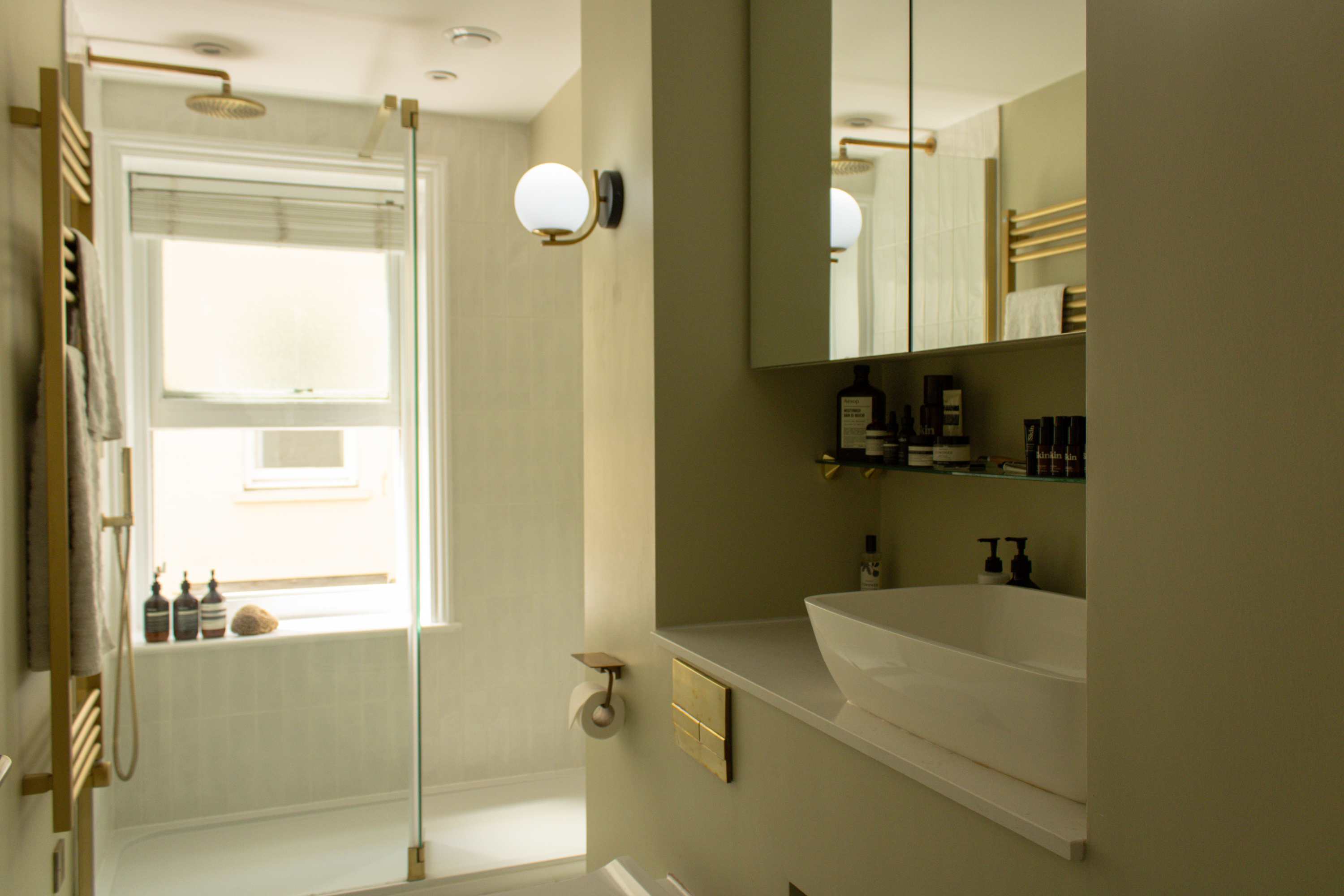
A few of the pared-down apartments were outfitted with finishes by Brooklyn design studio General Assembly, which has also set up shoppable showrooms in the building to promote local design. Dinesen designed the interiors of a full townhouse in the lower Vanderbilt Avenue portion of the ground floor.
Retail spaces were included along Myrtle Avenue.
Though the completion is just being announced, the building has hosted exhibitions and other social events for the last year.
Also for Tankhouse, SO-IL completed an apartment building with a similar profile, but clad in perforated metal, close by in Downtown Brooklyn.
This, along with other colourful buildings they've worked on in the borough, shows the studio's commitment to expanding the brownstone scale residential typology of Brooklyn.

"Most of the brownstone buildings don't maximise their envelope," said Liu.
"What threads all these projects through is this sense of community and sense of outdoor space, connectivity to the outdoors. We try to do as many windows and as many orientations and as much exterior circulation as possible in any of these buildings," she continued.
"That ethos is going to carry through in all of the buildings."
Meanwhile, Frida Escobedo recently completed an apartment building with an undulating facade nearby in Cobble Hill, Brooklyn.
The photography is by Valeria Flores unless otherwise stated.
The post SO-IL uses pink concrete to give Brooklyn apartment block "civic presence" appeared first on Dezeen.