











Canopy-covered World Trade Center proposed for long-stalled Brasilia development


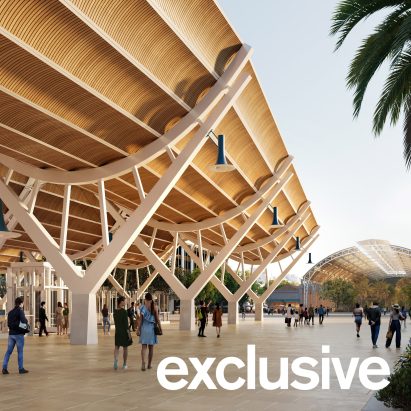
Brazilian studio Architecture Office has designed the undulating, solar panel-covered World Trade Center building for Brasilia's Biotic development to "reprogram" what the studio sees as the rigid infrastructure of the city.
The World Trade Center Biotic (WTC Biotic) is planned for an open swath of land in the Biotic development, masterplanned by architect Carlo Ratti. It is a one-million-square-metre district designed to be a high-tech innovation hub.

The Biotic development is located north of the city centre, just on the edge of a national park, on a mostly open, undeveloped plot of land.
Renderings show a square, 250 by 250 metre development, with an assortment of rectangular buildings tucked underneath a large, undulating canopy. Large openings are distributed around its surface and encircle open courtyards below.

A mixed typology of square, photovaltic, planter, and "pergola" panels create the canopy's rippling surface.
The WTC Biotic project was formally announced in 2023, and will contain multiple buildings that will serve as a centre for conferences, exhibitions and international trade events, according to the team.

The overall design was, in part, created to break away from Brasília's rigid grid system laid out by designers Lúcio Costa, Osca Niemeyer and Joaquim Cardozo in the 1950s, which arranged the city into distinct sectors.
"The concept of 'reprogramming' lies at the heart of this vision," said Architecture Office. "To reprogram is to break away from rigid zoning between living, working, and moving – and between architecture and urbanism."
"Biotic proposes a new urban ecosystem, where different uses intertwine within a single living framework."
The design of WTC Biotic was further based on "a building of extensive horizontal reach" according to the studio.

"The project is based on a singular condition: a building of extensive horizontal reach, with extremely restrained height," it said.
"This radical proportion inverts traditional hierarchies of vertical architecture, guiding the reading of the project not by elevation, but by levels, contours, and the relationships established with ground and sky."

Underneath the canopy, the buildings are organised into blocks of tiered office, residential, hotel, and convention buildings.
Renderings show lush green spaces and plantings throughout the development, as well as bodies of water.

According to the team, the project has entered its construction phase this month. It will be carried out in stages, beginning with corporate buildings, followed by the hotel, and then, later, the residential program.
It is estimated that 150,000 square metres of built area will be completed by 2030.
Carlo Ratti unveiled the Biotic masterplan in 2020, which is developed by the Brazilian real estate company Terracap. Also known as the Brasília Technological Park, the area has been under development for more than two decades.
It was originally known as Digital Capital Technology Park before its rebrand to Biotic.
The images are courtesy of Architecture Office.
The post Canopy-covered World Trade Center proposed for long-stalled Brasilia development appeared first on Dezeen.