












"Stadiums are the most significant expression of monumentality in our time"

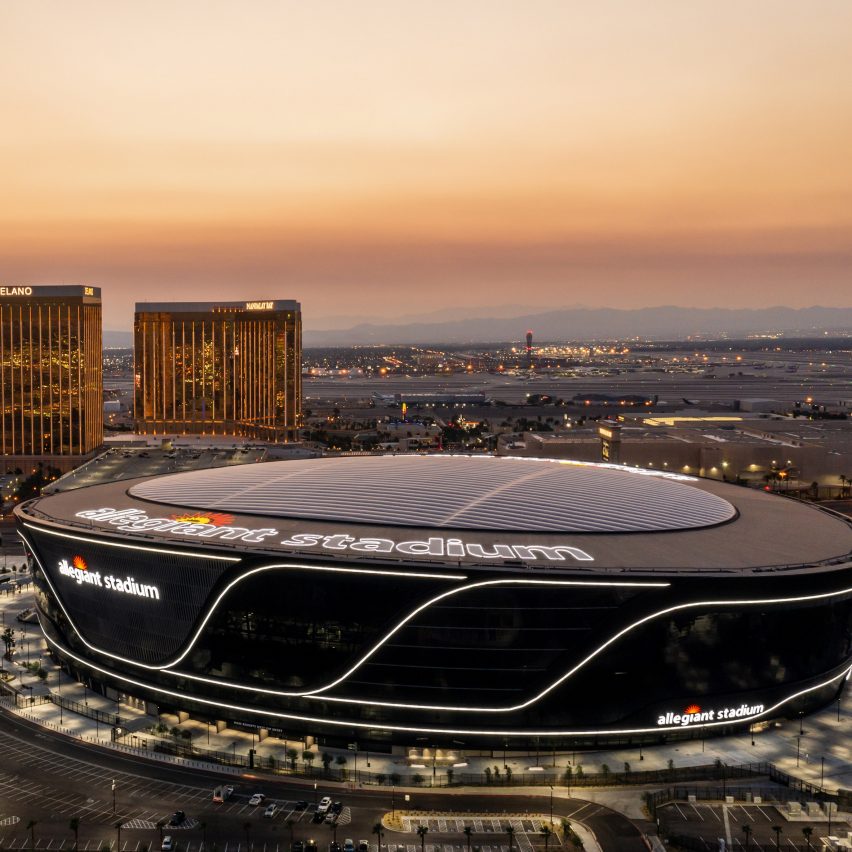
As part of Dezeen's Future Stadium series, academic Benjamin Flowers considers the role of stadiums as one of the last monumental architectural forms that demands affection from the public.
In any given city around the world, the single largest and most expensive building a visitor encounters won't be a church, or a major museum, or certainly a capitol building – it will be a stadium.
This holds for both new stadiums – SoFi Stadium in Los Angeles, a $2bn venue in a $5bn development, or renovations of existing grounds – Real Madrid's Bernabeu update in 2023 ran to $2bn.
Money likes architecture. Architects, in turn, quite like money. It is therefore no surprise that as stadium budgets exploded over the last 20 years, the ranks of big-name designers attached to them ballooned as well. Norman Foster, fresh from the opening of JP Morgan Chase's $3bn headquarters in New York City, dropped renderings for a new Old Trafford stadium projected to cost $2.6bn – and that looks suspiciously like a Frei Otto building. Star designers such as Herzog & de Meuron, Zaha Hadid, Kengo Kuma, Eduardo Souto de Moura and Bjarke Ingels have all done stadium projects. Top-shelf corporate studios have added or enlarged their sport studios.
Stadiums, these secular cathedrals, emerge from a comingling of capital and sport, forces that are inexorably intertwined in urban life.
The attraction, however, is more than just financial. The general public's trust in and affection for institutions that are the typical clients for monumental architecture – the state, organized religion, well-heeled or blue-chip corporations – are in decline. Jamie Dimon, CEO of JPMorgan, probably feels affection for his employer and its new tower, but I doubt many other New Yorkers do.
A stadium, on the other hand, is a building that fans will often love as much as they do their team. Indeed, this can be the case even when a team's owners are not especially popular. See, again, Manchester United, where fans have great affection for the aged Old Trafford but generally abhor the Glazer family.
It is also the case that in a sports-saturated media environment, stadiums are photographed and broadcast across screens large (think man cave) and small (your phone) more than any other building type. There may be, among the general public, no more broadly shared emotional attachment than that which takes place at the intersection of the social practices of sport and architecture in the form of the stadium.
In this sense, stadiums may be today one of the few forms of monumental architecture that can aspire to be loved rather than merely tolerated. There are aspects of human behavior unique to stadiums: we visit these structures on specific days of the week. We wear certain kinds of clothing, we sing certain songs, and we eat and drink in stadiums in a ritualized manner.
We make assumptions about the moral rightness of people we have never met before on the basis of which team's jersey they are wearing. Stadiums, these secular cathedrals, emerge from a comingling of capital and sport, forces that are inexorably intertwined in urban life.
Nearly all monumental architecture is expected to convey some set of values greater than its stated purpose. This is especially true of stadiums with their straightforward program – a pitch for a game to be played and seating from which to observe it. Building big in the US context, after all, has long been about finding new ways to extract ever more return from a fixed supply of real estate. In most American cities today, stadiums seem to have supplanted skyscrapers as the speculative investment of choice to make the land pay.
The aesthetics of monumentality today are heated and unsettled to a degree not seen for decades, perhaps since World War II.
The stadium, like the skyscraper, has been transformed from a building type with a narrow, specific program (white-collar office space or a playing field with stands) into one that is endlessly variable. Stadiums now are also concert venues, they have members-only clubs tucked away inside them, they offer conference spaces, they feature retail and year-round dining, and some even have churches and chapels where couples marry and children are baptized. All this is about building a relationship between the building and its audience that is both emotionally and economically intimate.
Of course, where large sums of money are involved, so too inevitably are politics and questions about the symbolic heft of appearances. Sports teams and their owners have their own expectations about how a stadium will speak on their behalf. The aesthetics of monumentality today are heated and unsettled to a degree not seen for decades, perhaps since World War II. Amidst proclamations about "making America beautiful again," the right wing in the US is embracing varied revivalist and neo-classical styles for ballrooms, courthouses, and triumphal arches.
Stadiums for teams owned by the wealthy and politically connected are part of this trend too. HKS recently unveiled its design for the Washington Commanders' long-delayed new stadium. With its stripped classical colonnade wrapping a monumental symmetrical bowl, it bears an unnerving resemblance to the Berlin Olympic Stadium designed by Werner March, built for the 1936 Summer Games in Nazi Germany.
In the American scene, figures from politics and business have long hoped to trade off of a proximity to sport and the stadium, and at some risk – see Donald Trump's less-than-positive reception at game three of the NBA finals at Madison Square Garden.
This trend is not, however, exclusively American. Victor Orban, the now-former long-time autocratic prime minister of Hungary and darling of American conservatives, oversaw the construction of the Pancho Arena by Imre Makoveczas, a physical articulation of religious nationalist policies. The result is a football pitch nestled inside a church with an explosion of gothic-revival pointed arches crafted in timber springing from concrete hips, and clad in slate.
The most prolific and well-compensated stadium designer of the first half of the 20th century – a Scot by the name of Archibald Leitch – was trained not as an architect but as an engineer. Indeed, Leitch was a factory engineer by trade. His designs across the UK display the humbler ambitions for the stadium (as well as their budgets) in his time. The grounds he designed, although monumental in size, had budgets that were a sliver of today's.
These obligations all come with baggage, some of it good, much of it bad.
Nearly all have either been dramatically redeveloped or demolished in the intervening decades. Few of his buildings are featured in surveys of modern architecture, and his name is largely lost to history.
The vastly more expensive projects we see today have very different expectations for their performance than those designed by Leitch. The architects designing them are far better known to the public at large than Leitch ever was. These projects are nominally meant to fulfill the same programmatic demands of hosting a game and its spectators, but much has been subsequently scaffolded onto that obligation.
These obligations – whether to help define a sense of place, or print money, or launder the reputation of a team owner – all come with baggage, some of it good, much of it bad. It is that very tension, however, that confirms the stadium as the predominant expression of urban monumentality in our time.
Dr Benjamin Flowers is a professor of architecture at The Ohio State University. His books include Beautiful Moves: Designing Stadia and Sport and Architecture.
Photo of Allegiant Stadium in Las Vegas by Jason O'Rear.
Future Stadium
This article is part of Future Stadium, our series exploring the growing role of monumental sports buildings in architecture and urbanism around the world.
The post "Stadiums are the most significant expression of monumentality in our time" appeared first on Dezeen.