







"Of all the projects in Saudi Arabia, this was the one capable of meeting its deadline" says architect behind 1km-tall skyscraper


Saudi Arabia's Jeddah Tower is on course to be the world's first kilometre-tall building. But, architect Gordon Gill tells Dezeen in this interview, a skyscraper double that height is already realistic.
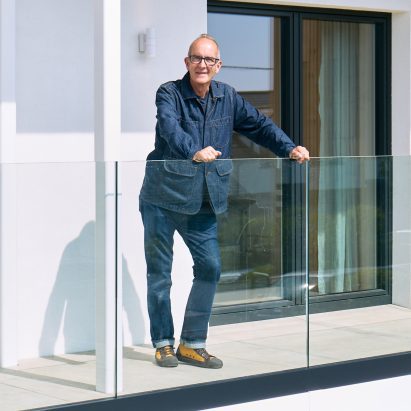
Together with Adrian Smith and Robert Forest, Gill co-founded Chicago-based studio Adrian Smith + Gordon Gill Architecture, a skyscraper specialist and the firm behind Jeddah Tower.
One of the most hotly anticipated buildings of the century, the megatall skyscraper is currently rising just outside the port city of Jeddah.
It is set to soon surpass the 830-metre-tall Burj Khalifa in Dubai – designed by Gill's partner Smith while at SOM – as the world's tallest building.

Jeddah Tower reached its 100th floor this week, but construction has not always been smooth sailing.
The building broke ground in 2013, but progress stopped and restarted multiple times for myriad reasons, including financial issues, the Covid-19 pandemic, and technical challenges.
One of the biggest blows came when the contractor, Binladin Group, was taken off the project due to the company owner being arrested as part of 2017 corruption purges in Saudi Arabia, which also saw the project's developer, Prince Al Waleed bin Talal Al Saud, detained.
However, after construction officially restarted in early 2025, Gill says Jeddah Tower is now on track to complete in 2028 with its lofty ambition intact.
That puts it in stark contrast to the current prospects of other high-profile Saudi projects, such as Neom.
What makes Jeddah Tower different is that its ambition of rising one kilometre into the sky is actually realistic, according to Gill.
"It's not a speculative endeavour"
"Of all the projects in Saudi Arabia, this was the one that was capable of meeting its deadline," Gill told Dezeen.
"What sets [Jeddah Tower] apart is its clarity and reality of being able to be delivered under a known set of circumstances, which include constructability, economy and time."
"It's not a speculative endeavour; it's a reality, and it has been a reality for some time," he continued. "Everything else was starting from paper, whereas this had already been established as a known entity; it just needed the impetus to finish it.
There are lessons here for architects, he suggests.
"One of the things that we have to be careful of in all of this is the common sense around what we're doing. As architects, we turn down projects all the time if we think they are unrealistic."
When it comes to skyscrapers, Gill believes that going well beyond a kilometre in height is already perfectly possible with today's construction knowledge and technology.
"We've looked at a mile, we've looked at two kilometres – today, technically or technologically, entirely feasible," he said.

Already, reports emerged in 2024 that British architecture studio Foster + Partners is working on a secretive plan for a two-kilometre-tall skyscraper, also in Saudi Arabia.
"There are things in the works right now that may well exceed Jeddah Tower, but you might not see them for another 10 or 15 years," said Gill.
"Owning [the world's tallest] title as a firm is tremendously humbling for us, but also very exciting."
"We've spent our decades working on this typology, so we know it very well," he continued. "We love them, we understand them, and to be asked to achieve something like this was a tremendous honour."
"Like a child's drawing of a paper aeroplane"
Gill describes Jeddah Tower as "one of the most efficient pound-for-pound supertalls out there".
The skyscraper will have a tapered form, not stepped, which crucially means there are fewer points of load transfer.
"It's a very simple tapered form, almost like a child's drawing of a paper aeroplane," Gill described.
"It's very rigid in its behavioural characteristics, but at the same time, as a three-legged tripod, it's offering you great programmatic opportunities for residential or offices without impacting personal views. So structurally, it is extremely efficient."

In this way, the Jeddah Tower project is helping advancements in the wider architecture and construction industries, claims Gill.
"The technology around concrete, structure, wind behaviour characteristics, oxygen and mechanical systems, safety criteria, vertical transportation – all of that gets a little bump every time you do one of these projects," said Gill.
"It's almost like a research lab. It helps people understand a lot of things about the technical aspects of building."
"The lessons that we learn from doing supertalls can be applied to a host of different building typologies and scales," he added.
"How do you move people? How do you get that ice cream cone from A to B without melting? What is the psychology of comfort that we can give you? Can we do something with your apartment that improves your air quality and health?"
"It's an amazing time to be an architect"
Gill is a clear techno-optimist, with a distinctly utopian view of how technology will advance and influence our cities.
He is constantly trying to predict what will be needed from skyscrapers of the future and what technology will be available.
"When we're in the Middle East and working on projects, we're having conversations about air taxi use and drone deliveries as no longer a dream, but actually integrating them into our projects," he said.
"There are construction companies that have invested billions of dollars in drone freight."
"As a kid, I used to draw flying cars all the time, and I always wondered why I could never have a jet pack and go to work or go to school," he added. "Now we're beginning to see this as a definite reality."
These types of technological advances could have a dramatic impact on the way buildings are designed in the future, Gill posits.
"I've always joked about the idea of ground-borne lobbies," he said. "If I said to you, I'll meet you in the lobby, you'll probably think it's the ground floor."
"Whereas a decade from now, you might say, 'Which one?' because we may be able to access buildings at different heights."
"It's an incredible time to live," he added. "It's an amazing time to be an architect and designer of any sort. I'm one of those eternal optimists, I just love where we're going."
Dezeen In Depth
If you enjoy reading Dezeen's interviews, opinions and features, subscribe to Dezeen In Depth. Sent on the last Friday of each month, this newsletter provides a single place to read about the design and architecture stories behind the headlines.
The post "Of all the projects in Saudi Arabia, this was the one capable of meeting its deadline" says architect behind 1km-tall skyscraper appeared first on Dezeen.