







Meet Swedish Girls, Sabine Marcelis’s pick for the most influential designer of the next 20 years


Sabine Marcelis has nominated Swedish Girls as a key name to watch over the next two decades for Dezeen's 20×20 project sponsored by Kohler. In this interview, we learn why the design duo deliberately play into stereotypes.
The steady emergence of Swedish Girls has not been lost on prolific Dutch designer Marcelis, who nominated the collective as one of 20 names to watch in architecture and design over the next 20 years.
"I really like how they work with existing industrial production processes, yet the result very much speaks to the current culture," Marcelis told Dezeen, explaining her selection.
Josefin Zachrisson and Mira Bergh run multidisciplinary studio Swedish Girls between Stockholm and Milan, creating furniture, installations and set design.
The duo met during their studies at Sweden's Beckmans College of Design, where they graduated in 2019. They bonded over a desire to make work "without hierarchies" and maintain creative control of the studio's output, which they prefer to call their ever-expanding "universe".
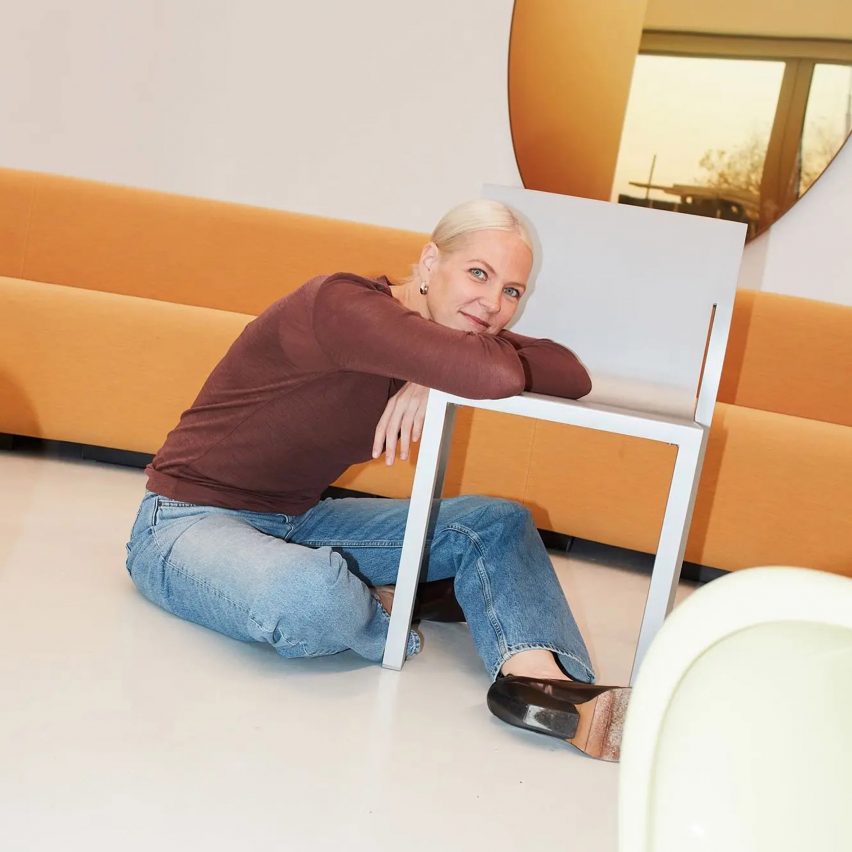
The Big Bang for Swedish Girls was the selection of their collective's tongue-in-cheek name, chosen after their first exhibition outing at Milan design week.
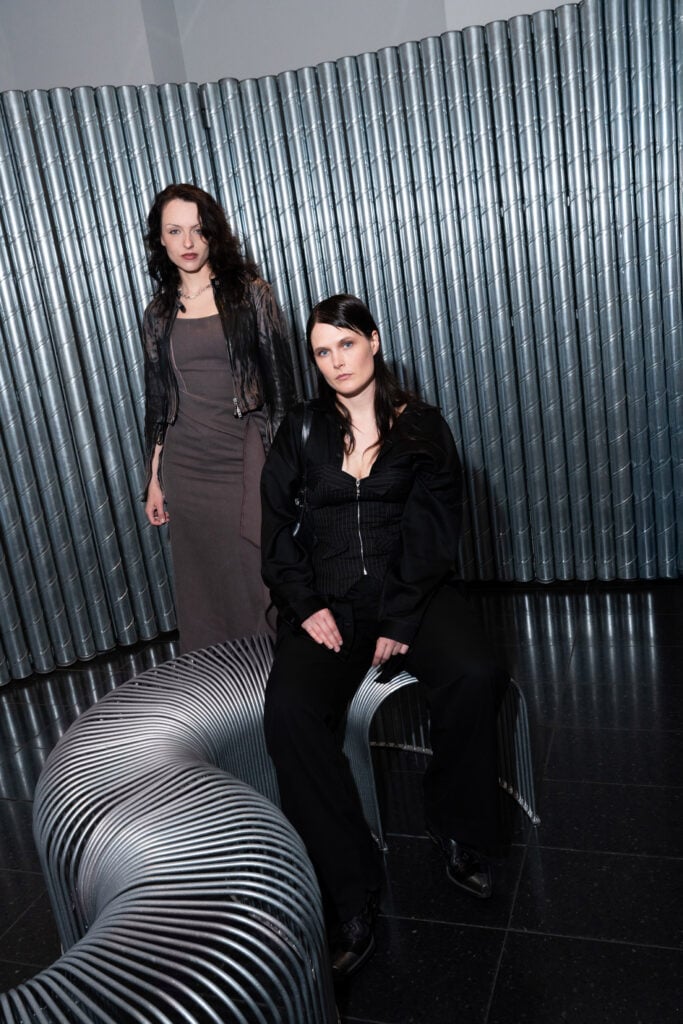
For experimental platform Alcova in 2021, Zachrisson and Bergh unveiled their ongoing metal rod Seats System project (pictured left).
Originally a single piece of modular seating without a defined front or back, the project has evolved into more metal pieces that follow the same design language, including a fruit bowl and a candle holder.
"We overheard people talking about our furniture, asking who made it, and others were like, 'ah, it was those Swedish girls', and we felt a bit belittled by it," recalled Zachrisson. The duo had previously made work under their own names.
"The Swedish girl has obviously become a phenomenon," added Bergh. "You know, blonde, sexy. But when we were talking about it, we also found it really funny because it's so stereotypical. We thought we'd call ourselves Swedish Girls because everybody else was already calling us that."
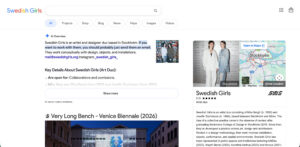
Humour is intrinsic to Zachrisson and Bergh's interdisciplinary practice. Even their website, admired by Marcelis, was playfully designed as a Swedish Girls-branded Google search engine. It is meant to look like the internet itself, complete with mock web pages listing each of the collective's projects.
"We got the idea when we launched the name Swedish Girls," the pair explained.
"A professor from Beckmans called and said that we should change our name because when she Googled 'Swedish Girls', the search result was not exactly art and design," they added.
"We thought that was so funny and decided to make Google about us instead of changing our name."
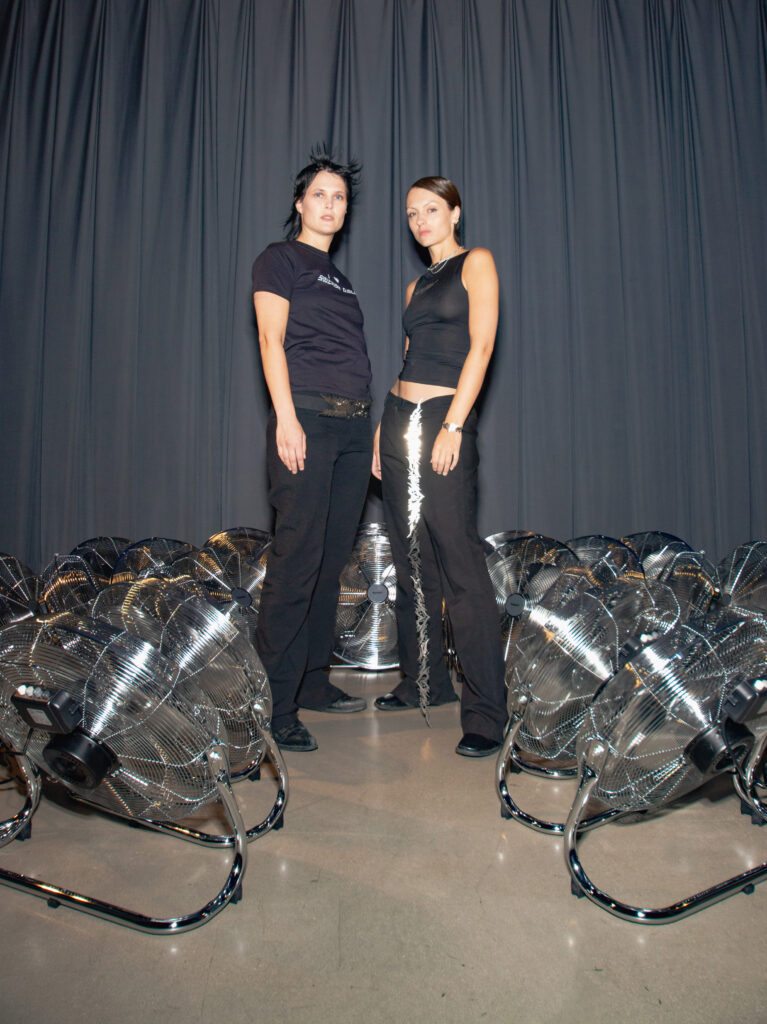
Another of the duo's wit-inflected projects is Only Fans, an installation presented at Gothenburg's Röhsska design museum in 2024 during local music festival Way Out West.
Dubbed "a multidimensional art experience about fan culture" in all its forms, the installation included 25 electric fans, selected as a riff on adult content platform OnlyFans, where women are often the subject of scrutiny.
"The installation was interactive, so that visitors could stand in the middle of the fans in a hysterical storm," said Bergh.
Our work is a lot of these really silly, stupid things. But it's also layered with some seriousness, because the projects handle things that we are affected by and women are affected by in real life
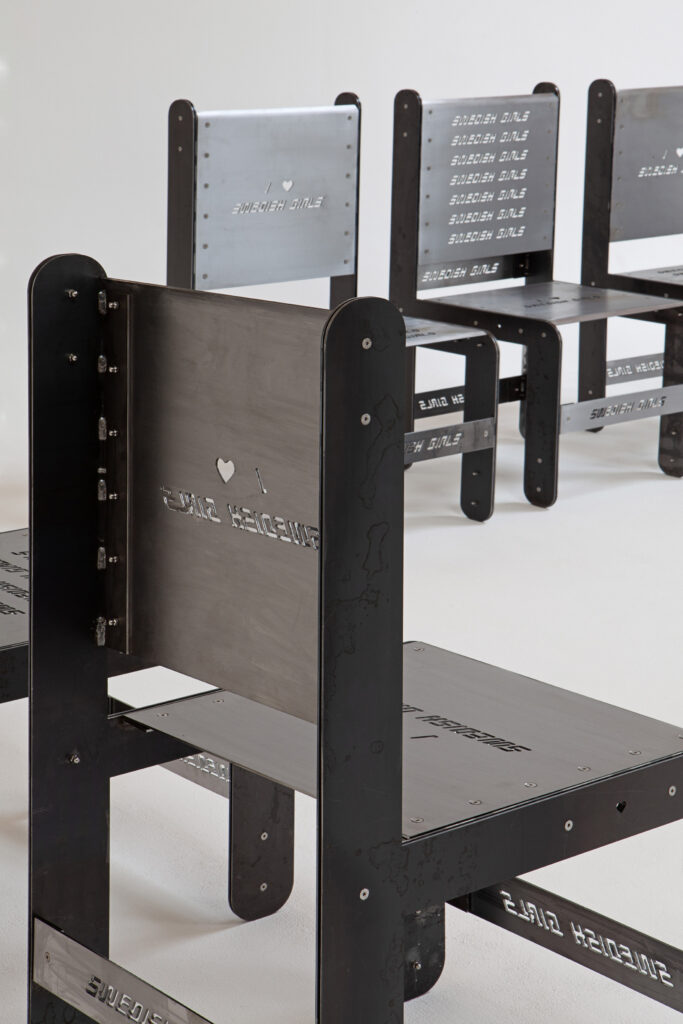
Alongside the fans, the collective presented seven laser-cut steel chairs emblazoned with I <3 Swedish Girls, along with a fanzine and female mannequins wearing "metal merch" designed by Zachrisson and Bergh.
"Our work is a lot of these really silly, stupid things," considered Zachrisson.
"But it's also layered with some seriousness, because the projects handle things that we are affected by and women are affected by in real life," she continued. "It feels like a way to approach it that makes it accessible."
"Sometimes it's hard because we get these questions like, 'are you a feminist?'" added the designer. "But it's inherently political to be a woman moving through the world. Our work is just reacting to our reality."
The pair is keen to highlight that although they make furniture, "social values are always a starting point" for their projects.
"We really want to have a practice that feels purposeful," said Zachrisson, considering the significance of partnering with institutions like design museums.
"We've realised that showing work in public spaces is the most important thing," she continued.
"Especially because the materials and processes we use have become quite expensive. So we want to put our pieces in public spaces so that everyone can take part in some way."
"You meet all different kinds of people, and we talk to them and grow from it," added Bergh.
The hardest thing is to earn money. We're adults, we've been doing this a long time. But we are still taken advantage of and expected to work for free or for very little money
Despite Swedish Girls' various collaborations and recurring presence at Milan design week, seven years after leaving Beckmans, Bergh and Zachrisson continue to work in cafes and supermarkets to fund their design practice.
The duo are hyperaware of the difficulties faced by emerging creatives, especially those like themselves who, as they put it, "want to listen to your gut and be close to the process".
"The hardest thing is to earn money," said Bergh. "We're adults, we've been doing this a long time. But we are still taken advantage of and expected to work for free or for very little money on very quick timelines. I feel like we should have more respect."
"You don't get paid in a way where you as two people can survive," added Zachrisson. "But all these years of working and keeping our creative integrity is paying off in every way except financially."
When it comes to building their studio, the designers consider themselves to be playing the long game.
"Long term, it's an investment to do it this way because we have now created a context where we can feel freedom and gain respect, which is why we were so happy when Sabine nominated us," said Zachrisson.
"You can measure success in so many different ways and with this we feel respected, and that is so valuable."
The duo said funding that they won from Sweden's Konstnärsnämnden arts council after graduating gave them a significant leg up when they were just starting out.
Zachrisson and Bergh are concerned that scholarships like theirs have been scarcer across Sweden in recent years thanks to the country's right-wing administration, which came into power in 2022 and has only just been voted out of office.
"All the artists we have talked to have felt an extreme difference in that time," noted Zachrisson. "The share of the total budget allocated to culture has not been this low in 26 years."
Still, the pair are confident and excited about what's to come.
"It comes in handy that we have a broad practice," said Bergh. "We have plans for the future to make it easier for ourselves to be designers."
"I like how they surprise with their projects and feel like we have only seen chapter one of their story," concluded Marcelis. "And I can't wait to discover the next chapter."
The post Meet Swedish Girls, Sabine Marcelis’s pick for the most influential designer of the next 20 years appeared first on Dezeen.