
.jpg)












Frank Gehry's 15 most significant buildings


Canadian-American architect Frank Gehry has passed away, leaving an almost-unbelievable architectural legacy. Here are his 15 most influential buildings.

For Gehry's radical extension to his own home in Santa Monica, California, he wrapped his Dutch-style suburban house in a series of interlocking structures.
Featured in the seminal Deconstructivist Architecture exhibition at MoMA, the house made Gehry's name. It was constructed largely from affordable materials such as corrugated steel.
"I was interested in simple materials – you didn't have to get fancy materials," Gehry explained in a 2021 interview with PIN-UP magazine.
"I worked with corrugated metal, which I liked galvanized," he added. "I didn't like the way it was typically used, but I liked the aesthetic. And I loved wood, of course, from the Japanese-influenced stuff to wood framing."

Vitra Design Museum, Germany, 1989
Constructed from white plaster and titanium-zinc alloy, the Vitra Design Museum is one of the earliest examples of the sculptural style that would come to define Gehry's career.
Gehry's first building in Europe, the deconstructionist-style museum echoes the curved forms of the nearby Ronchamp chapel by Le Corbusier.

Weisman Art Museum, USA, 1993
Designed to be a landmark among other significant buildings on the University of Minnesota's Minneapolis campus, the museum has a stainless steel facade that would become a signature move for the architect.
The building has a split personality, with the building's other facades – that face historic buildings – clad in brick.

Dancing House, Czech Republic, 1996
Designed with Croatian-Czech architect Vlado Milunić for the Nationale-Nederlanden insurance company, the iconic Dancing House now operates as a hotel.
The project takes its name from its sculptural form that looks like a taller male figure sweeping away a cinched glass form by its side.
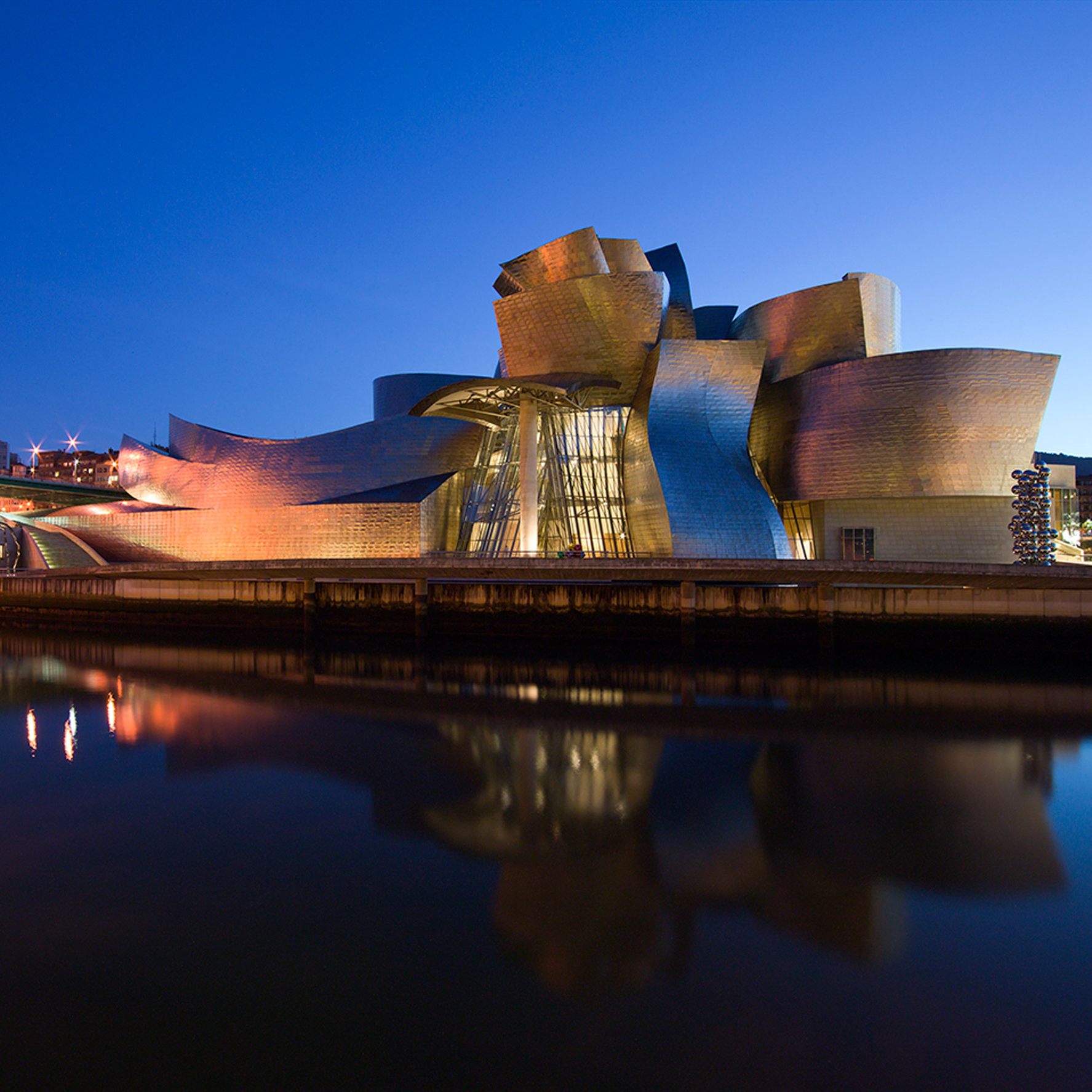
Guggenheim Bilbao, Spain, 1997
Perhaps Gehry's best-known building, and the most significant building in the deconstructivist style, the Guggenheim Bilbao museum has a facade made from swooping metal-clad panels.
The building was credited with transforming the city's image and financial fortunes, with numerous cities trying to replicate its success, which was dubbed "the Bilbao effect".
"People are always telling me how I changed the city," Gehry said in a 2021 interview with Dezeen. "I didn't mean to change the city, I just meant to be part of the city."

Museum of Pop Culture, USA, 2000
A slight dabble in the short-lived style of "blobitecture", the Museum of Pop Culture is also wrapped in sheet metal, although in this case the material was rendered in multiple colours.
Set next to the Space Needle in Seattle, the museum contains the world's largest collection of Jimi Hendrix memorabilia.

Walt Disney Concert Hall, USA, 2003
A formal sibling of the Guggenheim Bilbao, the Walt Disney Concert Hall is another of deconstructivism's most significant buildings and one of Los Angeles' best-known landmarks.
Earlier this year, we named the Walt Disney Concert Hall the most significant building of 2003.
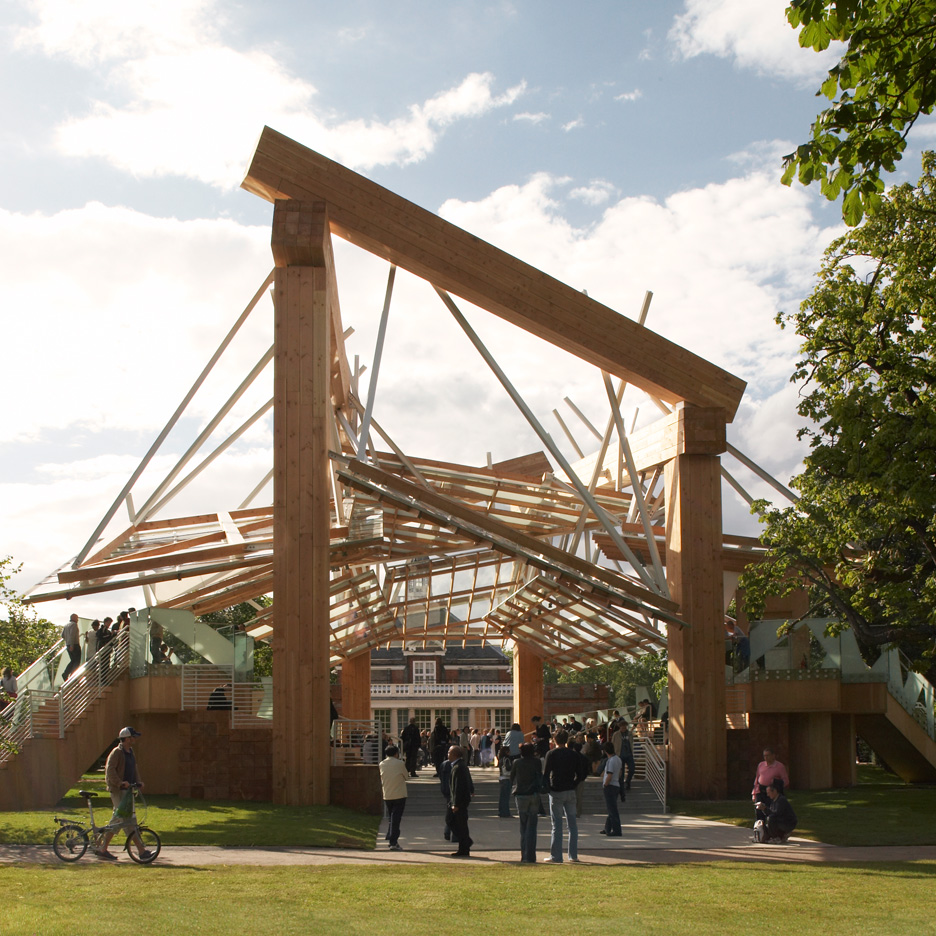
In 2008, Gehry designed the temporary Serpentine Pavilion in London, which appeared to be a return to his roots with a clashing form and materials used for his own home.
The pavilion consisted of four wood-clad steel columns, which supported a series of large timber planks and beams. It was Gehry's first building in London.

8 Spruce (New York by Gehry), USA, 2011
Gehry's first skyscraper in New York, Eight Spruce Street, has a crumpled, wave-like facade typical of his other housing schemes, such as the 2011 Opus Hong Kong.
The 265-metre-high skyscraper contains 903 apartments, with the wavy facade creating bay windows for some of the homes.

Fondation Louis Vuitton, France, 2014
Designed as an arts centre for the cultural foundation established by fashion brand Louis Vuitton, the Louis Vuitton Foundation in Paris appears to be covered in giant glass shells.
The eleven exhibition galleries and 350-seat auditorium are enclosed by curved facades made up of 3,600 glass panels.

The first building in Latin America by Gehry, the Biomuseo was built on a site surrounded by water on the Amador Causeway at the entrance to the Panama Canal.
"This has been a very personal project for me," said Gehry at the time. "I feel close ties to the people of Panama, and I believe strongly that we should all be trying to conserve biodiversity, which is threatened everywhere."
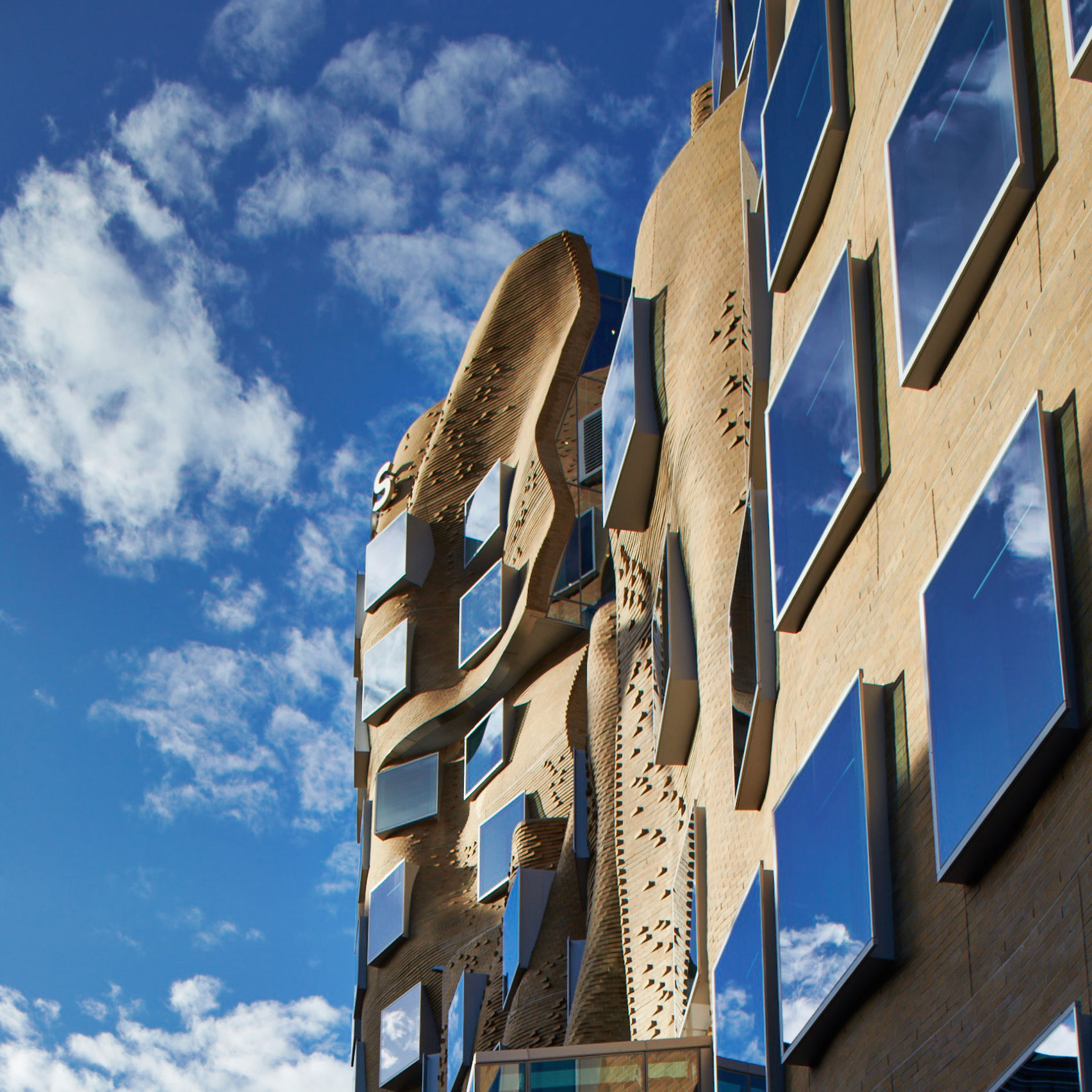
University of Technology, Australia, 2015
This teaching and research facility for Sydney's University of Technology has a distinctive, crumpled facade that led to it being described as "the most beautiful squashed brown paper bag".
Officially called the Dr Chau Chak Wing facility at the UTS Business School, the curved tower was clad in 320,000 custom-designed bricks. According to Gehry, the design was inspired by a treehouse.
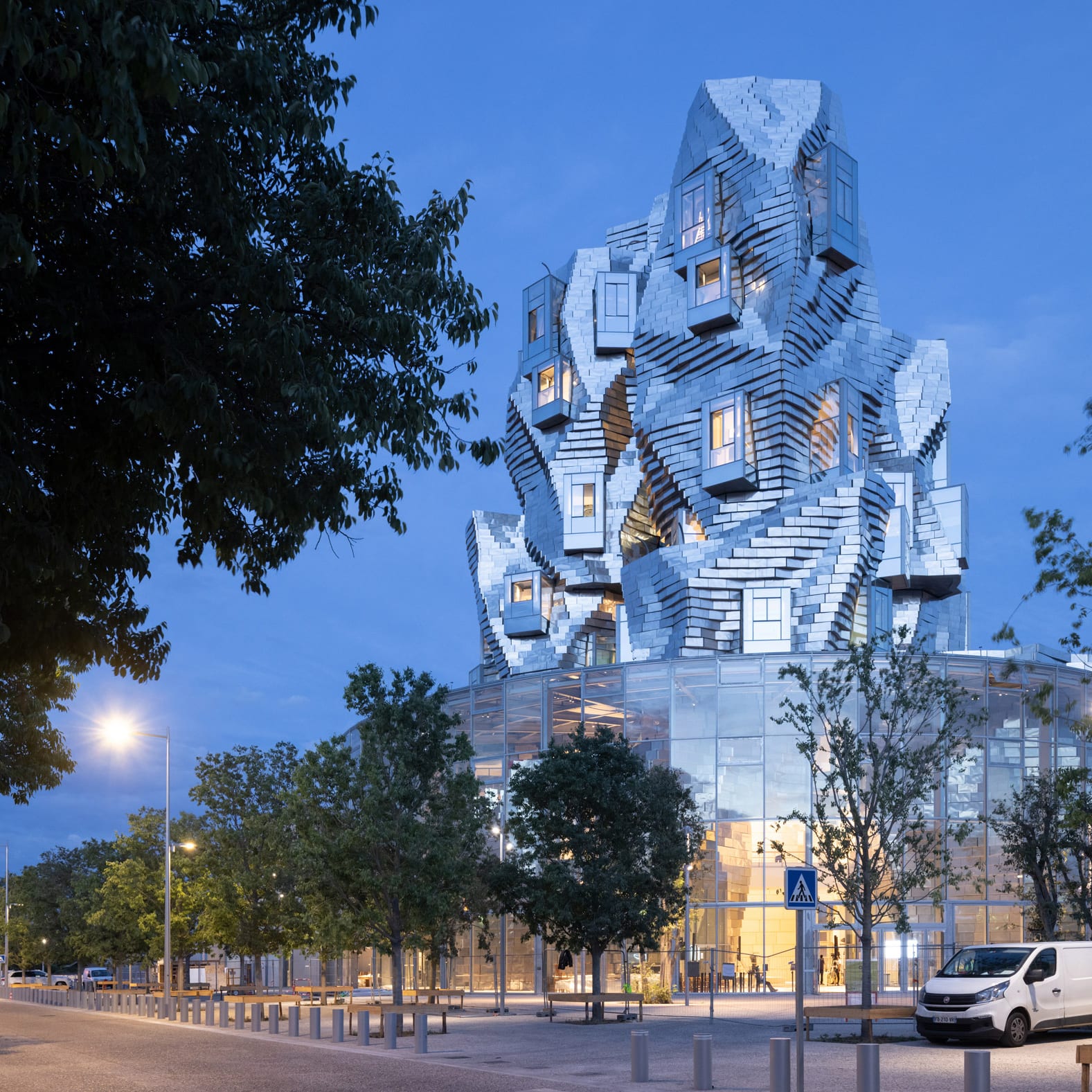
The centrepiece of the Luma Arles cultural district, the 56-metre-high tower was clad in 11,000 irregularly arranged stainless steel panels.
As well as being a marker for the site and a lookout tower, the building contains exhibition galleries, archives, a library, offices, seminar rooms and a cafe.
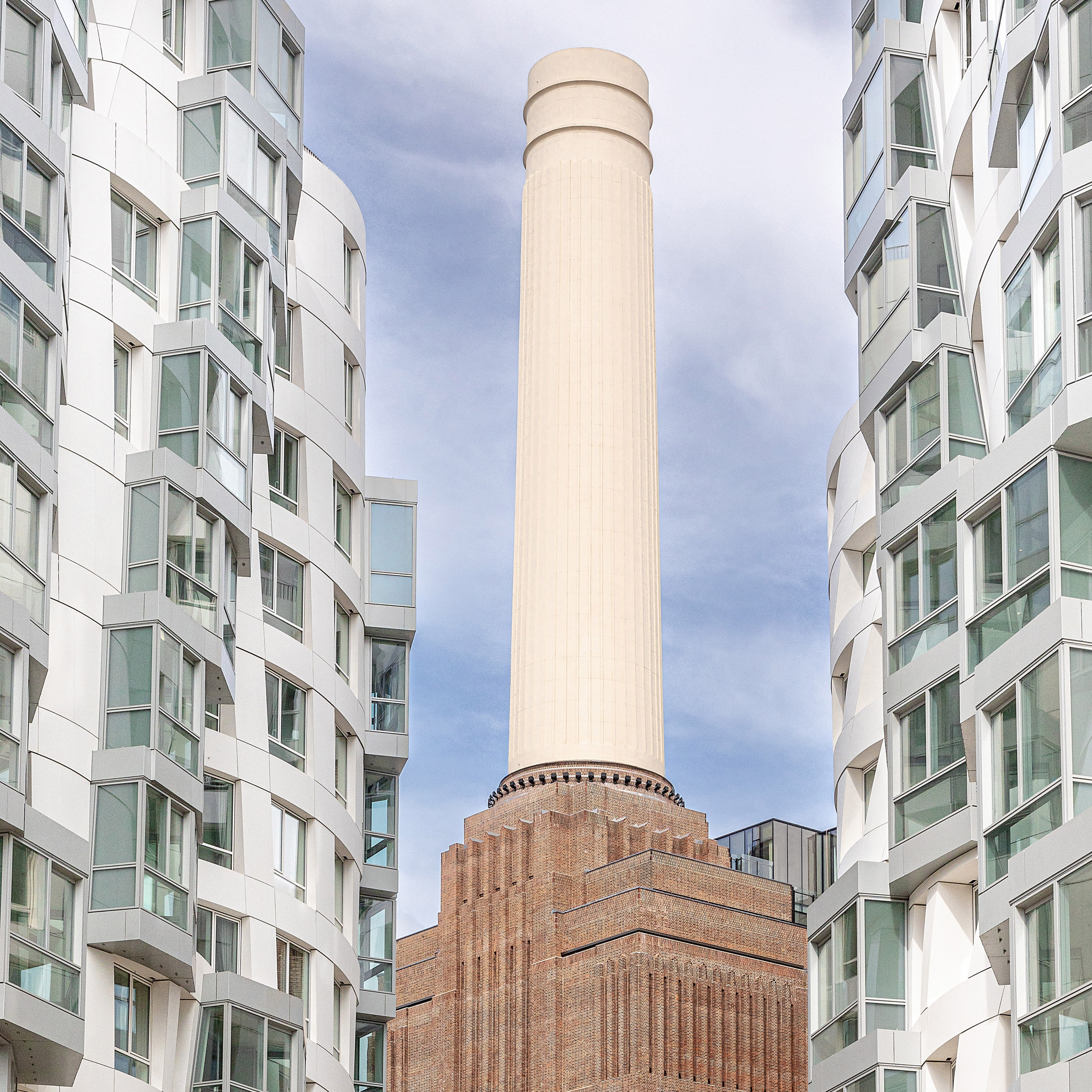
Framing the iconic Battersea Power Station, the Prospect Place housing development is wrapped in rippled white facades punctuated by large windows.
The development, Gehry's first housing project in the UK, contains over 300 homes.

Guggenheim Abu Dhabi, United Arab Emirates, 2025
Reportedly set to open later this year, Guggenheim Abu Dhabi will be Gehry's last major cultural building.
Being built as part of the Saadiyat Island cultural development in Abu Dhabi alongside Foster + Partners' Zayed National Museum and Jean Nouvel's Louvre Abu Dhabi, the building features a stack of block-like forms, curved metal sheets and jagged canopies.
The post Frank Gehry's 15 most significant buildings appeared first on Dezeen.