



















Brick Bonds book celebrates "the skill and craft of bricklaying"


Graphic designer Melissa Price shines a light on the anatomy of the humble brick and the variety of bricklaying techniques used in construction in her book Brick Bonds.
Printed to the dimensions of a standard UK brick, the book was designed and printed by Price as a guide that illustrates "the full range of bonds in a simple form".
It follows 10 years of research into the history of bricklaying and the wide range of bond patterns, which she feels are often overlooked or written about in a highly technical way.

"The subject matter for my personal work is driven by an interest in the potential of graphic design to reveal beauty in the normally overlooked," Price told Dezeen.
"My research has led me to really appreciate the skill and craft of bricklaying," she continued.
"The language of bricklaying is beautiful – there's a rich lexicon, from the names of the surfaces of bricks, such as 'stretcher' and 'sailor', to the bond names, such as 'rat trap bond' and 'quarter staggered bond' and a personal favourite, 'nogging', which is a way of using brick patterns as infill between timbers on half-timbered buildings."

Price, who is a graphic designer at London design studio Cartlidge Levene, decided to create the book after working on a series of needlepoint-stitched artworks 15 years ago that were based on brick bonds.
"I stitched a number of different brick bond patterns in simple red and white, and through researching for that, I noticed the beauty in the variations of the bonds as well as the names and felt it was worth exploring further as a subject area," she explained.

Brick Bonds is Swiss-bound to ensure it can lie flat, facilitating use as a reference book. Its red binding is exposed, emulating mortar and referencing "the structural nature of bricks".
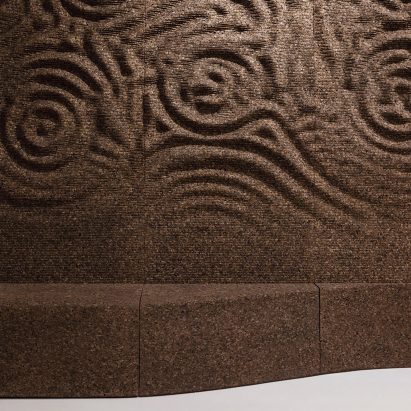
Red hues were chosen as the dominant colour throughout the 96-page publication in a nod to traditional red brick, including the darker tone of the textured brick-like front cover.
The book begins with an overview of the anatomy of a brick before honing in on the different kinds of brick bonds and patterns. The first two sections focus on wall bonds and paving bonds. Generally, vertical structures use wall bonds, while paving bonds are for horizontal surfaces – though there is overlap.
The final two sections illustrate diaper patterns, which are those formed from different-coloured bricks, and finally decorative patterns, which are used to create texture rather than a flat surface.

These are all visualised as clearly as possible, with a half-page illustration and the name positioned above.
Price's highlight of the book is the decorative techniques section, and her favourite pattern that she discovered is dogtoothing.
"Dogtoothing involves rotating the bricks 45 degrees in the wall so that the corners protrude, creating a beautiful texture that works so well with light and shadow," she said.
"There's a fantastic expanse of dogtooth bonded wall in the main hall at Haggerston School, a secondary school in Hackney, designed by Erno Goldfinger."

Price said she hopes the book will be enjoyed by members of the architecture industry, but also those outside of it. She said it could help non-specialists develop a greater appreciation for the built environment, but she'd particularly "love to come across a really battered copy on a building site".
Looking ahead, Price is now hoping to dedicate some time to exploring arch-building techniques.
Other architecture books recently featured on Dezeen include a colourful fold-out architecture book for children that showcases the work of architect Richard Rogers and a publication by Tadao Ando that collects drawings and models produced across his career.
The post Brick Bonds book celebrates "the skill and craft of bricklaying" appeared first on Dezeen.