





















Anatomy of a Standout Sketch
The votes for the 2025 Vision Awards have been counted! Discover this year's cohort of top architectural representations and sign up for the program newsletter for future updates.
It’s a fact, the architectural sketch never dies.
Even though architectural software has fully dominated the field, leading to a hyper-realistic render era, the sketch has never left the architect’s toolbelt. It acts as an extension of architectural thinking — a manual mechanism of thought that allows ideas to unfold and be understood in real time, before they become concretized.
This is the second “dissection” series that uses Architizer’s Vision Awards winners as a lens to discuss the best practices for architectural sketching, sustaining the oldest instrument of architectural thinking within this digital age.
1. A Good Sketch Explains More Than It Shows
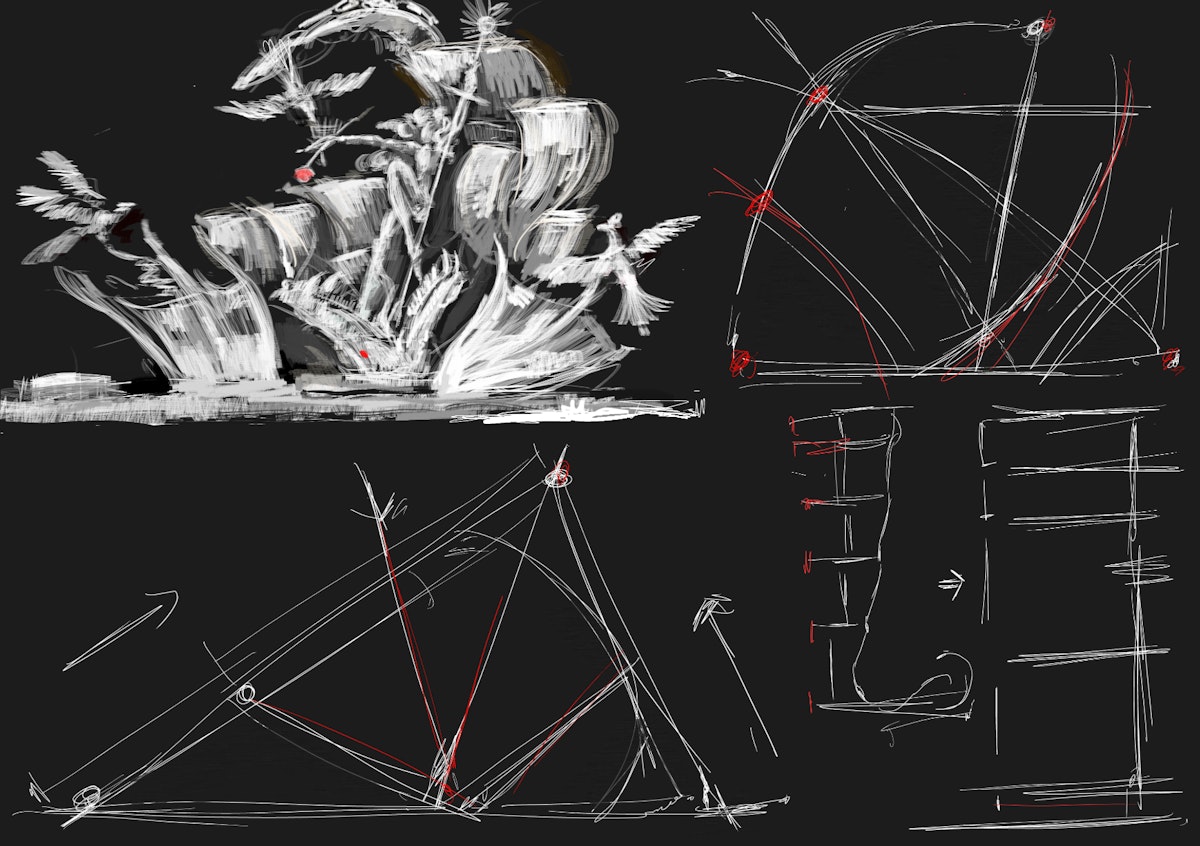
Ancient Proposition Solved by Xiaotao Tang | Finalist, Sketch, 2025 Vision Awards
Sketches are more than illustrations. If used correctly, they are explanatory tools that attempt to exaggerate a certain aspect of the design idea. Structural logic may be overdrawn, or the focus may turn to a very intricate circulation space organization. Regardless, they primarily address questions rather than provide final direction.
The Ancient Proposition Solved sketch, for instance, investigates classical design philosophy within the context of new materials. It seeks to uncover the dichotomy between ideals and order, using both geometric diagrams that complement a sectional composition — one that reads as a reinterpretation of the Guggenheim Museum.
Best practice: Use drawing to clarify intent, not to impress.
2. Line Weight Is a Narrative Device
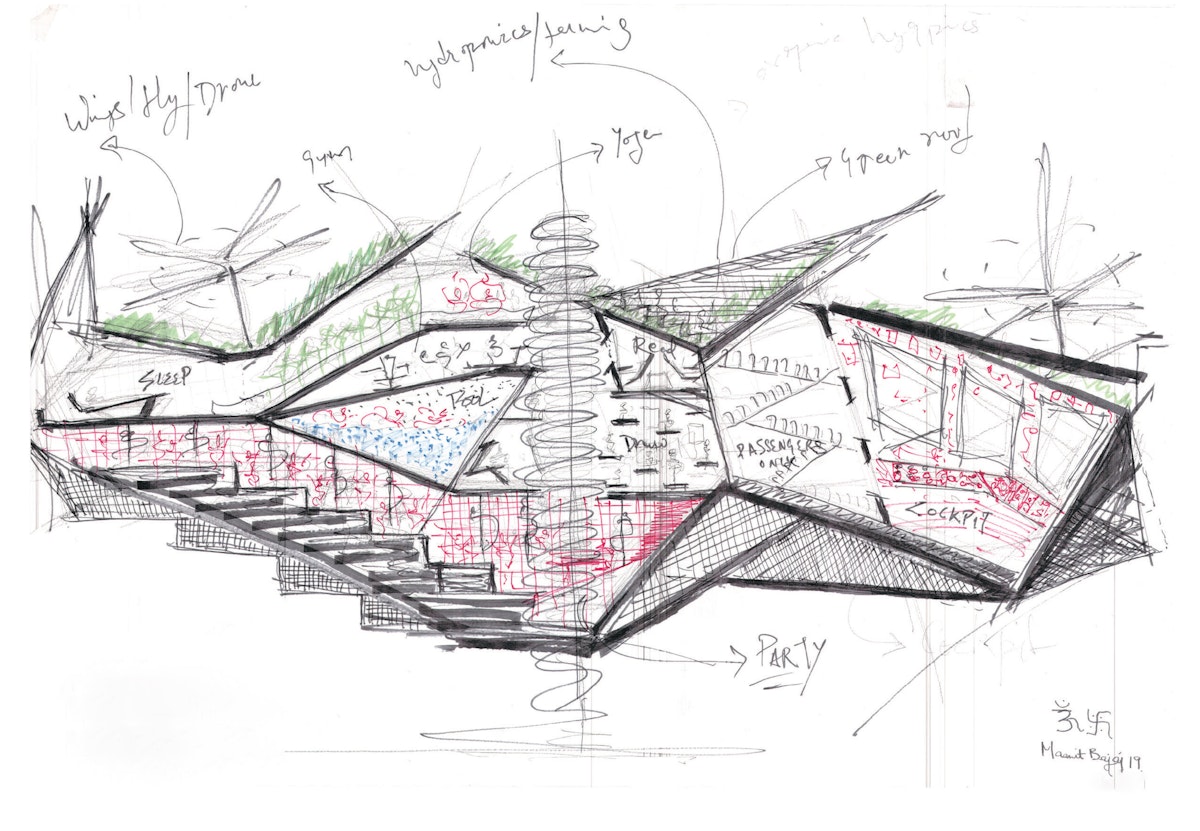
The Vortaal by Maanit Bajaj | Finalist, Sketch, 2025 Vision Awards
In sketching, hierarchy is effectively communicated via hand gestures — specifically, pressure and lightness. Heavy lines imply anchoring, ground or cuts, while lighter lines suggest motion, fluidity or speculation. In parallel, “nervous” — almost broken — lines suggest an uncertainty or temporality. In some sketches, the visual hierarchy is so legible that annotation becomes redundant.
The Vortaal communicates a hybrid habitat designed for a future where terrestrial land becomes scarce, and mobility is essential to survival. This sectional sketch uses heavy, intentional lines drawn with markers to suggest form and spatial organization. In parallel, more subtle lines imply sustainable, operational systems that support the structure. Green lines are vegetation, red and blue hatches convey materials or water tanks, while faint pencil textures are used to draw air circulation. Through these simple hand gestures, this flying vessel is “equipped” with advanced propulsion systems, hydroponic farming zones, energy harvesting wings, and wellness spaces – all without relying on a single technical drawing or computer simulation.
Best practice: Line weight is editorial control. It tells the viewer what matters most.
3. Section Is Where Ideas Become Architecture
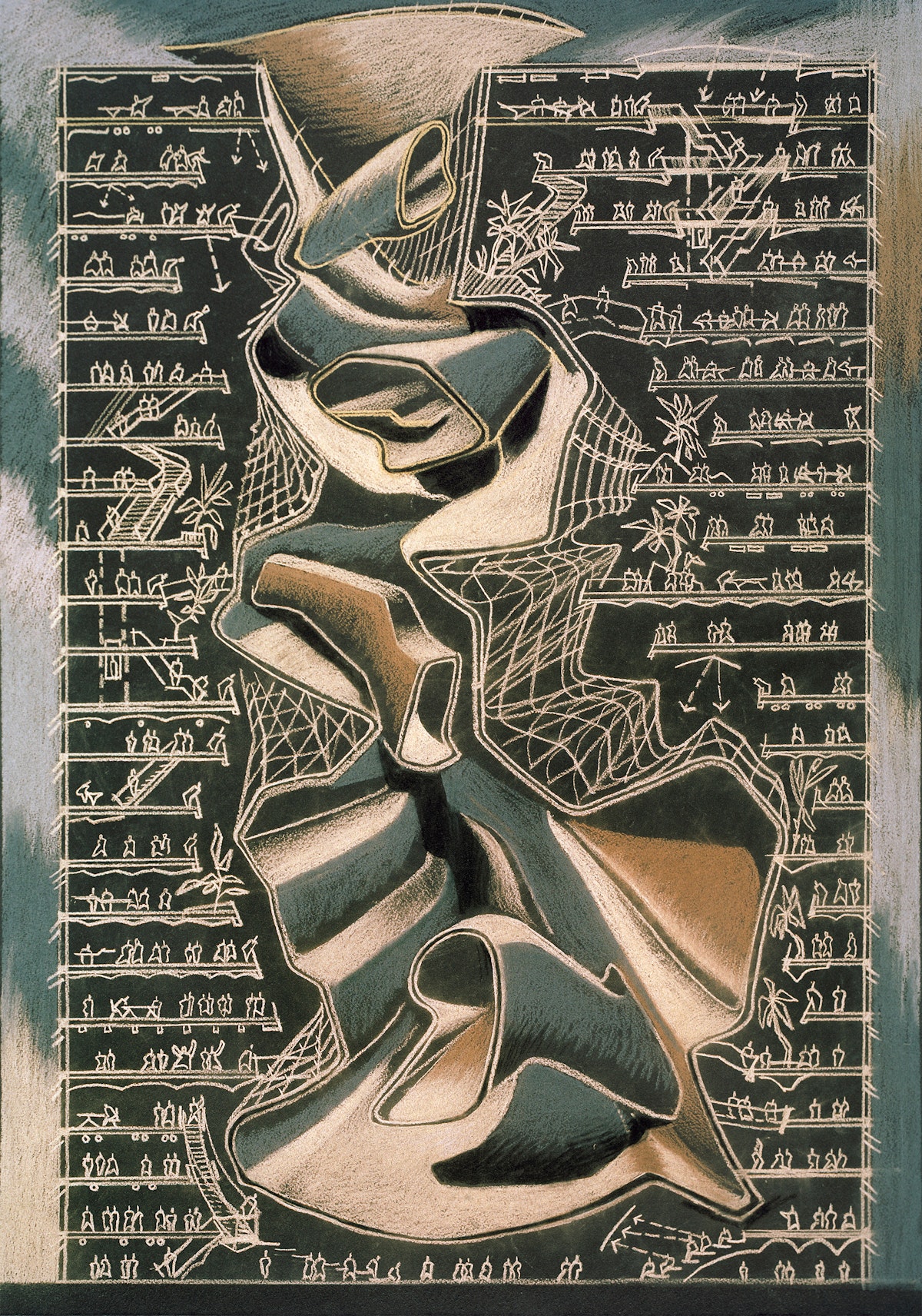
Pragmatic in contrast to non-pragmatic by Sergei Tchoban | Editor’s Choice Winner, Sketch, 2025 Vision Awards
Sketches thrive in sections. Why? Because sections can explore multiple systems at once. They can investigate structure, movement, atmosphere, landscape, interaction and so forth, staying away from the “traditional cut” and becoming positioned as spatial arguments.
The Pragmatic, in contrast to non-pragmatic sketch sets up the concept for the ecologically sustainable timber hybrid building SXB in Berlin. It is a sectional perspective that focuses on the relationship between the interior and exterior, where the latter is an elaborate climate-protected space, conceived as a living ecosystem, while the exterior is organized as a simple grid-like structure. The interior lines are intense, filled with texture, color and shading, drawing attention to the intricate design and its solidity. On the other hand, the exterior is rendered with an almost childlike simplicity — repetitive, and deliberately naïve — its pared-back lines reinforcing the rational grid.
Best practice: Think in sections early and draw it relentlessly. If the concept only works in plan, it is not yet “done.”
4. Atmosphere and Ambiguity Are Structural Tools
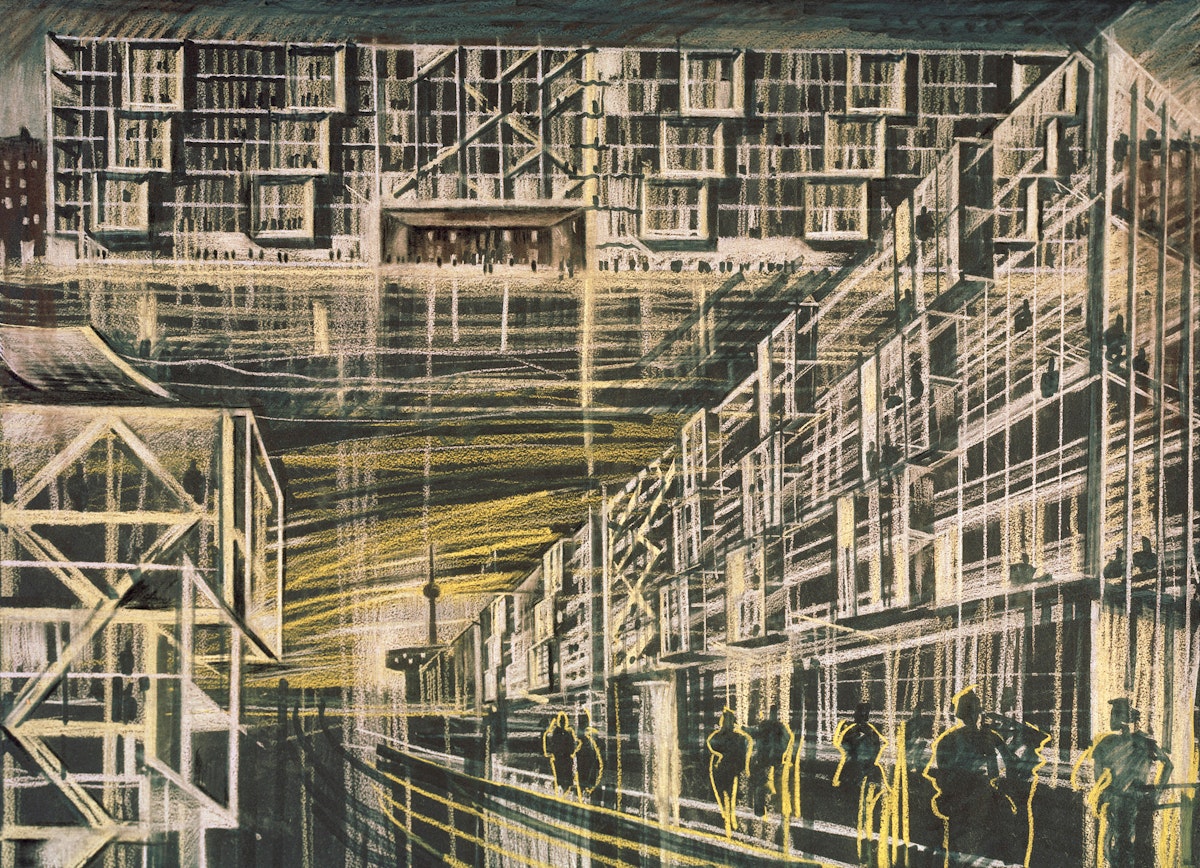
Projections. Dockyard Berlin by Sergei Tchoban | Jury Winner, Sketch, 2025 Vision Awards
In sketches, nothing is ever final. Tone, shading and color are instruments used to construct a mood and, at the same time, resist absolute resolution. A sketch does not necessarily occupy the full page; it leaves blurry edges, vague corners or overlapping spaces that invite subjective interpretation. This mode of thinking is entirely speculative, opening up fields of operation instead of synthesizing a single solution.
The Projections. Dockyard Berlin is a sketch composition that approaches a single building concept from different angles. An elevation, a perspective and a partial section are all exploring the idea of a timber hybrid Dockyard complex in Berlin’s Osthafen harbor, on the banks of the river Spree. Black and yellow hues dominate the drawing, while thick pencil lines provide direction, urging the viewer to focus on specific atmospheric moments: the people who trail patiently near the docks or what it looks like to approach the building from the shore. Together, these fragments form a sequence of lived moments.
Best practice: Use mood to frame what remains unresolved.
5. Imperfection Signals Observation in Progress
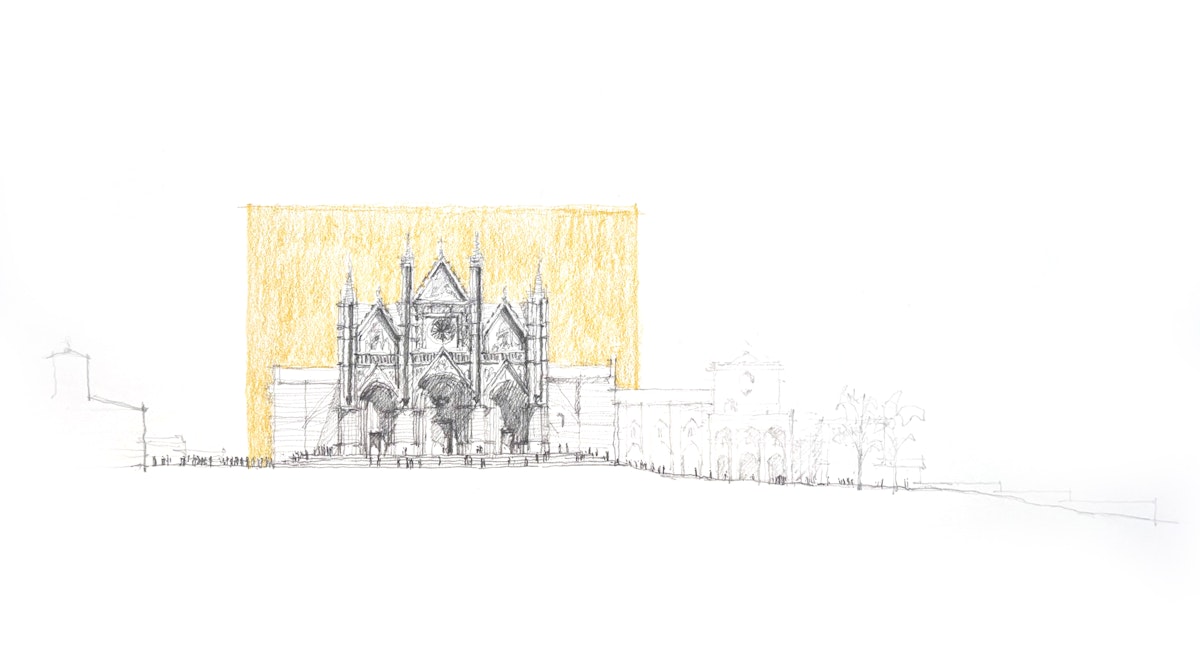
Piazza duomo, orvieto by Vance Lor | Finalist, Sketch, 2025 Vision Awards
Sketching is the perfect medium for early surveys. Although surveys need to be precise in the later stages of the design process, survey sketches are ideal for understanding an existing structure rather than abstracting it into certainty. Specifically, a smudge or a correction, as well as uneven proportions or inaccuracies, capture the instances of observation and reveal the aspects that the eye found (at that moment) interesting or important. Unpolished survey sketches, therefore, are almost forensic, approaching the site as a scene for investigation — an act of comprehension rather than mere recording. The Piazza Duomo sketch, for example, embodies this mindset, crafting a moment when the Duomo towers are bathed in sunlight, focusing on the shadows cast in the façade rather than the building as a whole.
Best practice: Let the act of looking remain visible in the sketch.
Together, these best practices enable architects to use sketching as a resilient form of architectural intelligence and not merely as a nostalgic drawing medium. In that sense, the sketch operates as a tool for testing ideas, prioritizing uncertainty over resolution and revealing “what is important”. When done right, it becomes the most agile form of architectural drawing — one that thinks alongside the architect.
The votes for the 2025 Vision Awards have been counted! Discover this year's cohort of top architectural representations and sign up for the program newsletter for future updates.
The post Anatomy of a Standout Sketch appeared first on Journal.