







Tropical hardwood and reinforced concrete form House in Minami-Azabu


Architect Keiji Ashizawa saw the planning process as "solving a puzzle" when creating this house in central Tokyo, which features wooden louvres for privacy.
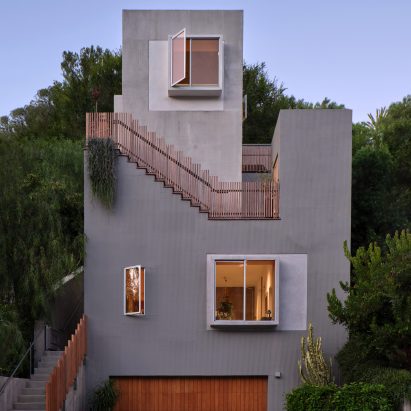
Designed for a couple and their three children, the three-storey House in Minami-Azabu – named after the neighbourhood in which it's located – sits next to a residential street on its southern side and a temple ground to the north.
To balance privacy and openness, the studio added wooden louvres and greenery to the house on the southern side.

Meanwhile, the northern facade is set back from the edge of the plot and features sliding shoji screens.
"The planning process was almost like solving a puzzle, but we believe the project works both as a spatial composition and as an actual lived environment," Ashizawa told Dezeen.
"By fully developing elements such as the balcony louvres and planting, large terraces, a rooftop garden, and a small garden in front of the bedroom, we were able to create a calm and generous living environment despite the dense urban context."

The location also influenced the interior layout of the building, which has private spaces on the first and second floors and an open-plan living and dining space on the third floor.
"Placing the living and dining spaces on the third floor was decided at an early stage of the planning process, as it allowed us to directly connect them to a large terrace and an open rooftop garden," Ashizawa explained.
"This configuration makes it possible to enjoy a greater sense of openness, light, and sky, while maintaining distance from the street and surrounding buildings – an important condition for comfortable living in the city."

Reinforced concrete was used as it is a suitable material for both the city surroundings and regulations, and for creating terraces and rooftop spaces.
"Reinforced concrete was selected after considering Tokyo's climate, the fire-resistance requirements of urban housing, as well as acoustic performance and vibration control," Ashizawa said.
"In addition, because terraces and rooftop spaces play a significant role in this house, reinforced concrete was judged to be the most suitable structural material in terms of waterproofing performance and long-term durability."
Ashizawa chose ipe, a tropical hardwood that is highly weather-resistant, for the loures that decorate the southern facade, which the studio added to help control views into the house.
"Combined with planting, the louvres help soften sightlines while maintaining ventilation," he said. "Wood was chosen to prevent excessive heat buildup and to create a more comfortable and breathable interface between the interior and exterior."

Creating a connection to nature was an important part of the project, with the studio adding traditional Komatsu stone for paving at the entrance of the home to evoke the feel of a Japanese garden.
On the third floor, the dining area opens directly onto the terrace, which was designed to merge with the greenery of the temple gardens behind. A spiral staircase leads onto the rooftop, creating additional outdoor space.

Inside, Ashizawa added a large skylight to illuminate the interior. The colour palette is kept mostly neutral, with natural wood and greige hues used throughout.
In the living space, which features a stone fireplace, slim dark tiles decorate one wall and match the dark-hued furniture.
"A bar counter is placed between the dining and living areas, and the top floor has many openings, including skylights, which provide ample daylight during the day," Ashizawa said.

"For this reason, we chose darker-toned materials to bring balance and depth to the space," Ashizawa continued.
"The inclusion of a fireplace also influenced this decision, helping to create a calm and grounded atmosphere. We also anticipated the experiential effect of gradual tonal change as one moves up the stairs, allowing the character of the space to shift subtly floor by floor."
Other recent residential projects by Ashizawa include another house with louvres in Aoyama and a minimalist apartment lined with local wood.
The photography is by Tomooki Kengaku.
Project credits:
Architect: Keiji Ashizawa Design
Project architect: Keiji Ashizawa, Kenji Kawami
Structural engineer: AS Associates Akira Suzuki
Construction: SHIN
The post Tropical hardwood and reinforced concrete form House in Minami-Azabu appeared first on Dezeen.