








Tristan Burfield adds bushfire-resilient annexe to coastal holiday home in Australia


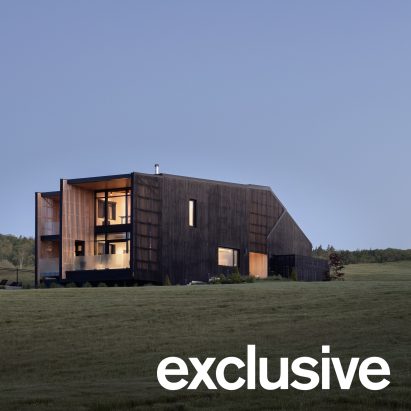
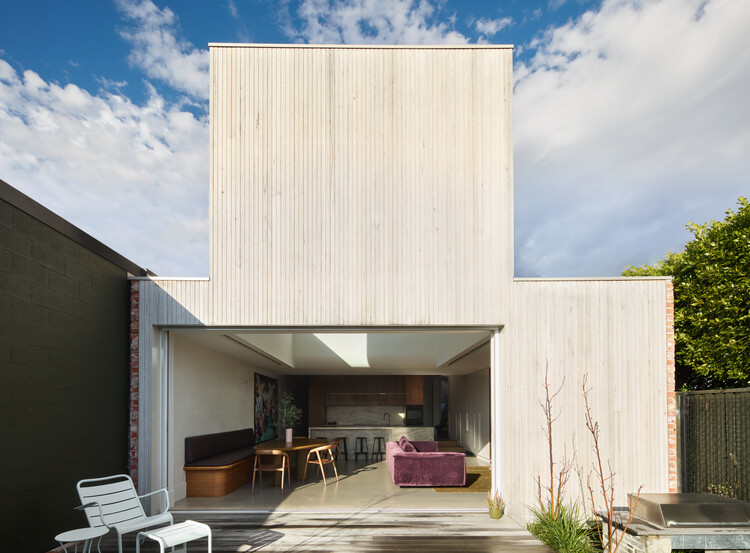
Architect Tristan Burfield used a palette of galvanised steel and Blackbutt timber to meet bushfire regulations at No. 23, a small annexe he has added to a holiday home in Australia.
Located close to Eagle Rock on Victoria's southern coast, the annexe provides additional sleeping areas for a larger holiday home on the site, which is set among bushland, surf beaches and limestone cliffs.
Burfield used what he termed an "agricultural" palette of timber and galvanised steel for the design, leaning into the area's mandatory bushfire design requirements rather than viewing them as an obstacle.

"I rather enjoy taking seemingly boring or prescriptive building conventions or codes and trying to find the little moment to lever them just enough to be something special," Burfield told Dezeen.
"I think of it as a sort of craft of composition. The fun in this project became those subtle pairings of ultimately quite agricultural materials and detailing solutions into a composition of little architectural moments, just enough to be quietly enjoyed," he added.
No. 23 has a simple L-shaped plan organised around a paved garden, overlooked by an ensuite bedroom and bunk room through tall windows set within skinny timber frames. These are made from Blackbutt timber, a type of Australian hardwood with natural fire resistance.

Above these frames are panels of galvanised steel, which extend into a shallow canopy punctured by circular openings for rain chains that will gradually be covered by climbing plants.
Matching galvanised steel was used to frame both the openable windows and doors of the annexe, which match the tall, skinny proportions of the windows.

Inside, timber planks line the walls of No. 23, while the metalwork of the exterior is carried through into the bathrooms in a raw steel "trough" sink.
The main bedroom is organised around a freestanding log burner and alongside the bunk room is an additional bathroom.
"Lifting the bottom edge of any external window glazing away from the external floor surface is a direct requirement within that standard that is often the bane of many architects lives," Burfield explained.
"In this case, the decision to continue the window frames down to ground and substitute the lower-level glazing with timber cladding and steel at the doors respectively resulted in a lovely little moment inside and out that would otherwise not have been explored," he added.
"The steel originally came into the palette due to the owner's frustration with a previous external timber door that had sagged."

Other homes in Australia that have made a feature of the need for bushfire-resilient materials include Ironbark House by Klaus Carson Studio, which is clad in panels of corrugated steel, and Mt Coot-Tha House by Nielsen Jenkins, which has high blockwork walls.
The photography is by Tasha Tylee.
The post Tristan Burfield adds bushfire-resilient annexe to coastal holiday home in Australia appeared first on Dezeen.