







The top 10 Chinese buildings of 2025


Continuing our 2025 Review, China editor Christina Yao selects the year's best Chinese architecture projects including grand schemes by international studios BIG, OMA and Zaha Hadid Architects, as well as small-scale pavilions from local studios.
Yohoo Museum, Hangzhou, by Aedas
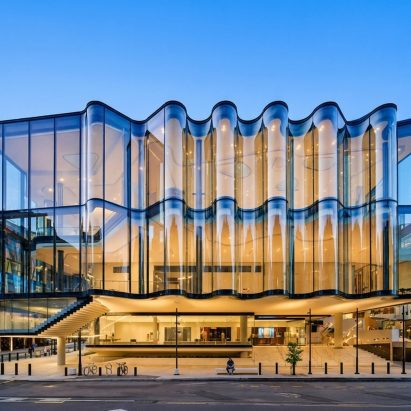
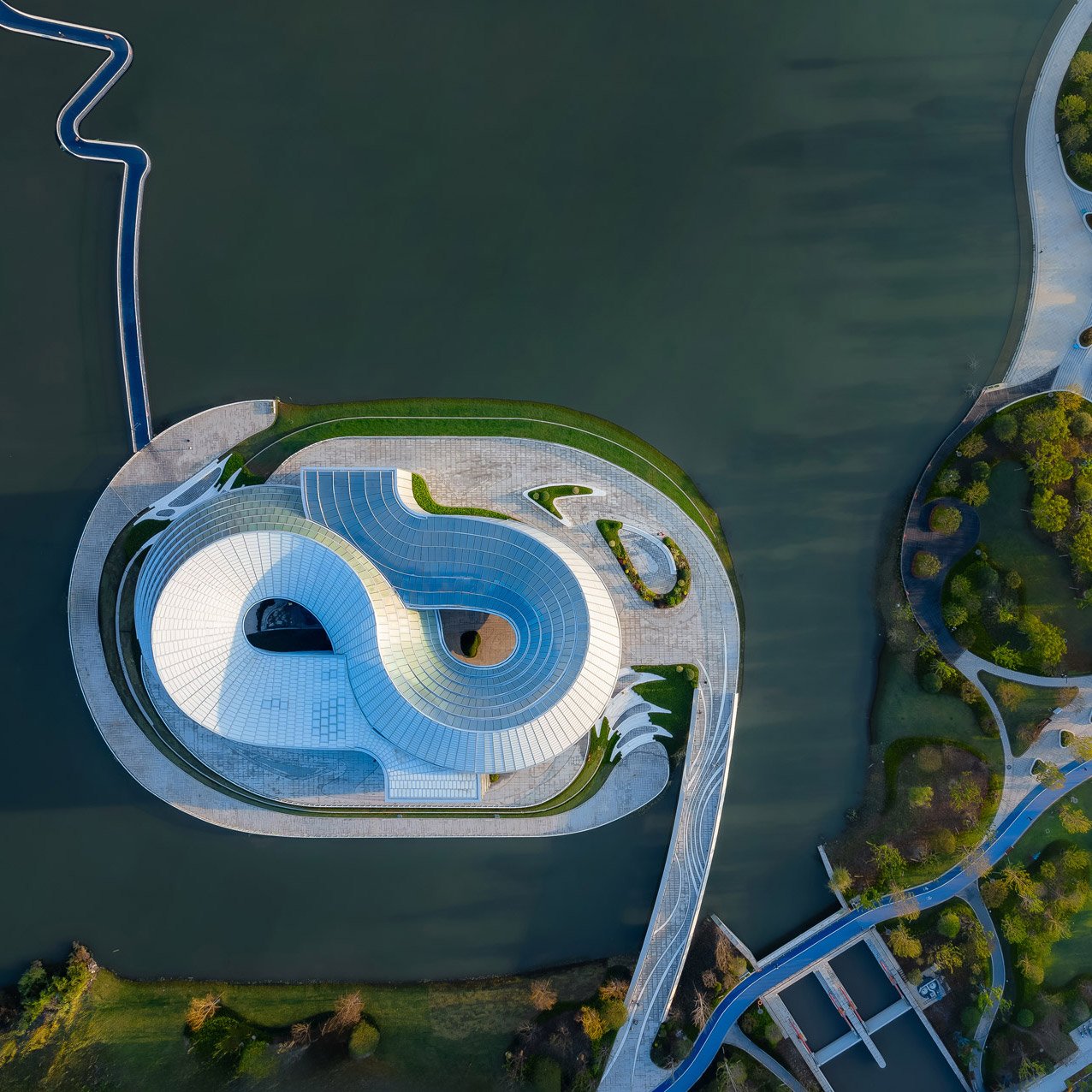
Designed by architecture studio Aedas, Yohoo Museum features an undulating roof that is shaped like an infinity loop comprised of two interlocking rings.
The interlocking rings create two circular light wells, which according to the studio, symbolise the connection between heaven and earth. The two ends of the museum were gently raised off the ground without visible support, creating the entrances to the museum.
Entirely clad in glass, the crystal-like quality of the translucent, multi-layer, laminated glass, known as "emerald glass", was intended to imitate jade's gentle warmth.
Find out more about Yohoo Museum ›

The Seaside Pavilion, Chaishan Island, by GN Architects
Designed as a gateway to the remote island of Chaishan, The Seaside Pavilion is sheltered by a canopy of leaf-like sails.
Local studio GN Architects used fishing nets to create the 36 slender blades that form the pavilion's canopy, with each connected to a central axis that allows them to move with the sea breeze.
Visitors are invited to rest and watch the sea while sitting on the benches located at the base of the timber frame. A reinforced-steel platform was added to support the lightweight timber frame to withstand strong ocean winds and typhoons.
Find out more about The Seaside Pavilion ›

Drifting Stones pavilion, Chongqing, by DoDesign
Informed by a large flat-topped boulder, Chinese studio DoDesign perched this fully-glazed viewpoint on a rocky site in Chongqing.
Designed to immerse visitors within this dramatic landscape, the main viewing area is concealed beneath a stepped stack of cement-coated slabs that imitate natural stones.
The stone-like roof elements were created by covering steel frames with poured cement mixed with local stone powder, which was then hand-chiselled by local artisans to mimic the textures of the surrounding rocks.
Find out more about Drifting Stone pavilion ›

The Louis, Shanghai, by Louis Vuitton
A new landmark in central Shanghai, the boat-shaped concept shop is wrapped in a metallic skin printed with Louis Vuitton's monogram.
The first two floors of the three-storey shop contain an exhibition that showcases the brand's culture and history, while a cafe with a sunken terrace occupies the top floor.
According to Louis Vuitton's in-house design team, the boat shape pays homage to Shanghai's port culture as the "gateway to the east", while also nodding to the brand's history of crafting trunks for ocean voyages.
Find out more about The Louis ›

Jomoo headquarters, Xiamen, by OMA
Dutch architecture studio OMA created the 105-metre-tall skyscraper as the office campus for Jomoo, China's largest sanitaryware company.
Informed by the rocky and mountainous terrain of Fujian province, OMA designed a mountain-like base for the tower by pulling up the podium to form a series of angles on the facade.
The studio also added white ceramic stripes to the glazed facade, to evoke the window tracery that is commonly seen in local architecture and reference the main material used in Jomoo's products.
Find out more about Jomoo headquarters ›

This ring-shaped visitor centre was designed to celebrates the history and culture of the nearby UNESCO World Heritage site known for its 1,600-year-old caves, grottoes and Buddhist carvings.
ZXD Architects and BIAD referenced the importance of circumambulation in Buddhism – the ritual act of moving clockwise around a sacred site – in their design, by creating six volumes in the ring-shaped form that guides visitor movement.
The six volumes also reference the Six Paths of reincarnation in Buddhism, encircling a pool of water. Each volume is clad in sandstone panels, nodding to the geology of Maiji Mountain.
Find out more about Maiji Mountain Visitor Centre ›

AYDC Public Art Centre, Guiyang, by Atelier Xi
Atelier Xi created an art centre in three sculptural stone-clad pavilions that house a library, events space and an outdoor stage. Drawing inspiration from the native karst cave formations of Guizhou province, each of the pavilions features a distinct, carved-out interior.
The library sits beneath a large, vaulted ceiling, with a sunken reading pit at the centre surrounded by full-height glazing.
The chapel is formed by four bulging walls shaped like inverted arches that create an intimate events space, while the central stage is defined by a single arched section sheltering a concrete plinth.
Find out more about AYDC Public Art Centre ›

The Suzhou Museum of Contemporary Art, Suzhou, by BIG
Designed by BIG in collaboration with ARTS Group and Front Inc, the Suzhou Museum of Contemporary Art is located next to the Jinji Lake waterfront.
According to the studio, the architecture of the museum reinterprets "lang" – a long, sheltered corridor connecting various pavilions commonly seen in centuries-old Suzhou gardens.
Each of the museum structurs was clad in rippled and curved glass and warm-toned stainless steel, reflecting the surrounding sky, water, and gardens.
"Our design for the Suzhou Museum of Contemporary Art is conceived as a garden of pavilions and courtyards," said BIG founder Bjarke Ingels. "Individual pavilions are woven together by glazed galleries and porticoes, creating a Chinese knot of interconnected sculpture courtyards and exhibition spaces."
Find out more about The Suzhou Museum of Contemporary Art ›

Greater Bay Area Sports Centre, Guangzhou, by Zaha Hadid Architects
In Guangzhou, Zaha Hadid Architects and local studio Guangdong Architectural Design and Research Institute (GDAD) designed a stadium informed by the hulls of traditional sailing ships from the Song Dynasty.
The centre includes a 60,000-seat stadium, a 20,000-seat arena for basketball and indoor events, and a 4,000-seat aquatic centre with a swimming pool and diving well.
The roof of the stadium was designed as a system of layers that help passively cool and ventilate the buildings, which Zaha Hadid Architects described as "emulating the pleated silk structures of traditional Chinese fans".
Find out more about Greater Bay Area Sports Centre ›

Pujiang Platform, Chengdu, by MVDRV
Dutch studio MVRDV revamped a viewpoint in the hills of Chengdu to blend in with the landscape, featuring domed roof covered in grass and a projecting balcony that overlooks the new town of Pujiang.
Used as a visitor destination and event space, Pujiang Platform was built from timber to show respect to the nature of the site and reduce embodied carbon.
Inside, the roof of the structure slopes upwards, while the floor slopes down, creating what MVRDV describes as a "telescopic" effect that draws "visitors to the expansive viewing window and balcony that projects out over the slope".
Find out more about Pujiang Platform ›
The post The top 10 Chinese buildings of 2025 appeared first on Dezeen.