







Ten highlights from Melbourne Art Fair's first collectible design salon


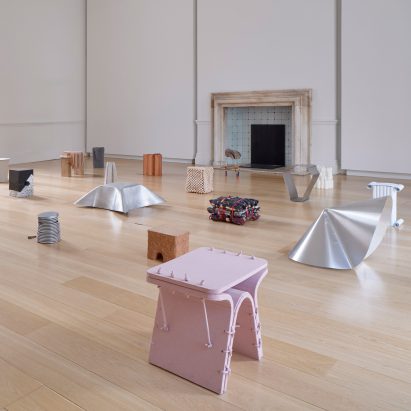
Futureobjekt, the inaugural collectible design salon held within Melbourne Art Fair, gathered some of Australia's most forward-thinking designers to present contemporary design and crafted objects.
Twenty leading Australian designers and studios were invited to present curated selections of their work, including new collections created exclusively for Melbourne Art Fair – the longest-running contemporary art fair in Australia.
From mushroom-like lamps made using Venetian glassmaking techniques to a series of furniture that can be folded into flat sheets, here, Dezeen has chosen ten key pieces from this year's Futureobjekt.

U lights and vases, by Anna Varendorff, Melbourne
Multidisciplinary artist and designer Anna Varendorff’s installation marks the first Melbourne Art Fair Design Commission to be presented first at the fair and later at National Gallery of Victoria.
Suspended ceiling lights in a series of interlocking modular units — each comprised of one upright and one inverted tube — formed a rhythmic composition that cast light both above and below.
Large-scale floor vessels in corresponding U-shaped tube forms were created to hold plants and flowers on the ground.

ReStitch, by Adam Goodrum, Sydney
ReStitch is a series of folding furniture in mirror-polished stainless steel. It is the latest evolution of industrial designer Adam Goodrum's iconic "Stitch" chair, released and manufactured by furniture brand Cappellini in 2008.
Comprising a chair, a side table and a table, each piece in the collection could be folded into a flat sheet, thanks to a fully integrated hinge and bisecting zig-zag knuckles connected by a shared pin.

Oxide, by Locki Humphrey, Melbourne
The Oxide collection, presented by artist and furniture maker Locki Humphrey, transformed waste materials into furniture and included a lamp, an occasional chair, shelving, a coffee table and wall designs.
Discarded steel and textile waste from industrial manufacturing were recycled to create the furniture collection, which also features timber stained with iron oxide derived from metal waste.
Additionally, a leather alternative was developed from the production waste of harvesting the local prickly pear tree, which, according to Humphrey, is an abundant invasive species and identified as one of Australia's worst weeds.

Comfort Zone, by Beci Orpin x Softer Studio, Melbourne
Comfort Zone is a collaborative work of artist Beci Orpin and Softer Studio, led by furniture designer Dustin Fritsche to explore the intersection between craft, material and technology.
The playful motifs in the collection were based on the shared grid image between traditional craft forms, such as filet lace and cross-stitch, and pixelated screens commonly seen in technology.
The title, Comfort Zone, reflects the tension within their collaboration: while Orpin works with soft textiles and digital imagery, Softer Studio shapes solid timber into tactile forms.

Pillar, by Dean Norton, Melbourne
Comprising tables, mirrors, and lighting, multidisciplinary designer Dean Norton's Pillar furniture collection was defined by its serrated edges.
Vertical layers of handcrafted wood and glass created geometric compositions that contrasted the smooth reflective surfaces, which the designer described as merging "sculptural elegance with architectural form".
All his furniture is manufactured in Melbourne, where Norton works closely with local factories and craftspeople.

Translations, by Don Cameron, Sydney
Don Cameron, the music video director-turned-designer, presented his limited-edition furniture collection "Translations", informed by his photography series of brutalist architecture in Europe.
Nevers Stool is reminiscent of the monolithic form of the Church of Sainte-Bernadette du Banlay in Nevers, Burgundy, designed by architect Claude Parent, but the furniture piece was crafted with black American walnut instead of concrete.
Bloc Floor Lamp 01, meanwhile, was made from patinated sheet steel and referenced the stacked rectangular blocks of the Wotrubakirche church in Vienna.

Pliz Collection, by Volker Haug, Melbourne
Pliz Collection comprised twelve lamps of various sizes, shaped like mushrooms. Volker Haug Studio travelled from Melbourne to Venice to work directly with Murano glassmakers, the Venetian artisans who mastered the 4,000-year-old technique.
Each lamp was blown in Murano, Italy, and given coloured floral or geometric patterns that were made from glass rods and revealed in cross-section when cut.

Cor Light, by Tom Fereday, Sydney
The Cor Light collection was made from a series of stone and aluminium towers with soft lighting interiors, revealed within an oval cut out on each of the surfaces.
Named after the Latin word for "heart", designer Tom Fereday exposed sections of the materials through an angled dissection that "speaks to the beauty of natural stone and raw cast aluminium", he said.

Basalt Shelf, by Dalton Stewart, Melbourne
The Basalt Shelf was designed by Dalton Stewart to demonstrate basalt's raw surfaces, in combination with the precision of laser-cut steel.
Stone and steel were interlocked through gravity and dry joinery, without the use of adhesives or mechanical fasteners.

Flute side table, by Zachary Frankel, Melbourne
Crafted from a solid piece of salvaged cypress, the short-lived trees commonly grown in Victoria, the Flute side table featured natural cracks and knots from the wood that will change as it ages.
According to designer Zachary Frankel, the effect was achieved by hand-brushing the wood with Milk Paint, a traditional paint that mixes pigments with milk protein and leaves the brush marks visible on the surface.
Alternatively, Frankel would burn the wood using Shou Sugi Ban, a Japanese charring technique. The latest edition of the Flute side table was brushed with aluminium or textured powder coat finishes.
Futureobjekt took place during Melbourne Art Fair from 19 to 22 February at Melbourne Convention and Exhibition Centre. For more installations, talks and fairs in architecture and design, visit Dezeen Events Guide.
The post Ten highlights from Melbourne Art Fair's first collectible design salon appeared first on Dezeen.