









Ross Barney Architects exposes mechanical elements at Illinois technical school


Chicago-based practice Ross Barney Architects has highlighted ducts and machinery at an industrial-style community college building outside of Chicago, USA, to expose students to the very mechanical systems taught at the school.
The Foglia Center for Advanced Technology and Innovation (CATI) at McHenry County College (MCC) was designed for technical education in Crystal Lake, Illinois, outside of Chicago.

Studio founder and AIA Gold Medal recipient Carol Ross Barney expressed pride over the project and said she worked with her team and the client to create a "noble" space for the students that also demonstrates mechanical principles learned by student occupants.
"I like this term, noble space," Ross Barney told Dezeen. "They couldn't just fulfil the purpose of being a lab. [The client] wanted it to be aspirational."

The long, horizontal building is partially embedded into the site and is divided lengthwise. One side has two floors for smaller classrooms and labs. On the other side, it is double height to provide plenty of space for the massive workshops.
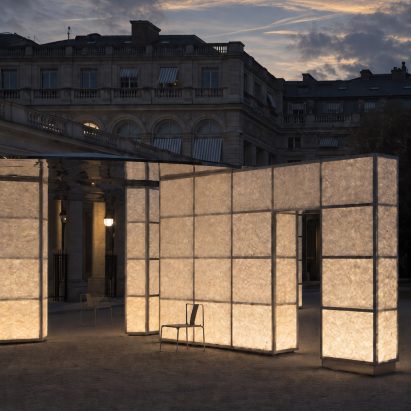
Its exterior is industrial in character, with large stretches of grey brick accented by semi-transparent polycarbonate pannelling, which, at night, gives the building a "cathedral-like" glow.
"[The glow] makes it noticeable and recognises its importance," said Ross Barney, who added that the relatively simple materials allowed for them to be cost-efficient for the project.

In addition to the glazing along the facade, the polycarbonate helps insulate the energy-intensive structure while allowing for additional natural light.
In the centre of the structure, a long monitor window projects from the roof, bringing additional light into the double-height atrium that separates the two sides and serves as the primary circulation for the building.

Inside, the studio left much of the corrugated metal used for the ceiling structure exposed, with white-painted I-beams and cross bars defining the space.
The main entrance is on the ground floor of the laboratory bar and features a polished concrete library with social steps. The steps meet glass and appear to extend outside; both staircases lead up to the secondary entrance area on the top floor of the classroom aspect.

Yellow detailing was used on some of the walls to create visual distinction among the different spaces, and was also used in some of the furniture.
A catwalk above the circulation atrium leads between the second-storey classrooms and other floating classrooms that are suspended above the workshops.
Ross Barney said that the exposed mechanical elements of the building allow students, especially those in the HVAC programme, to see the way a building functions in real time.
In some cases, even the machine rooms were given windows so that students could see them.
"Exposing those beautiful industrial parts really added so much to the design," said Ross Barney.
"We thought that if this is what they're repairing, we should show them where these things are on the building. If that's what you're here to learn, you might as well look at the ones that are running this building. That was our theory."

While Ross Barney Architects is well known for its high-profile public projects, such as the Chicago River Walk and transportation projects, including rail stations and upcoming work on Chicago's airport extensions, Ross Barney said that projects such as this work well with its "analytical approach to design".
Other laboratories completed by the studio include one for NASA in Cleveland.
The photography is by Kendall McCaugherty, Hall+Merrick+McCaugherty Photographers.
The post Ross Barney Architects exposes mechanical elements at Illinois technical school appeared first on Dezeen.