







Reed Watts puts contemporary spin on half-timbering for visitor centre in Kent


London studio Reed Watts has completed a visitor centre for the medieval Ightham Mote manor house in Kent, creating an exposed timber and hempcrete structure that mimics the Grade I-listed building.
Operated by the National Trust, the 317-square-metre centre provides a reception, shop, storeroom and offices within the walled garden of the manor house, to accommodate an increase in visitor numbers.

Reed Watts designed the centre as a contemporary take on the design of Ightham Mote itself, using an exposed timber frame infilled with hempcrete and lime render to mimic its half-timbered, wattle and daub structure.
Half-timbering is a traditional form of construction where a load‑bearing timber frame is left exposed on a building's exterior.

"We looked at a number of sites for the building and opted to build next to the National Trust's original, 'temporary' ticket office that it built when taking over the property in 1985," explained Reed Watts co-founder Matt Reed.
"From here, there is a beautiful journey down to the house where its chimneys, roofs, timber frame and moat gradually appear from between the trees as you walk down into the valley," he told Dezeen.
"A key concept for us was to design a building that honours the construction of the existing timber-framed Manor House through a simple expression of the construction materials."

To reduce its visual impact, the ground floor of the centre is "hunkered down" below the height of the surrounding garden walls, with only its smaller, lantern-like clerestory level visible through the surrounding trees.
This lantern, framed by reddish-brown metalwork, pulls light into the shop at the building's centre, where exposed timber columns sit against walls of precast hempcrete blocks.

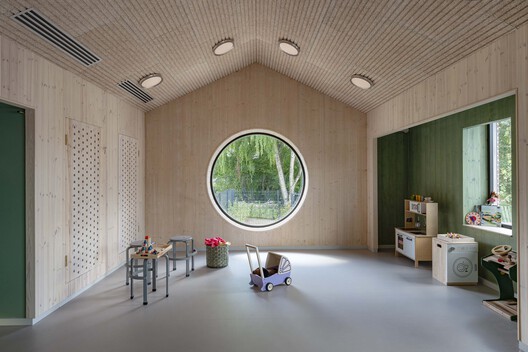
Facing north, a large round window aligned with the central axis of the walled garden gives visitors a glimpse of the site as they move into the adjacent reception, which opens out onto a patio beneath a timber pergola.
Externally, the hempcrete walls that infill the timber frame have been coated in pale lime render, while the windows are framed by sections of sweet chestnut battens.
"Almost everything is on show from the timber frame with steel flitch plates, hempcrete walls and lime render exterior," Watts said. "The house acted as inspiration with its exposed timber frame, lime render, brickwork and stone detailing."
"The clerestory forms the main focal point for the space, but it's a simple round window on the northern elevation that has created the most interest from visitors," he added. "Kids especially love to sit in the window and visitors regularly take photos through it to the garden beyond."

The centre incorporates an air-source heat pump, natural ventilation strategy and high levels of insulation, and according to the studio, outperforms the framework set out in the Royal Institute of British Architect's Sustainable Outcomes Guide for 2025 by over 25 per cent.
In addition to creating the visitor centre, the London-based studio worked with landscape architects Colvin & Moggridge to improve the surrounding gardens, adding drainage systems and new parking areas.

Reed Watts was established in 2015 by Watts alongside Jim Reed. The studio was previously part of a team that completed a creative centre alongside Camden's Roundhouse clad in old railway sleepers.
Other visitor centres recently featured on Dezeen include a ring-shaped building dedicated to Maiji Mountain in Tianshui and a proposal for a rock-like structure on Taiwan's coastline by MVRDV.
The photography is by Fred Howarth.
The post Reed Watts puts contemporary spin on half-timbering for visitor centre in Kent appeared first on Dezeen.