







PPAA utilises "subtractive design" for concrete house in Los Angeles


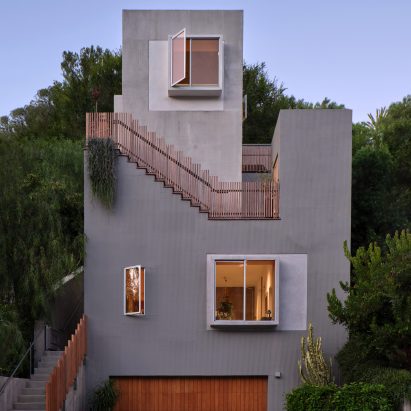
Mexican studio PPAA has created a blocky concrete house on a narrow site in Los Angeles, California, USA, carving out courtyards and voids into the form.
Known as Mar Vista, the 4,488-square-foot (417-square-metre) house is a practice in what the studio called "subtractive design", a way of reframing the site's restrictions and opportunities.

"The project embraces the setbacks, height limits and footprint regulations of its site and transforms them into spatial strategies," said PPAA founder Pablo Pérez Palacios.
"By carving out patios and carefully aligning openings, the house creates a sequence of spaces where light, air and landscape are always present."

It features stepped massing that adapts to the narrow lot, allowing it to be open to the climate with patios and voids that blur the boundaries between interior and exterior spaces.
"The focal point is the alignment of openings that run across the house, generating long transversal views and connecting interior spaces with patios and the surrounding landscape," the studio said.
"This spatial continuity ensures that the central courtyards and voids become the true heart of the project, bringing daily life into direct dialogue with light, vegetation and the sky."

The circulation spaces run through the courtyards, creating a rhythm of open and closed spaces, curved and rectilinear forms, while ensuring that natural light and ventilation carry through the house.
"The success lies in demonstrating that a house can be both a response to limitations and an act of freedom," the studio continued.
"By aligning openings and using subtraction, the project achieves generosity and openness within a constrained urban context. The lesson is that restrictions can generate stronger, more poetic architecture."

The design is composed of exposed light-toned concrete with a raked finish. In addition to plaster, light stone and untreated wood, the concrete was selected for its durability and natural weathering pattern in the coastal climate.
"The restrained palette of raw and tactile materials allows it to feel both grounded and discreet within the neighborhood fabric," the studio said.

Inside, the studio introduced refined elements like oak joinery and polished concrete floors to the honest materials of the outside, creating a consistent atmosphere between interior and exterior.
In addition to the passive ventilation strategies, the design employs deep overhangs to shade the spaces and photovoltaic panels and rainwater collection systems to reduce the environmental footprint.
"The interplay of curves and straight lines, solids and voids, gives the house a sculptural quality while maintaining a human scale," the studio said.
"Rather than projecting as a statement, the house integrates itself quietly into its context, privileging intimacy, light and material honesty."

Previously, PPAA has worked on a coastal guesthouse with rammed earth in Baja California, a terraced home in the forest of Valle de Bravo – both in Mexico – and a Swiss villa with a reflective "water mirror" near Lake Zurich.
The photography is by Fabian Martínez unless otherwise stated.
Project credits:
Architecture: PPAA
Team: Pablo Pérez Palacios, Emilio Calvo, Miguel Vargas, Alice Moreno, Jonathan Reséndiz, Nancy Estévez
The post PPAA utilises "subtractive design" for concrete house in Los Angeles appeared first on Dezeen.