








Lebanese students create drone noise-blocking headphones and more designs for life under conflict


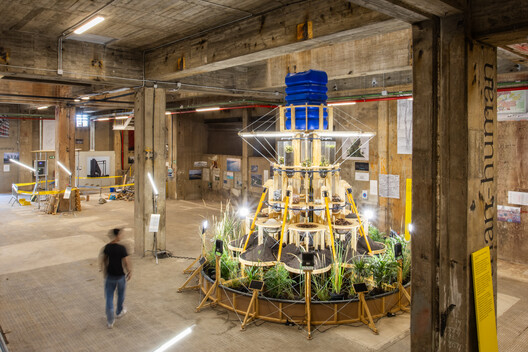
Design and architecture students from Lebanon have tackled some of the biggest challenges facing their country in the exhibition Design in Conflict, held in Beirut's notorious abandoned Burj El Murr skyscraper.
A kit to block out the sound of drones and an adaptive reuse proposal for the silos at the heart of the 2020 Beirut port explosion were among the projects in the show, organised by online platform Archifeed along with product designer Youssef Bassil and design engineer Tark Mahmoud.

Design in Conflict took place during the We Design Beirut festival, which has been held for the last two years despite Israel's ground invasion and continued strikes in nearby southern Lebanon.
Within this context, Archifeed co-founders Teymour Khoury and Yasmina Mahmoud felt that the best way to channel their support for the country's young designers and architects was to have them address the realities of war and conflict.

The attainment of Burj El Murr as an exhibition venue was a stroke of luck enabled by We Design Beirut's existing working relationship with Solidere, the development company that now owns the building and is leading the reconstruction of central Beirut.
Construction on the Burj El Murr began in 1974, when Beirut was flourishing economically and culturally, and ended mid-build when the civil war broke out in 1975.

"This ambitious project turned into a sniper's nest," Mahmoud told Dezeen. "Burj El Murr really signified the violence of the civil war."
"It was the highest tower in the city, so it was really an amazing vantage point. Whoever had control of Burj El Murr basically had control of the city."

For Mahmoud's generation, too young to remember the civil war, the empty tower looming over the city became a reminder of Lebanon's constant "state of interruption".
"We were so happy to host [the exhibition] in a space that really needed this sort of dialogue," Mahmoud said.

Design in Conflict featured 58 architecture and design projects from nine universities across Lebanon.
The students developed the works within their courses in response to a brief from the Archifeed team, who then helped them hone the strongest projects during a summer bootcamp.
The curators urged students to resist "comforting" narratives around post-war reconstruction and instead explore how designers can really navigate conflict, expose its mechanisms and engage with people's needs.
Several of the architecture students focused on Lebanon's most famous sites of the last decade.

Joe Maatouk's project, Runway 17: An Index of Dysfunction, envisions a way to bring an unused runway at Beirut Airport back into service by raising the airstrip above the height of an adjoining informal settlement that obstructs its use.
At the same time, he proposed a conflict-specific aviation academy and museum to be built under the sloped earth, turning the infrastructural challenges caused by instability and displacement into an opportunity for education.

Another architecture project, Accretions of the Port by Nour Atallah, tackles the site of the 2020 Beirut Port explosion, envisioning its reuse as a "layered museum" that evolves over time to reflect the "continuum of structural shocks" that have marked the harbour.
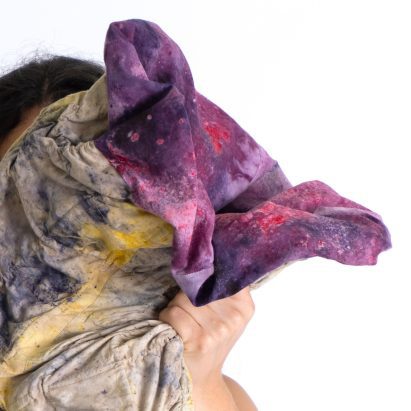
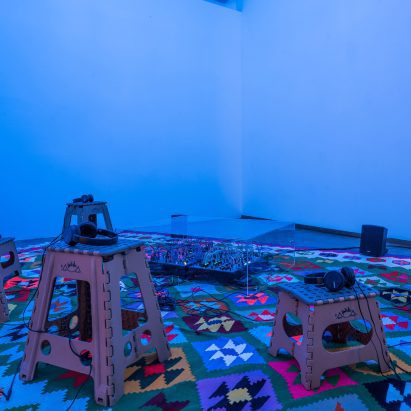
Most of the design projects address problems common to contemporary conflicts all over the world. Rhea Bassil's Sonic Protection Kit offers relief from the psychological torment of constant drone noise and was designed for mass production and distribution through humanitarian aid.
Christy Asfar and Hanady Estephan's Deskrest is a classroom desk and chair that transform into a bed, for when schools are turned into shelters, while Marc Khalil's Survive, Live, Thrive is a kind of instruction manual for transforming everyday items into wartime essentials.

"In Lebanon, conflict is not a rupture in an otherwise stable terrain but a mode of existence, a lens through which the built environment, material landscapes and lived realities are continuously reconfigured," the exhibition organisers said in their curatorial statement.
"These works do not seek to define what comes after conflict. They insist on engaging with what emerges through it."
Images of the exhibition are by Leva Saudargaite, all others courtesy of the students.
The Design in Conflict exhibition took place from 22 to 26 October at the Burj El Murr during We Design Beirut. See Dezeen Events Guide for an up-to-date list of architecture and design events taking place around the world.
The post Lebanese students create drone noise-blocking headphones and more designs for life under conflict appeared first on Dezeen.