














HKS releases first design of colonnaded Washington Commanders Stadium


Architecture studio HKS and NFL team the Washington Commanders have revealed images of a "monumental" stadium wrapped in a colonnade, set to be built in Washington DC.
With a capacity of more than 70,000, the Washington Commanders Stadium at the RFK Campus was designed by HKS to be monumental, both in its sheer size and impact on the Washington DC skyline.
It will be wrapped in a white colonnade that recalls the city's civic monuments including the Lincoln Memorial.

According to the team, it was designed with respect to the layout of Washington DC – known as the L'Enfant Plan – with deference to the Capitol Building and the RFK Stadium that is currently on the site.
"Every design decision is guided by the significance of place – shaped by its local, regional and national history and generations of memories rooted in RFK Stadium," said HKS global venues director Mark A Williams.
"Monumental in presence, grounded in the L'Enfant Plan and scaled to the urban fabric of the district, the stadium design will be a bold civic landmark that carries the city’s architectural legacy forward in a way that is confident, dynamic and unmistakably Washington, DC."

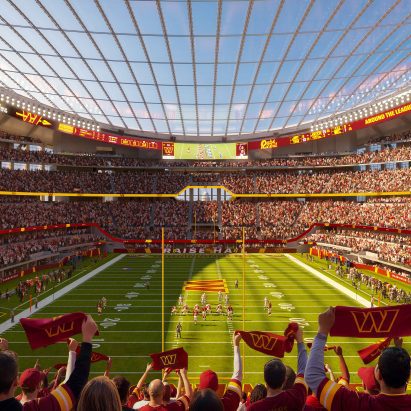
Positioned on a roundabout interchange adjacent to the Anacostia River and the parklands of the RFK Campus, the stadium will have a cable-net, anti-clastic glass roofing system.
The shape of the roof "establishes a dynamic yet respectful profile rising to welcome visitors from the north and south while maintaining a lower presence along the east–west axis in deference to the US Capitol and monuments," according to HKS.
The sleek column system will stand in front of large expanses of glass. Around the roofline, the columns will intersect with a massive bezel-like form that lines the rim of the bowl. The columns will be most likely be made from coloured concrete.
Renderings show a potential lantern-like effect at night, given the large amounts of glass used for the facade treatment.
At the primary entry points on the east and west side, the bowl will dip down to compress a wide glass-fronted entryway. Within the stadium, the field will be sunk meaning visitors enter at a higher plane, similar to Allegiant Stadium in Las Vegas.
This entrance will sit on a plinth, reminiscent of other civic buildings in Washington DC.
Hardscape surrounding the stadium will allow for pre-game gatherings and other public events, and the renderings show millions of square feet of development, laid out to adhere to the Perkins Eastman masterplan of the RFK campus, which connects to the river.

The stadium design has been highly anticipated. Though the Washington Commanders stopped using RFK in the late 1990s, other sports such as football, baseball and collegiate American football were played there through the 2010s, with the George Dahl-designed stadium going out of commission in 2019.
It is currently being gradually disassembled.
RFK's site has been contentious given the multiple jurisdictions in Washington DC. However, last year, the property moved from being administered by the National Parks Service to the local government, which leased out the land to the Commanders and approved the development plans late last year.
Due to its proximity to the capital, the design has also been the subject of national debate. The Donald Trump-appointed chairman of the National Capital Planning Commission (NCPC), the commission that oversees buildings in the Capital Region, suggested that the stadium should be "classical" at a meeting in December.
A source close to the project said that the decision to have the collonades on the stadium occurred well before these comments, and that the Washington Commanders' management and architects will work with the NCPC, which has an advisory but not approbative say in the matter.
The renderings suggest an integration of both classical and contemporary elements in the design.
Washington Commanders president Mark Clouse emphasised the focus on football in his statement on the design release, as well as the importance of the structure to the wider community. Community engagement processes requesting feedback for the design are ongoing.
“We're designing a stadium that amplifies the energy of football, supports year-round events and becomes a place the community can be proud of," said Clouse. "We look forward to hearing feedback from our community as the design continues to evolve."

Washington DC's mayor Muriel Bowser emphasised the proximity to public transport, as well as the job creation attendant to the project.
"These renderings give DC a lot to look forward to – a beautiful and unique waterfront stadium and the return of our Commanders; year-round events that are steps away from an entertainment district and public transportation," said Bowser.
The Washington Commanders will continue to play at their current stadium in the adjacent state of Maryland until the Washington Commanders Stadium at the RFK Campus opens around 2030.
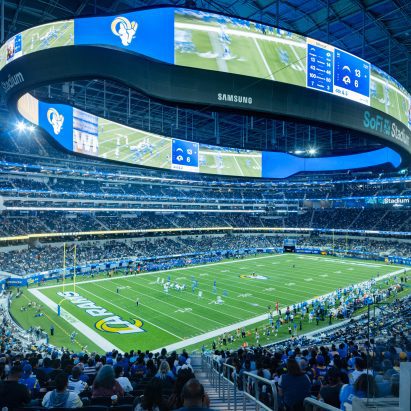
HKS has designed other NFL stadiums, including SoFi Stadium in Los Angeles and is also working with the Cleveland Browns team for its new stadium.
The imagery is courtesy of the Washington Commanders/HKS.
The post HKS releases first design of colonnaded Washington Commanders Stadium appeared first on Dezeen.