







Full-scale paper replica of Renée Gailhoustet apartment installed at London's Architectural Association


An exhibition exploring a brutalist social housing complex in Paris by Algerian-French architect Renée Gailhoustet has opened at the Architectural Association in London.
Titled Renée Gailhoustet: A Thousand and One Ways of Living, the retrospective exhibition explores the work of the late architect, who was awarded the Royal Academy Architecture Prize in 2022 for her lifelong commitment to improving French social housing.
The exhibition was curated by Architectural Association (AA) tutor Nichola Barrington-Leach, who wanted to spotlight the 1970s Le Liégat social housing project – Gailhoustet's former home and best-known project.

Held within the AA's Front Members' Room and Bar, the exhibition centres on a 1:1-scale installation of one of the complex's apartments, crafted from draping paper walls that reinterpret flexible internal partitions.
"The ambition of the exhibition was to really bring one of the flats into the AA," Barrington-Leach told Dezeen at the exhibition opening.
"How can we attempt to show her space rather than just her ideas?"

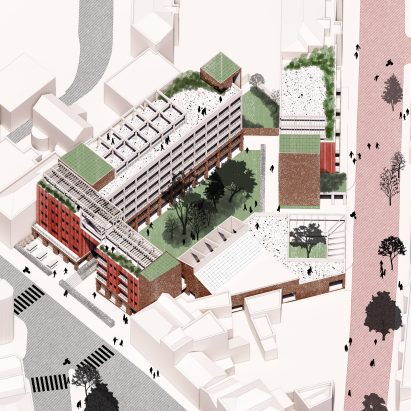
Located in Ivry-sur-Seine, Le Liégat was built in the early 1970s during the post-war period, which is reflected in its austere, 10-storey-tall concrete exterior.
Its angular form is composed of intersecting hexagonal volumes lined with planted external terraces.
Inside, Gailhoustet designed each apartment's layout to optimise light, openness, and adaptability for their respective residents, Barrington-Leach explained. This layout was often organised around a generous central space, off which additional rooms are accessed through adaptable, wooden partitions.

"Gailhoustet doesn't just think of it as you deserve a box, or seven square meters, or, let's standardise everything," Barrington-Leach said.
"She starts to question, well, what can we provide that's more and how can we give them as much as we can?" she continued.
"Every single person has something, and it might be different, but they have something."

Keen to highlight this quality of Gailhoustet's work, Barrington-Leach modelled the installation on a series of apartment floor plans, using hanging paper walls with cut-out openings to reflect the apartments' "extremely light" partitions.
"I wanted to start with this idea of readaptation and very flexible space," she said. "The idea of hanging was a loose way to do that."
"I also call her partitions 'cardboard partitions', so you have a strong infrastructure, but actually the partitions are extremely light."
"People change them, they open up, they change the wallpaper on them," she continued. "And so the paper is not only a symbol of like just paint hanging, but it's also this idea that it could change very quickly."
Alongside the installation, thin, metal tables were used to display maquettes, drawings and detailed studies of Le Liégat, which are complemented by photography by Sacha Trouiller and Valerie Sadoun.
Barrington-Leach, who is founder of London-based architecture studio NVBL, hopes that Gailhoustet's people-centred approach can offer insight into designing with care in what is now largely a profit-led industry.
"I think that often what we do in a developer world that's profit led is think we have to meet certain ways of living, and that's been regimented into a typology that actually never existed before," she said.
"You end up working with the market rather than working with the people," she continued. "And I think that we can learn a lot from [Gailhoustet's] philosophy, and her value and position in how she saw how people live."

The exhibition, which is on display at the AA until 21 March, builds on work undertaken by Barrington-Leach as part of the Royal Academy of Arts 2023 Residency at the Parisian housing complex.
It also precedes the launch of Renée Gailhoustet, a book edited by Barrington-Leach and published by AA Publications, which celebrates the late architect's career.
Elsewhere, the Palais de Lomé showcase in Togo featured objects and installations that demonstrate the scope and diversity of west African design and Kwangho Lee created anime-informed chairs from sponge pipes and nylon ropes for his Ghost in the Shell exhibition in Tokyo.
The photography is by Philip Dale Nogare unless otherwise stated.
The post Full-scale paper replica of Renée Gailhoustet apartment installed at London's Architectural Association appeared first on Dezeen.