








Forma lifts Hudson Valley cedar-clad house on angled legs


US architecture studio Forma has completed a cedar-clad, cube-like house that changes appearance based on angle and lighting on a gently sloping hill in the Hudson Valley.
The 1,474-square-foot (137-square-metre) residence was designed by Forma principals Miroslava Brooks and Daniel Markiewicz, who wanted to build a country weekend house for their own use.

The three-bedroom, three-bath home sits on a compact 700-square-foot (65-square-metre) space within a nine-acre wooded property in Hillsdale, New York.
It was designed to stick out from the landscape as "art" while having minimal environmental impact.

"With minimal impact to the environment, this singular artistic gesture stands off from the serene landscape that envelopes it," the studio said.
"This house is a piece of art. It engages with the picturesque countryside in which it sits through carefully calibrated design moments inside and out."

Set in a small hilltop clearing accessed by a private driveway, the house looks out to the Catskills to the west through vertical windows and the Berkshires to the east through pentagon-shaped windows.
The angle of the cedar siding changes as residents circumvent the house, with vertical planks on the west facade, which sits firmly on the ground, and diagonal boards on the east facade that correspond to the way the house lifts up on angled legs to create a covered patio.

While the majority of the exterior cedar is blackened for a dark contrast to the surrounding landscape, the walls of the patio were left in their natural, warm hue.
This brings out "the innate texture of the cedar planks, appearing as if 'carved' from the volume of the house," the studio said, adding that it wanted the structure to appear scaleless, like a sculpture, on the site.

All three floors of the square floorplan are split in half – one side shared public areas, the other private sleeping areas.
A private suite pairs with the covered deck on the ground level, while a smaller bedroom and ensuite share the second level with a double-height living room and kitchen space. Above, a third suite looks out to the west.
"The vertical layout and minimized foundation drastically cut costs without sacrificing livability or aesthetics," the studio said.
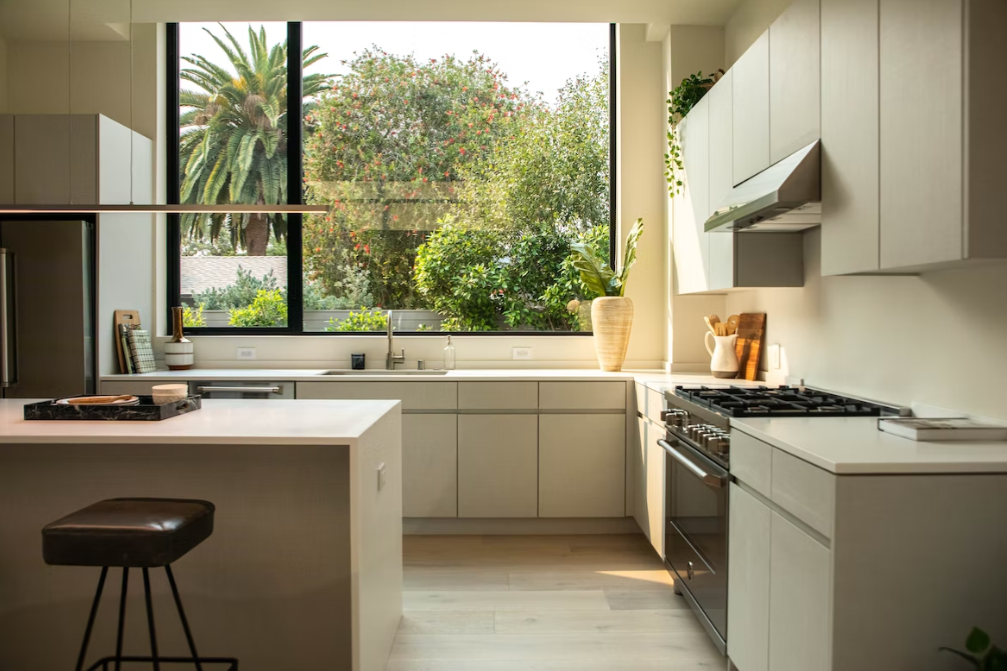
In the main room, a contemporary fireplace, embedded into the countertop millwork, pulls the living and dining spaces together while combining functionality across the east facade. The compact kitchen faces north of optimal daylighting.
Skylights were positioned strategically, such as above the bed in one of the upstairs bedrooms.

"This home is a creative response to real-world constraints – a blend of idealism, pragmatism and design ingenuity shaped by pandemic-era realities," the studio said. "It's a story of first-time homebuilding that reflects broader shifts in how Americans are thinking about space, location and lifestyle in a post-COVID world."
Skyrocketing construction costs and labour shortages prompted by the Covid-19 pandemic led to years of redesign, multiple sets of construction documents and a slog through contractors – as well as both family and firm expansions – extended the project for nearly five years.

Other houses recently completed in the Hudson Valley include a cross-laminated timber house with classing used by early settlers by nArchitects, a white, gabled house on a hilltop by Solk Architecture and a blue, L-shaped house for a collector by Steven Holl.
The photography is by Devon Banks.
The post Forma lifts Hudson Valley cedar-clad house on angled legs appeared first on Dezeen.