




















Eight actually interesting uses of AI from 2025


It might have been the year of AI "slop", but 2025 also saw the emergence of some genuinely innovative, intriguing and even beneficial uses for artificial intelligence. Here, we round up eight of our favourites as part of Dezeen's Review of 2025.
"Slop" was the defining word of 2025 – at least according to Merriam-Webster – and describes the flood of mindless, machine-generated content that has flooded social media courtesy of generative AI systems like OpenAI's Sora 2.
Meanwhile, the companies creating these models are still locked in their arms race to create the most intelligent algorithm, spending unthinkable amounts of money to build up their vast data centres, which are already generating more annual carbon emissions than New York City and guzzling more water than humans (via water bottles that is).
But outside of the generative AI bubble, architects, designers and engineers are dreaming up some actually interesting new applications for the fledgling technology, from visualising dreams and keeping plants alive to finding salvageable materials among the ruins of Ukraine.
Below are eight of our highlights.

Dutch design studio Modem – founded by Astin le Clercq and Space10 veteran Bas Van De Poel – has been quietly serving up some of the most innovative uses for AI since its launch in 2021.
Among them is a "compass" designed to enable phone-free walks and a chair co-created by British designer Ross Lovegrove and a Google AI trained to emulate his style.
This year, our most-read AI story by a country mile was Modem's Dream Recorder, a bedside device that allows users to replay their dreams as short animated videos.
Find out more about the Dream Recorder ›

WaterSense buoy by Filip Budny
The global sustainability winner at this year's James Dyson Awards was a buoy that uses AI to monitor the water quality of our rivers and lakes, arming local communities with real-time data to fight back against pollution.
Landlocked bodies of water are especially vulnerable to agricultural runoff, sewage and industrial waste, but are currently supervised only via sporadic manual testing.
In these blind spots, Polish engineer Filip Budny's WaterSense buoy provides unprecedented oversight by continuously and autonomously assessing water quality using cheap paper sensors, evaluated not by humans but by an AI, which he says can forecast pollution events up to 72 hours in advance.
Find out more about WaterSense ›

California company 1X made headlines this year when it opened pre-orders for its robo housekeeper Neo Gamma, which promises to do your household chores.
Clad head-to-toe in beige knitwear, the robot will reportedly be steered by a multitasking AI model that can process both language and visual information. This means that Neo Gamma can understand and respond to voice commands, while simultaneously controlling all the motor functions needed to carry them out.
The catch is that, at least in the early stages, the robot will rely heavily on remote operation, with a 1X employee seeing through its eyes and acting as the metaphorical guard rails while the AI is trained in real home scenarios.
Find out more about Neo Gamma ›

FOODres.AI by MIT's Biru Cao and Yiqing Wang
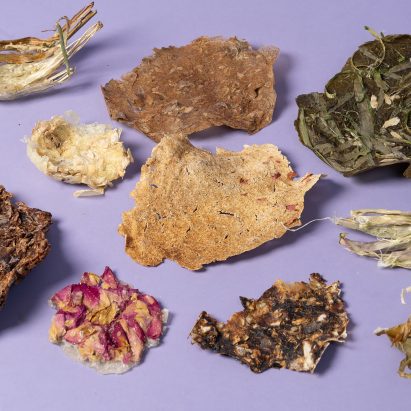
On the more experimental side of things, a duo of MIT students have developed a prototype for an AI-powered 3D printer, which guides users through turning their food waste into printing filament.
Whether born from fruit peels, coffee grounds and leftover rice, the resulting biomaterial can then be used in lieu of traditional plastic filament to 3D-print everyday household objects like cup holders and small containers.
So far, designers Biru Cao and Yiqing Wang have only built a partial prototype. But they're working to develop a fully realised version, which they hope could one day help to tackle the food waste crisis.
Find out more about FOODres.AI ›

One of the buzziest launches to come out of the 2025 Consumer Electronics Show in Las Vegas was this self-watering smart planter.
Designed for nature lovers who weren't blessed with the green thumb to match, LeafyPod features an AI-powered watering system that automatically adapts to the needs of its current inhabitant.
This calculation is based not just on the type of plant it holds but also on real-time data about light exposure, humidity and temperature, gleaned via a suite of sensors hidden inside the minimalist white planter.
Find out more about LeafyPod ›

Circularity on the Edge by Kateryna Lopatiuk and Herman Mitish
The use of artificial intelligence in conflict zones like Ukraine and Gaza has raised grave ethical concerns and carried devasting consequences in recent years.
But Ukrainian architect Kateryna Lopatiuk and developer Herman Mitish have also discovered a way the technology can actually help countries rebuild.
Their project Circularity on the Edge uses computer vision and remote sensing technology to analyse drone footage and identify salvageable materials in the rubble, which can then be used in the reconstruction effort.
Find out more about Circularity on the Edge ›

Even G2 smart glasses by Even Realities
Smart glasses are promising to be the next big product category for artificial intelligence, with a veritable avalanche of AI-powered specs released in 2025.
Meta's collaboration with Ray-Ban was perhaps the most notable – and tech giants including Apple, Samsung and Google reportedly have their own models in the works.
So far, the Even G2s by Chinese company Even Realities have stood out for looking the most like a regular pair of glasses – complete with prescription lenses – while eliminating the controversial outward-facing camera seen in other models, which has raised concerns about privacy and surveillance.
Find out more about the Even G2 ›

Prompting Nowhere treadle-powered AI by Max Park
A vintage foot-powered sewing machine generates the energy needed to run a large language model (LLM) in this critical project from Central Saint Martins graduate Max Park.
The AI itself was trained on the socialist ideals of textile designer William Morris and visualises the hidden labour behind the technology by making its output contingent on manual effort on the part of the user.
Unlike conventional LLMs like ChatGPT or Claude, which rely on far-off data centres, all of the data is processed locally in a bid to help users reclaim a sense of ownership over artificial intelligence.
Find out more about Prompting Nowhere ›
The post Eight actually interesting uses of AI from 2025 appeared first on Dezeen.