






Dezeen's top houses of 2025


To kick off our Review of 2025, Dezeen editor Tom Ravenscroft picks 10 of the most interesting houses from the year, including a brutalist-castle-like home and a glass-brick fronted house.
This year on Dezeen, we have published around 300 of the most unique and interesting new homes from all around the world, in a huge variety of styles and scales and integrating numerous materials.
Here are 10 that show the wide variety of high-quality houses completed this year. Do you agree with our picks?

The Wild House, India, by Earthscape Studio
One of numerous impressive and distinctive houses created in India this year, Wild House in Tamil Nadu has a sculptural shell coated in mud plaster and a winding, cave-like interior.
"The reason behind the structure was to avoid columns and beams, making a self-sustaining structure that flows in a fluidic form – we call this 'fold architecture'," lead architect Petchimuthu Kennedy told Dezeen.
Find out more about The Wild House ›

Hedge and Arbour House, Australia, by Studio Bright
This Dezeen Award-winning house in Australia was wrapped in perforated metal screens and solid blockwork walls by Studio Bright.
The screens, which will become more covered in deciduous climbing plants over time, allow light and air into the home while providing shading in summer and aiding privacy.
"The architectural response is deliberately recessive and quiet, designed to defer to the landscape," Studio Bright principal Mel Bright told Dezeen.
Find out more about Hedge and Arbour House ›

Frame House, Portugal, by Pedro Domingos Arquitectos
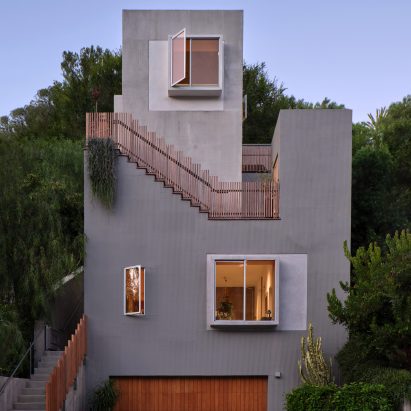
Built on top of a hill near the village of Santa Bárbara de Nexe in Portugal, this four-bedroom home was constructed entirely from board-marked concrete, giving it a fortress-like appearance.
According to Lisbon-based Pedro Domingos Arquitectos, the brutalist home was designed to "seamlessly integrate with nature". It features large openings that frame the surrounding landscape, multiple terraces and a rooftop pool.
"Like an ancient ruin, the design belongs to the landscape in a timeless way, as if it has always been there," studio founder Pedro Domingos told Dezeen.
"Every window frames a breathtaking landscape, offering views of either nature or the sky, like perfectly composed photographs."
Find out more about Frame House ›

Glass Brick House, Belgium, by Delmulle Delmulle Architecten
One of the most unique homes of the year took advantage of a material that has been becoming more fashionable in recent years – glass brick. Simply called Glass Brick House, the home was designed by Delmulle Delmulle Architecten for an enclosed, infill site in Ghent.
The glass facade, which gives the 98-square-metre house its name, was designed to let light into the house.
"The house is situated on a very challenging plot – extremely small and completely enclosed on all sides," studio founder Seger Delmulle told Dezeen. "The main challenge was to make the most of the minimal available space and natural light."
Find out more about Glass Brick House ›

Cairnconon Byre, Scotland, by Loader Monteith
Cairnconon Byre is a simple home in Angus, Scotland, that was designed to celebrate rural Scottish architecture.
Designed by architecture studio Loader Monteith, the home comprises two single-storey volumes finished with stone and black-painted pine, which were topped with red corrugated-metal roofs.
"Across rural Scotland, failed thatched roofs are often replaced with metal, which subsequently rusts down to red," project architect Jamie Mack told Dezeen. "These were the forms and materiality that inspired Cairnconon Byre."
Find out more about Cairnconon Byre ›

Twin House, UK, by Graeme Williamson Architects
Designed with a double-gabled form and all-over red colouring, Twin House was created by London studio Graeme Williamson Architects for studio founder Graeme Williamson.
The home takes its name from its form, which gives the impression it is two aligned homes. Williamson wanted the house to reflect the blended nature of his and partner Melanie's family.
Find out more about Twin House ›

HATA, USA, by Anastasiya Dudik
Another of the year's standout homes with a distinctive profile, HATA is enclosed within a white concrete dome punctured by porthole-like windows.
Designed by Ukrainian designer Anastasiya Dudik in the Californian desert of Pioneertown, the house was conceived as a refuge for "a slower, more connected way of being".
According to Dudik, the home was informed by memories of Soviet-era brutalism, as well as California's history of futuristic architecture.

Houses with One Pillar, Germany, by Buero Wagner
Local studio Buero Wagner designed a pair of neighbouring homes in Söcking, Starnberg, Germany, which are united by their charred-timber facades and geometric cut-outs.
The blackened facades contrast with the exposed-concrete interiors of the homes that were designed for a father and his son.
"The design aims to redefine suburban living by demonstrating how high-quality, socially connected housing can be achieved within existing settlement structures," studio founder Fabian Wagner told Dezeen.
"It combines architectural clarity, efficient use of space, and material honesty to create a cohesive and sustainable living environment."
Find out more about Houses with One Pillar ›
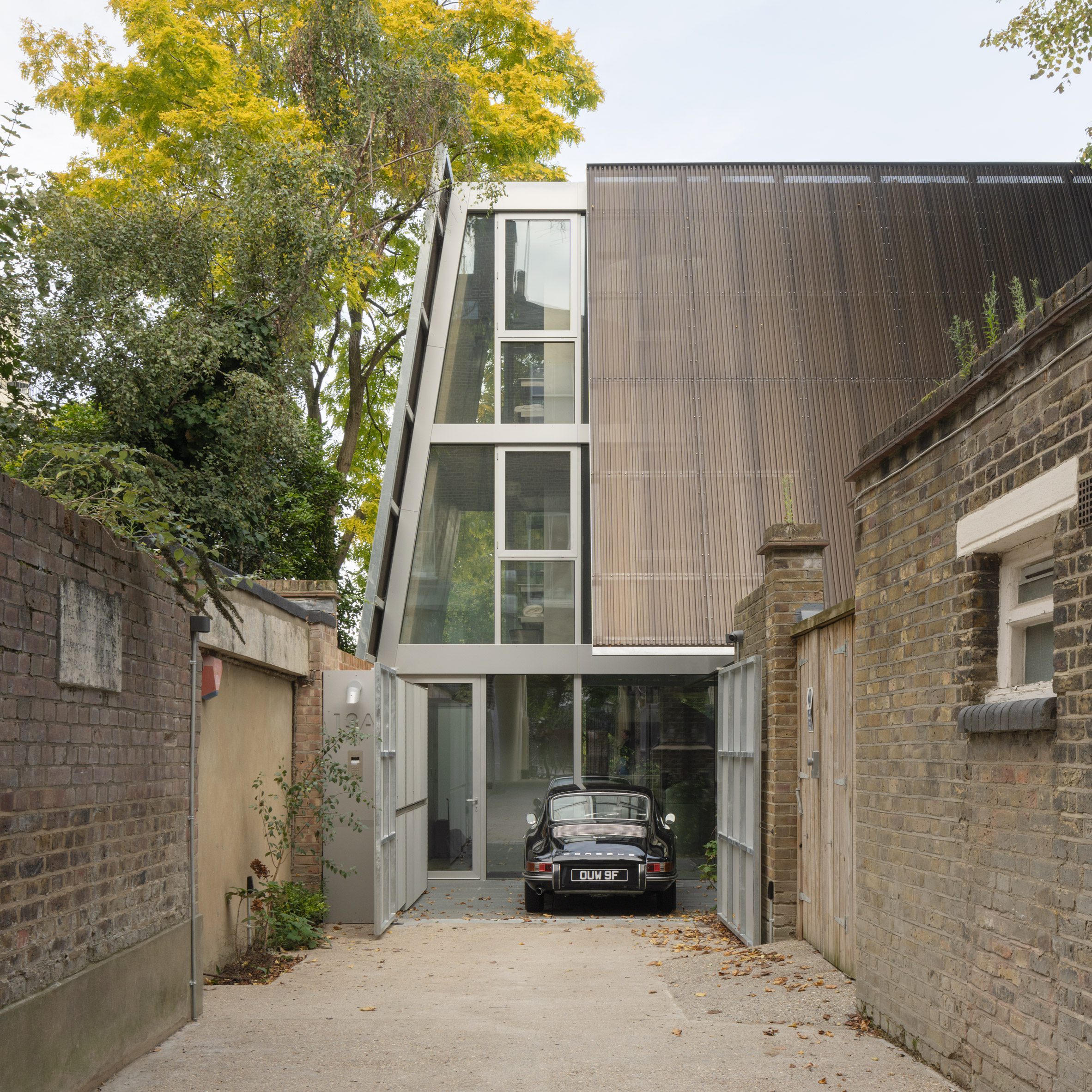
Reciprocal House, UK, by Gianni Botsford Architects
In London, Gianni Botsford Architects added a house to an extension designed by the country's best-known architect – Pritzker Architecture Prize-winner Norman Foster.
Designed to complement the distinctive, high-tech extension designed by Foster and his then-wife Wendy Foster in the 1960s, the new trapezoidal-shaped house replaces a 19th-century coach house.
"My client was in contact with Norman Foster before buying the house, who was very open about what would happen with the house but asked only that he hoped 'you are able to maintain the original intended spirit of the home for you and family – one of lightness and a place to entertain'," director Gianni Botsford told Dezeen.
Find out more about Reciprocal House ›

Omloop Farmhouse, Belgium, by Hé!
Architecture studio Hé! extended a traditional Flemish home in Belgium by adding a glazed timber and metal addition within the roof space on its upper floor.
According to the studio, the renovation was designed to improve the home's connection with nature.
"By dissecting the organisation of the typical Flemish fermette, the project explored how to minimise the heated volume while enhancing the home's connection with nature," studio co-founder Hanne Eckelmans told Dezeen.
Find out more about Omloop Farmhouse ›
The post Dezeen's top houses of 2025 appeared first on Dezeen.