







Cornetta Arquitetura immerses "contemporary cabin" in Brazilian forest


Brazilian studio Cornetta Arquitetura has designed a concrete and wood, prefabricated vacation house to provide "a lesson in conservation" in the Atlantic Forest outside of São Paulo.
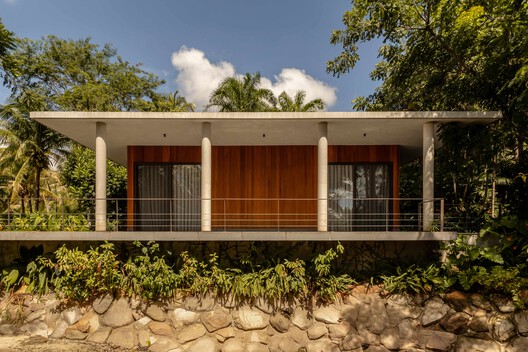
Casa Guapuruvus sits on a forested site near São Roque, due west of the metropolis, and was designed by Cornetta Arquitetura to preserve as much of the native flora as possible.

The building was positioned in a spot where plant life was already degrading and is elevated off the ground to minimise the disturbance of wildlife.
"This project is a lesson in conservation," said Cornetta Arquitetura founder Pedro Cornetta. "It's not about planting trees for the photo – it's about truly preserving what was already there."

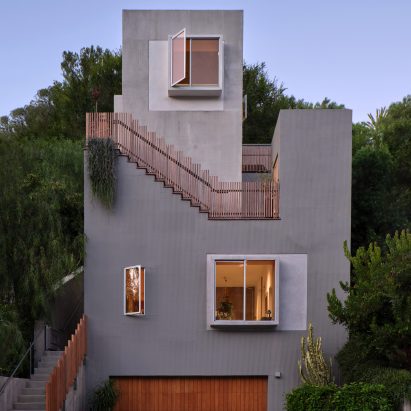
Accessed via a flight of concrete stairs, the rectangular building has a modular structure that allows it to be divided exactly in half down the long central axis.
On one side are the living spaces, which fully open to the outdoors via sliding glass panels – effectively creating a large covered terrace.

In the other half, two large square bedrooms occupy the corners, while two smaller bedrooms with built-in bunks and the bathrooms are tucked in between.
"The result is a 'contemporary cabin' that redefines the relationship between architecture, landscape, sustainability, and new ways of living," said Cornetta Arquitetura.

The prefabricated structure is built from a combination of glued-laminated timber, nailed-laminated timber, black metal columns and light-steel framing walls.
Underneath the west end, a concrete and masonry base houses service and utility areas, and provides retaining walls for the swimming pool.

Pine wood charred using the Japanese shou sugi ban technique clads the diving wall between public and private spaces, disguising doors and storage cabinets along its length.
The underside of the roof is clad in thin timber strips, which extend beyond the glazing to echo the reach of the concrete floor slab.
Furniture and fixtures were kept to a strict palette of warm wood, tanned leather, black and stainless steel.
A thick dining table built from reclaimed peroba rosa wood extends from the stone-topped kitchen island to provide a communal gathering spot.

Landscape architect Nick Sabey reintroduced native plants to the site but only in areas of previous intervention, softening the edges of the architecture without damaging the ecosystem.
At night, the house becomes a glowing volume within the dense vegetation thanks to a lighting scheme that highlights the wooden ceiling.

"By day, the vegetation softens the presence of the house; by night, the construction becomes the protagonist, revealing the many roles of architecture in its dialogue with the environment," said Cornetta Arquitetura.
The Atlantic Forest, or Mata Atlântica, stretches along the Atlantic coast of Brazil and extends into Paraguay and Argentina. This richly biodiverse tropical habitat is also the setting for a house by Studio MK27 that's raised on concrete pilotis and a wooden cabin on stilts by Atelier Marko Brajovic.
The photography is by Pedro Kok.
Project credits:
Architecture team: Pedro Cornetta (lead architect), Renan Antiqueira, Luigi Borges (collaborators)
Structural timber design and execution: Rewood
Hydrosanitary project: Latar Engenharia
Electrical project: Latar Engenharia
Construction: Pedro Neto
The post Cornetta Arquitetura immerses "contemporary cabin" in Brazilian forest appeared first on Dezeen.