







"Authenticity and connection to nature" guide guesthouse renovation by Team BLDG


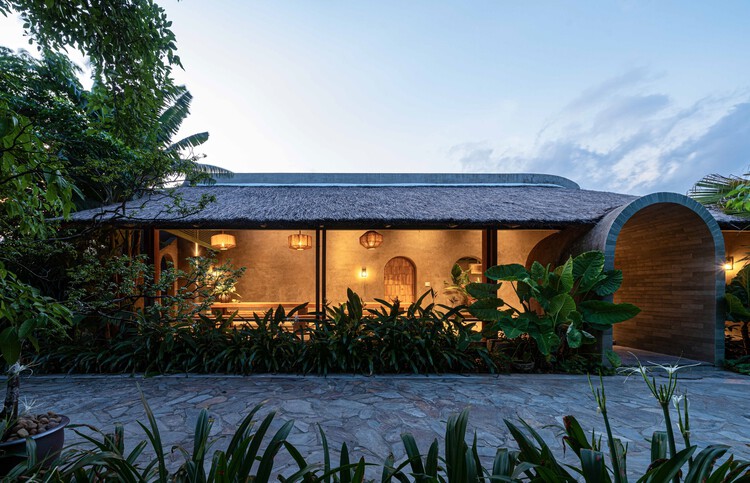
Chinese architecture studio Team BLDG has converted two rural homes outside Shanghai into The Catcher guesthouse, adding three connecting volumes to the existing structures.
The 11-bedroom guesthouse is located near the ancient town of Xinchang in Shanghai's Pudong district, overlooking a series of rice fields to the south and east of the site.

Team BLDG set out to give The Catcher a strong connection to the natural landscape, while ensuring it fit among the surrounding rural architecture.
"We simplified the original facade's shape and colour palette, and incorporated natural materials in parts to echo the pure, natural state of the surroundings," said Team BLDG's lead architect Xiao Lei.

Working within the constraints of a limited budget, the studio said it avoided extensive modifications and retained as much of the existing structures as possible, including the gable-roofed bungalow at the site's entrance.
Interventions included the addition of three connecting volumes that contain the guesthouse's shared spaces, as well as a unifying wall that wraps around the perimeter of the site.
Team BLDG opted for traditional construction techniques and local materials where possible, incorporating wood, stone and bamboo.

"Material choices were heavily constrained by budget, leading to the predominant use of local materials," said Lei.
"The white exterior wall finish uses a textured paint – a water-borne sand finish – commonly employed in rural areas," he stated. "The bamboo fences and gates are also crafted using traditional local methods."
"The stone-clad surfaces wrapping utility shafts also employ a local technique typically used for landscape walls," said Lei.
"Leaving many interior surfaces unfinished is also a common approach in local rural construction."

According to the studio, creating circulation routes that establish a dialogue between indoor and outdoor spaces was a key consideration in the design of The Catcher.
Gaps integrated between the courtyard and the buildings allow for pathways that link the guesthouse's various indoor and outdoor areas.

In the entrance lobby, the studio utilised a preexisting, sunken space from the old structure to create a seating area. Here, large expanses of glass bring in natural light and provide views out into the courtyard.
A new volume behind the main building contains shared social spaces, such as the dining room, tea room and games room.

Almost all of the guest rooms are located on the south side of The Catcher maximise natural light, while the north side houses circulation routes and ancillary spaces.
Each guest room is complete with its own private outdoor space, with either a courtyard, balcony or rooftop terrace, as well as carefully positioned windows to frame views.
In keeping with the wider scheme, a pared-back palette was applied throughout the bedrooms, pairing pale, neutral walls with parquet wooden flooring and fixed furniture pieces, such as beds on wooden platforms.

"The goal for the interior was to distinguish the space from the refinement and complexity of urban hotels, striving instead for authenticity and connection to nature," said Lei.
"We aimed for furniture pieces that are as multi-functional and adaptable as possible," he stated.

Other projects by Team BLDG featured on Dezeen include a textile gallery wrapped with woven lattices in Songzhuang and a series of visitor facilities for a sports park in Pazhou.
The photography is by Hu Siyuan.
Project credits:
Architect: Team BLDG
Team: Xiao Lei, Deng Zhaojing, Deng Caiyi, Shigeno Yuji, Shen Ruijie
The post "Authenticity and connection to nature" guide guesthouse renovation by Team BLDG appeared first on Dezeen.